Showing posts with label Middle Ages. Show all posts

Wednesday, October 30, 2013

Icelandic Witchcraft

On the way to Strandagaldur, the Museum of Icelandic Sorcery and Witchcraft, I had a panic attack. Getting to our B&B at Kirkjubóll was grueling: in and out of deep fjords, sometimes a paved road, sometimes gravel, sometimes two lanes, sometimes one, wind buffeting our tiny rental car, sun glare, traffic passing, pushing, campers and cars, and a sheer, sheer drop off to the sea far below, without even a white line to mark the edge of the road. It was tiring and took concentration to keep an eye on the road and not be distracted by the striking landscape or be pulled off into the void by that sheer, unmarked edge.

Did I mention I'm afraid of heights?

At a headland I pulled over between two campers (whose drivers were peeing over the edge) and my traveling companion, Jenny, pulled out her handy bottle of Rescue Remedy, a mix of herbs and vodka. Two drops on my tongue did the trick. My hands came uncramped from the wheel. I began to breath again.

Jenny is an herbalist. In Iceland when I introduced her, my friends would nod and whisper among themselves. Suddenly their faces lit up in a smile. "Oh, she's a witch!" And she did cure a little girl of the night terrors by giving her a potion and a posey to put under her pillow. Truly. 

Jenny's also a photographer, trained to see things differently. A perfect person to take to the Westfjords to see the witchcraft museum, someone's brilliant idea to lure tourists to an incredibly bleak part of Iceland with hair-raising roads.

When we reached our night's lodging, Jenny made herb tea from some leaves she picked behind the house. We took a stroll on an arc of black beach into the teeth of the wind, the late evening sun behind a mountain--this was June--bundled up in sweaters and scarves and ear-warmers (we could have used long underwear), singing, and picking up mussel shells, orange scallops, broken conchs, driftwood, feathers, sea urchins, while the arctic terns and oystercatchers and razorbills strafed us, shrieking. Suddenly, I was ecstatic: waves and mountains with snow on them, bird cries, cold. It was magic.

The next morning we drove to the town of Hólmavík in misty low cloud, over a gravel road between banks of old snow--it really was June--and a few brave tussocks of flowering lamb's-grass and bilberry. We passed more black-sand bays littered with driftwood logs. Someone had pulled them from the tide and sorted them by size. Also ropes, nets, pallets, and flat building panels. We passed a road sign that said "I." Jenny decided it meant, not "Information," but "Isolation."

Hólmavík is a very small town, even for Iceland. There's a gas station, a bank, a health clinic, and Strandagaldur, the Museum of Icelandic Sorcery and Witchcraft, which itself is very small but beautifully designed by Árni Páll Johannsson, who also designs movie sets. The exhibits are evocative, the descriptions informative, with a good mix of "wow" displays and deep scholarly stuff (reproductions of manuscript pages, maps, timelines, genealogies).

The English audio-guide took about an hour and focused mostly on who the witches were and why they were singled out. Their stories were well-told: You could draw your own conclusions about their magic powers and were sympathetic to these 20 men and 1 woman who were burned at the stake in the late 1600s for being different. Many were the victims of one rich woman, the sheriff's wife, who accused someone of witchcraft every time she got sick. In another case, the priest was awarded "compensation" for any acts of witchcraft in his parish--meaning he got to confiscate all the witch's property. Quite an incentive to accuse a neighbor of working black magic. I bought the book Angurgapi: The Witch-hunts in Iceland by Magnús Rafnsson to learn more.

Then there's the magic itself, with lots of spells written in runes. I bought a booklet of Love Spells. Here's one:


It says you are supposed to carve this design on a piece of bread and cheese and give it to your beloved to eat. A sure way to his or her heart.

Other spells will make your sheep docile or give them twin lambs, protect them from being drowned in floods or keep foxes away, make fish jump onto your hooks, keep a scythe sharp, and strengthen your rowing or wrestling or grass-mowing skill.

Still other spells will prevent theft, kill an enemy's horse, or just break its leg. To keep visitors away, according to another booklet published by the museum, carve this rune stave 


on a piece of rowan wood when the sun is at its zenith. Walk three times around the house the way the sun turns and three times widdershins (the opposite way) holding the carved rowan stick in one hand and "sharp thorn grass" in the other. Then lay both of them on the gable above your house door.

The rune stave at the head of this blog post, the Helm of Awe or Ægishjálmur, used as the museum's logo, induces fear and protects you against abuses of power--if you carve it in lead and press it on your forehead.

The grisliest (and most popular) magic item on view at the museum was the pair of corpse-skin trousers or "necropants" that promise to make you rich. You can see a video about them here on their website [click here].

Here's how to make them, according to the website--be sure to get permission first!

If  you want to make your own necropants (literally, nábrók), you have to get permission from a living man to use his skin after his death. After he has been buried, you must dig up his body and flay the skin of the corpse in one piece from the waist down. As soon as you step into the pants, they will stick to your own skin. A coin must be stolen from a poor widow and placed in the scrotum along with this magical sign


written on a piece of paper. Consequently the coin will draw money into the scrotum so it will never be empty, as long as the original coin is not removed. 

If you want to go to heaven after you die, however, you have to be sure to pass your necropants on to someone else while you're alive (and still rather flexible): That person has to step into each leg of the skin as soon as you step out of it. The necropants can thus keep a family in riches for generations.

Note that, despite what you might have read elsewhere on the internet (such as at the International Business Times, here), the necropants in the museum are plastic fakes, not "dead human skin on display," as that headline claims. The article itself is clear: "just a replica, according to The Huffington Post." (The headline at HuffPo also screams: "Necropants, Made from Dead Man's Skin…" Told you this was the most popular exhibit.)

The Sorceror's Cottage was a good second act. "Let there be mist and mischief," said a witch from these parts in the most famous of the medieval Icelandic sagas, Njal's Saga. We drove about an hour farther to see the cottage, through mist, on rocky, bumpy, scary roads, and encountered more than enough mischief in the form of a strange knocking sound from beneath our car that sounded like we were dragging a body--but when we stopped to look nothing was there. Might have been a stone in the wheel-well. We hoped so, at least.

The Sorceror's Cottage is a very rough turf-house of the poorest sort, a low-ceilinged, dirty hovel with a pen for the sheep next to two beds for the people. Again, it was very realistically recreated, stocked with 17th-century tools and rough, hooded robes. The curator wisely told us to go through the house twice: look, read the text, then look again. 

When there are more than two tourists, the curator puts on her witch's robe and acts the part. With us she simply shared the story of the three trolls who tried to separate the Westfjords from the rest of Iceland so they could escape the awful ringing of the church bells. She gave us directions to the rock stacks the trolls turned into when the sun rose and caught them at their work. 

We went to find them and had a picnic beside one troll, a tall, black slab of columnar basalt laid up sideways like a stack of firewood, the size of a house but only about 6 feet thick. It stood on a grassy lawn between the swimming pool and some guest cottages at the hamlet of Drangsnes. On the way there we had passed the other two trolls, standing at the tip of a rocky headland with their feet in the sea. 


Join me again next Wednesday at nancymariebrown.com for another adventure in Iceland or the medieval world.

Wednesday, September 25, 2013

The Death of Snorri Sturluson


In 2010, on the night of Snorri Sturluson’s murder, September 23, I sat on the stones surrounding his hot tub at Reykholt in western Iceland and dabbled my feet in the warm pool. The weather had turned: A cold mist replaced the sunshine of Thingvellir, where I’d walked, picking blueberries, that afternoon, memorizing the verse on the bronze plaque beside Snorri’s Althing booth, the place he called Valhalla. In English the lines run:

Snorri’s old site is a sheep-pen; the Law Rock is hidden in heather,
blue with the berries that make boys—and the ravens—a feast.

I knew the next two lines of this poem by Jónas Hallgrimsson (in the translation by Dick Ringler):

Oh you children of Iceland, old and young men together!
See how your forefathers’ fame faltered—and died from the earth!

And knew its fears were unsubstantiated: Researching Snorri Sturluson’s life for my book Song of the Vikings, I had concluded that Snorri, who lived from 1178 to 1241, was the single most influential writer of the Middle Ages.

For that we must thank the king of Norway, Hakon IV. Only fourteen when Snorri met him in 1218, King Hakon preferred the fashionably new French legends of King Arthur and the Knights of the Round Table to traditional Viking skaldic poetry and tales of the gods Odin, Loki, and Thor. Snorri must have been shocked. It also hit him in the pocketbook. Poetry was Iceland’s cultural capital, to use a term popularized by sociologists. It was all Snorri had to sell on the international market. Iceland’s other exports were wool and dried fish. The bright-colored alum-dyed cloth from England and Flanders was more highly prized, and Norway had ample fish.

Perhaps, Snorri thought, King Hakon was just ill-educated. He simply needed a good introduction to the lore of the North. Snorri began writing his books to teach the young king to appreciate his own heritage.

His motives were not pure. Snorri was not only a poet and lover of books. He was one of the richest men in Iceland, holder of seven chieftaincies, owner of five profitable estates and a harbor, husband of an heiress, lover of several mistresses, a fat man soon to go gouty, a hard drinker, a seeker of ease prone to soaking long hours in his hot-tub while sipping stout ale, not a Viking warrior by any stretch of the imagination, but clever. Crafty, cunning, and ambitious. A good businessman. So well-versed in the law that few other Icelanders could out-argue him. At age forty-two, he was at the height of his power.

His secret ambition was to rule Iceland—and he almost succeeded. On the quay at Bergen in 1220, departing for home, he tossed off a praise poem about the king’s regent, Earl Skuli, said to be the handsomest man in Norway for his long red-blond locks. In response, the earl gave him the ship he was to sail in and many other fine gifts. Young King Hakon honored Snorri with the title of landed man, or baron, one of only fifteen so-named. The king charged Snorri, too, with a mission: He was to bring Iceland—then an independent republic of some 50,000 souls—under Norwegian rule.

Or so says one version of the story. The other says nothing about a threat to Iceland’s independence. Snorri was not asked to sell out his country, simply to sort out a misunderstanding between some Icelandic farmers and a party of Norwegian traders. A small thing. A few killings to even out. A matter of law.

This trip to Norway was the turning point of Snorri’s life. One quick, persuasive speech to the king, along with one colorful poem pronounced on the quay at Bergen, would mar his reputation—and seal his doom. When he sailed to Norway in 1218 he was, by most calculations, the uncrowned king of Iceland. When he returned in 1220, he was a suspected traitor.

The voyage did not go well. It was late in the year to sail, and the weather in the North Atlantic was fierce. His new ship lost its mast within sight of Iceland; it wrecked on the Westman Islands off the southern coast. Snorri had himself and his bodyguard of a dozen men ferried over to the mainland with their Norwegian treasures. They borrowed horses and rode, bedecked in bright-colored cloth like courtiers, wearing gold and jewels and carrying shiny new weapons and sturdy shields, to the nearby estate of the bishop of Skalholt. There Baron Snorri’s new title was ridiculed. Some Icelanders even accused him of treason, of having sold out to the Norwegian king.

From then until his death in 1241, he would fight one battle after another (in the courts, or by proxy) to see who, if anyone, would be Earl of Iceland, deputy to Norway’s king. He would die in his nightshirt, cringing in his cellar, begging for his life before his enemies’ thugs. He did not live up to his Viking ideals, to the heroes portrayed in his books. He did not die with a laugh—or a poem—on his lips. His last words were “Don’t strike!” As the poet Jorge Luis Borges sums him up in a beautiful poem, the writer who “bequeathed a mythology / Of ice and fire” and “violent glory” to us was a coward: “On / Your head, your sickly face, falls the sword, / As it fell so often in your book.”

Yet his work remains. In the twenty turbulent years between his Norwegian triumph and his ignominious death, while scheming and plotting, blustering and fleeing, Snorri Sturluson did write his books: the Edda, Heimskringla, and Egil’s Saga. He covered hundreds of parchment pages with world-shaping words, encouraging his friends and kinsmen to cover hundreds of pages more.

I had come to Reykholt to keep vigil on the night of his death. The clouds crept up on me as I drove north from Thingvellir, slowly, on the torturous, washboard roads of Uxahryggir and Kaldidalur, alone for hours, no other cars, not even a bird, only the gleaming presence of Skjaldbreidur over my shoulder, the inverted smile of Ok, a chunk of rainbow here and there, a hidden stream, patches of dirty snow, a cairn. Now, at Reykholt, I sought darkness—some place I could see if the northern lights were shining in celebration of Snorri’s life and art.

Snorri’s Reykholt is much the same as it was in 1241, though nothing medieval but his hot-tub remains: Beside an imposing church is a school, hotel, and library. Up a spiral stair is a writer’s studio. But the modern designers were in love with light. Streetlamps and spotlights washed the night sky everywhere but here, at Snorri’s pool, tucked beneath the hill beside the school. I leaned back and looked up—no northern lights; the stars were faint, veiled in cloud. I imagined Snorri’s last moments.

His enemy (and former son-in-law) Gissur of Haukadal had spies watching Reykholt. Late at night on September 23, 1241, he rode up with seventy men. They broke into the building where Snorri slept. He leaped out of bed in his nightshirt and ran next door into the fine Norwegian-style loft-house he had built at the height of his power twenty years before. He was heading, perhaps, for his writing studio and the secret spiral stair that led from it down into a tunnel to his hot-tub and escape…

It is cold in Iceland in late September. The birch leaves are bright gold, the berry shrubs crimson, the songbirds have all flown. Swans flock in the marshlands, sounding their haunting note. Night falls quickly and lingers long, the wind has the bite of ice. An old fat man in his nightshirt, barefoot, would not get far in the cold and dark of a late-September night.

Snorri hid in a cellar. A priest gave him away. Gissur sent five men down.

I dried off my feet and headed back toward the Snorrastofa writer’s studio, which I had booked for five days. On the way I heard people oohing and aahing. They were halfway down the drive, looking up at the northern lights, they said. I saw nothing. “They’re breaking up now,” said a man standing in the road.

Turns out that I, like Snorri that fateful night 772 years ago, had been looking the wrong way.

Join me again next Wednesday at nancymariebrown.blogspot.com for another writing adventure in Iceland or the medieval world.


Wednesday, September 11, 2013

Surtshellir: The Outlaw's Cave


To explore the Outlaw's Cave, my friend told me, you need "a headlamp and serious shoes." I had a headlamp, though it malfunctioned and would only point straight down. On my feet I had rubber Wellington books--not up to clambering over hummocks of toaster-sized lava-rubble without twisting an ankle. I didn't make it far into the cave.

I never saw the statues a local artist had placed there--eerie faces carved of rock, I'd heard.

I missed the ice formations that apparently linger year round.

I gave up well before I reached the outlaws' hideout, thoroughly freaked out by being alone in the unimaginable dark, some 30 feet under a lava field on the fringe of Iceland's uninhabitable interior. If I cried for help, no one would hear.

Usually cavers don't come to Surtshellir alone. And most are more courageous than I. In fact, so many tourists have reached the outlaws' hideout, some 600 feet along this lava tube, that Icelandic archaeologists have launched a rescue excavation to learn what they can about the outlaws' house before the evidence disappears. As archaeologist Guðmundur Ólafsson  and his colleagues noted in 2004, tourists "were removing bones from it as souvenirs."

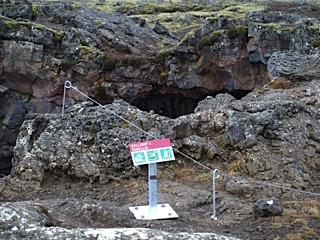
Surtshellir means "the cave of Surtr," the Norse fire-giant who will destroy the world. The lava in which the cave is found flowed shortly after Iceland was settled in the 870s. A mile-long tube, or tunnel, the cave was formed by thicker lava congealing around a faster flowing central stream that eventually ran out. At its broadest, the tube is about 45 feet wide and 30 feet high, though it shrinks down to about 6 feet high. In some places it branches out into side tunnels. In other places, the roof has fallen in, leaving large holes to the sky.

Beneath one of these sky holes, about 300 feet from the cave's mouth, the outlaws built a wall about 8 feet high and 43 feet long. Another 300 feet along a side passage stands "a unique drystone structure with an associated midden," or garbage dump, according to the archaeologists.

One of the first books written in Iceland, the Landnámabók or Book of Settlements (from about 1130) notes that outlaws lived in in the lava field near Surtshellir in the late 900s. Two of the Icelandic sagas (written in the 1200s and 1300s) describe the outlaws' downfall, when a posse of chieftains decided to wipe them out.

In the 1700s century, two Icelanders explored the cave and found what they thought was the outlaws' hut. Two centuries later, the Icelandic novelist Halldor Laxness visited the cave and had his souvenir cow-bone dated by radiocarbon (carbon-14) testing in 1971. The dates he got spanned Iceland's Golden Age, from its founding in 870 to when it became a colony of Norway in 1264.

Since 1971, radiocarbon dating has improved. In 2004, Guðmundur Ólafsson and his colleagues dated some cow-bones from the midden to between 690 and 960.

The science of tephrochronology is also new since Halldor Laxness's effort; it uses the Greenland ice cores and other sources of information to date the layers of volcanic ash, or tephra, found like stripes in Iceland's soil. The lava field around Surtshellir rests on top of a tephra layer from an eruption dated to 871 (plus or minus 2 years).

That means the earliest date for outlaws to have lived in the cave (and left cow-bones in their garbage) is about 880. A range of 880 to 960, Guðmundur Ólafsson notes, is roughly consistent with the stories in the Icelandic sagas.

Which is why Guðmundur is a little puzzled by what he and his colleagues found in the cave in 2013, according to a recent report from Iceland Review.

With Kevin Smith from Brown University and Agnes Stefánsdóttir of Iceland's Cultural Heritage Agency, Guðmundur had made a 3D scan of the Outlaw's Cave in 2012. This year, the team returned--with huge lights--to excavate the cave floor. "Because there's an increased flow of tourists to the cave, we considered it necessary to save these remains before they're completely destroyed," Guðmundur told Iceland Review. 

They didn't find much besides animal bones. The outlaws weren't wealthy and they didn't live there long. But along with a few beads and scales made of lead, the archaeologists found "a small metal cross, probably made of lead but maybe of silver," Guðmundur said.

A cross? Although Iceland officially converted to Christianity in the year 1000, some of its first settlers were Christian. But the outlaws of Surtshellir? "The general view," said Guðmundur, "is that outlaws resided there around the year 1000, or in the 11th century, maybe. But they must have been Christian and that is a little strange."

The piles of bones they left, however, prove that they were a serious nuisance to the surrounding farms. There was no sign, in the form of fishbones or birdbones, that the outlaws even tried to support themselves by foraging. All the bones came from adult cows, horses, pigs, and sheep that could be rustled--or extorted--from the nearby farms.

But neither were the outlaws living rich. They worked over those bones, getting every bit of meat off them, breaking them for the marrow. It must have been a hard life, deep underground, cold and damp, with a long, treacherous way to lug your firewood or face the unimaginable dark.

They had no headlamps. No serious shoes. And did I mention the constant annoying drip-drip-drip of water from the roof? Christian or pagan, there must have been a lot of praying going on in the Outlaws' Cave.

Join me again next week at nancymariebrown.blogspot.com for another adventure in Iceland or the medieval world.

Wednesday, August 14, 2013

Purple Parchment and the Cave of Smoo

In the year 997, the excommunicated archbishop of Reims sent the Holy Roman Emperor a kingly gift: a copy of Boethius's On Arithmetic written in gold and silver inks on purple parchment. It had the desired effect. As I wrote in The Abacus and the Cross: The Story of the Pope Who Brought the Light of Science to the Dark Ages, my biography of that archbishop, the 17-year-old emperor summoned Gerbert of Aurillac to court with the plea, "Pray explain to us the book on arithmetic." Archbishop Gerbert became the emperor's tutor, friend, counselor--and ultimately, through the emperor's influence, Pope Sylvester II, the pope of the Year 1000.

Earlier in this blog, I described how parchment and ink were made in the Middle Ages. (See "How to Make a Medieval Book, Part I" and "How to Make a Medieval Book, Part II.")

But purple parchment? How did they color the parchment purple? I hadn't given that much thought.

Then the other day, researching something quite unrelated--the Viking settlements in northern Scotland--I stumbled upon the answer.

In 1992, a team of archaeologists led by Tony Pollard excavated four neighboring caves in a narrow inlet in Sutherland, one being the famous Smoo Cave. (See the great website, from which these photos of the cave were taken, at www.smoocave.org) In 2005, Pollard posted their report online at www.sair.org.uk/sair18.

"Smoo" comes from the Old Norse word smuga, which Cleasby-Vigfusson, the classic Old Icelandic dictionary, defines as "a narrow cleft to creep through, a hole." The related verb is smjúga, "to creep through a hole" of which the past tense is smaug. Bells are now going off in the heads of all Tolkien readers--but I won't be following that digression any farther.


Back to Smoo Cave. Surprisingly, I had visited the cave in 1995. Two balding Scotsmen with rat tails and earrings took me on a river raft under a low stone arch, across a pool into which a sun-sparkled waterfall fell. In the dark cave, it was a real surprise. We disembarked in the dry inner reaches of the cave and had a geology lesson. The outer, larger cavern was made by the sea: the hole, wider at the bottom than the top, is a blowhole. The inner caverns were made by an underground river that feeds from a large lake. The waterfall only runs when there’s been rain—today’s fall is last night’s rain.

As Pollard points out, Smoo Cave has been a tourist attraction since at least the early 1700s. One practical-minded traveler described it as "stretching pretty far underground with a natural vault above." Inside, "there is room enough for 500 men to exercise their arms." (I'm imagining jumping jacks here--but maybe he means to practice their shooting?) There's "a harbor for big boats" at the cave's mouth, a pool full of trout, and "a spring of excellent water."

Earlier visitors also valued the cave for its usefulness--not its surprising bright waterfall. Pollard and his crew of archeologists found signs that Vikings had used Smoo Cave as a fishing camp, as well as a place to sit out a storm and repair a boat. They may have stopped here on their way from the Orkney Islands to Dublin. They butchered animals and cooked them. They ate dried fish they'd brought with them. They ground grain. They carved pins and knife handles and other useful objects out of antler and bone.

But the most interesting thing the Vikings did at Smoo and its neighboring caves was collect and crack open whelks. These were not just any whelks, but Nucella lapillus, also known as Purpura lapillus, the source since antiquity of a purple dye. These whelks are not edible, and they were not used as fish bait, Pollard says. "It is clear that purple dye was being extracted from the shells recovered from the cave."

The whelks, Pollard writes, "had been split from the second and third whorl and also split from the shoulder to the base.... This would have facilitated the removal of the animal from its shell to extract the ink."

In 1895, archaeologists found "Purpura-mounds" in Connemara, Ireland. The shells in the mounds had been broken exactly like those in Smoo Cave, though in Ireland there were many more of them. One heap measured 165 by 45 feet. In one square foot, the researchers counted two hundred whelks. Purpura-mounds have also been found in Cornwall, England, but Smoo Cave is the first record from Scotland, although the whelk is common there.

To learn how to make the dye known as Tyrean purple, Pollard refers the reader to the 1919 book, Shells as Evidence of the Migrations of Early Culture by J.W. Jackson. Like Pollard's own report, Jackson's book is available online. (Historical research is so easy these days!)

Jackson, in turn, cites the first-century Roman writer Pliny to explain that "the precious liquid was obtained from a transparent branching vessel behind the neck of the animal and that at first the material was of the colour and consistency of thick cream."

Several kinds of whelks produced purple dye. Small ones were smashed together in a mortar; if large, "the animal was taken out entire, usually by breaking a hole in the side of the shell, and the sac containing the colouring matter was taken out, either while the animal was still alive, or as soon as possible after death, as otherwise the quality of the dye was impaired." The sacs were salted, allowed to sit for three days, then boiled and frequently skimmed. Exposed to the sun, the fluid (smelling like garlic) slowly changed color, from creamy to yellow, green, blue, and finally a purplish red. After ten days, the dye was ready to use.

To dye wool, a clean fleece was dunked into the boiling dye pot and left to soak for five hours. It was taken out, cooled, and the wool plucked off and carded, only to be "thrown in again, until it had fully imbibed the colour" (still smelling like garlic--one reason the wearers of royal purple robes wore so much perfume, suggests Jackson). It took between one and two pounds of liquid dye to color a half-pound of yarn.

To turn parchment purple, Jackson says, the dye was used as a paint, applied with a brush. The "magnificent and expensive style of writing" on purple parchment with gold and silver inks was mostly confined to sacred texts. Jackson cites an English Bible and a Gospel book, another book of the Gospels commissioned by Louis the Pious, king of France from 814 to 840, and a Book of Prayers, "bound in ivory and studded with gems" owned by his son, King Charles the Bald.

It's significant that Gerbert of Aurillac, who would become "The Scientist Pope," owned a mathematical treatise made in this "magnificent" style. The book still exists in the Staatsbibliothek Bamberg in Germany, where it is catalogued as MS Bamberg Class. 5 (HJ.IV.12), but we don't know how it came into Gerbert's possession. Like the gem-studded prayer book, On Arithmetic was commissioned by King Charles the Bald in about 832. But the dedicatory verses apply equally to the young emperor Otto III as to King Charles, and scholars long thought Gerbert (known as a poet) had written them. Otto III may have thought so too, for he answered the gift with a verse.

Join me again next Wednesday at nancymariebrown.blogspot.com for another adventure in Iceland or the medieval world.

Thursday, June 27, 2013

Names for the Sea


British writer Sarah Moss and I are kindred spirits. Shortly after I visited Greenland to see Viking Age archaeological sites in 2006, I read her novel Cold Earth, in which strange things happen during an archaeological investigation in Greenland. The novel remains one of my favorites, recommended to many friends, so it's no surprise I bought her memoir about a year in Iceland, Names for the Sea, as soon as it was available in the U.S. I have always wanted to spend a year in Iceland.

Instead, I visit frequently and I read a lot about Iceland--though most of what I read disappoints me. American journalists always seem to have landed on some other island that bears no relationship to the Iceland I've known and loved since 1986. For one thing, I've spent very little time in the city of Reykjavik, particularly the city these journalists seem to find, with its "diverse milieu of funky cafes, cutting-edge restaurants and Icelandic-chic bars, all catering to a cozy chat society that hummed late into the infinite night" (NY Times, January 18, 2013), and where "half the country appears to take it as a professional obligation to drink themselves into oblivion and wander the streets until what should be sunrise" (Vanity Fair, April 2009).

Never seen it. Granted, I'm never out wandering the city streets in the wee hours looking for it. Reykjavik to me is a city of libraries, museums, and bookstores--especially bookstores, some of which I'll grant are funky (like the one inside the weekly flea-market at Kolaportid), and which I wish were open until what should be sunrise.

Sarah Moss, in Names of the Sea, doesn't dwell on the drunken nightlife. She's in Iceland to teach English literature at the university, with a husband and two young children in tow. But her Iceland is still not my Iceland. In a year she seems to have rarely left the city. And she never discovered the joys of the bookstores. She does not read Icelandic, she confesses. I'll forgive her that. Icelandic is a very difficult language to learn.

But Moss also doesn't seem to have read much Icelandic literature in translation. Particularly, in a whole year of living in the country, Moss doesn't seem to have read a single Icelandic saga.

That is harder for me to understand. Iceland without its sagas is just not Iceland. Iceland's medieval manuscripts, in which the sagas are preserved, "are at one and the same time the repository of medieval Icelandic culture and its visible symbol," according to the 2004 book The Manuscripts of Iceland. They are Iceland’s "main source of pride."

Only someone who had never read an Icelandic saga could write, as Moss does: 

"The sagas are long narrative poems about the settlement years, which were first written down in the 12th and 13th centuries, several hundred years after the events they describe. In the 20th century, Icelandic historians questioned the status of the sagas as historical truth, and the poems are now widely seen as literary artefacts, but there is still something of the sacred text about them. Many Icelanders can quote the sagas in the way that 17th-century Puritans quoted the Bible. Every so often, a discussion in a faculty meeting will end with someone saying something in Icelandic alliterative verse. … everyone else will be nodding and agreeing, the issue somehow resolved, and I'll know the sagas have spoken again. They combine the functions of the Bible and the Domesday Book…"

Poems? Narrative poems?? At first I thought it was a typo, and Moss meant to say "the sagas are long narratives." But no, she repeats the word poems and even believes her fellow academics were quoting the sagas when they said something in alliterative verse. They were not.

Moss has missed the whole point of the sagas' literary-historical importance. The Icelandic sagas are not poems. If someone was quoting alliterative verse, they were probably quoting the Poetic Edda, or maybe just a proverb.

The Icelandic sagas are "the envy of most world literatures," according to scholar William Ian Miller, because they are not poems: The sagas are written in prose. About 40 tales, some as quick as a short story, others stretching to several volumes in today’s paperback translations, make up the corpus. They tell of Iceland’s Golden Age, the Saga Age, 400 years of a free republic before the island succumbed to Norwegian rule in 1262. And they tell it beautifully: "This is not only the stuff of art," said Miller, "it is the stuff of a confident art that needs no instruction in sophistication."

In the 13th century, when verse was the norm in Europe, Icelanders were writing a vernacular prose that "achieved a height of excellence which can only be paralleled in modern times," declared E. V. Gordon, author of the standard Old Icelandic grammar book. 

Peter Hallberg, who wrote a college text on the sagas, compared their style to Hemingway’s, with its simple, lucid sentence structure and finely calculated artistic effects. And there is none of that “metaphysical brooding,” in Hallberg’s words, that make medieval works like Dante’s Divine Comedy, for example, so tedious.

The sagas are Iceland’s claim to literary fame. Literary scholars have called them "muscled, powerful narratives" that are surprising in their "seductiveness." They have inspired countless authors, from Kipling and Longfellow to Milan Kundera and Günter Grass. 

J. R. R. Tolkien found much of his Middle Earth in Icelandic literature; he and C. S. Lewis started a saga-reading club at Oxford University and translated the texts from Old Norse, the Viking language. 

Another saga translator was the Victorian writer and designer William Morris. Asked once if he was going on a trip to Iceland, Morris replied, "No, I am going on a pilgrimage to Iceland." 

Quoting Morris, the Argentine poet Jorge Luis Borges said, "This is also my answer. Any specialist in Anglo-Saxon literature is sooner or later drawn to Icelandic literature. It is like admiring a sunset or falling in love." 

The American novelist Jane Smiley ranks the sagas beside the works of "Homer, Shakespeare, Socrates, and those few others who live at the very heart of human literary endeavor."

I enjoyed Names for the Sea. It was fun to see Iceland through the eyes of a sensitive observer to whom everything was new--the light on the mountainsides, the cruel shapes in the lava, the misty rain, the ever-present sea. I envied her her ability to knit. But Moss's Iceland--without sagas!--is not my Iceland. 

Join me again next Wednesday at nancymariebrown.blogspot.com for another adventure in Iceland and the medieval world.

Wednesday, May 8, 2013

Remembering the Scientist Pope


“See those towers?” Costantino Sigismondi points to the two square Romanesque towers crowning Saint John Lateran. “We can imagine Gerbert up there looking at the stars.”

In 2008, while researching my biography of Gerbert of Aurillac, the French mathematician who became Pope Sylvester II, I visited Rome. I met my guide to the city, Costantino Sigismondi, through his website, where he had posted all of Gerbert’s known works. This year, on May 10, Sigismondi has organized a full day of lectures devoted to Pope Sylvester II at Rome’s Sapienza University. On May 12, a mass will celebrate the 1010th anniversary of Gerbert’s death. I wish I could join Sigismondi for the festivities. He's one of those rare people who brings light to the Dark Ages.

Sigismondi, an astrophysicist, teaches the history of astronomy at the University of Rome. In 2000, a friend reading Sky & Telescope chanced upon an article about “Y1K’s Science Guy,” Gerbert of Aurillac. She sent it to Sigismondi, who was astonished. Why hadn’t he known about The Scientist Pope? Sigismondi immediately contacted the Vatican and, with the pope’s support, began planning a series of lectures and events to commemorate the millennium of Gerbert’s pontificate (999-1003), including a grand requiem mass in the cathedral of Saint John Lateran in 2003.

Now we were in the square on the north side of the basilica; we turned to see an obelisk covered with hieroglyphics. “That wasn’t there when Gerbert was pope. We need to go to the Campo Marzio, close to the Pantheon. Ten years before Christ, Augustus put an obelisk there to make a sundial. One of the legends of Gerbert, you remember—William of Malmesbury tells it—is the story of Gerbert and a servant walking through the Campo Marzio, and Gerbert suddenly understands the Augustine obelisk. This is the story of the buried treasure.”

William of Malmesbury, writing in the 1120s, describes not an obelisk but “a statue … pointing with the forefinger of the right hand, and on its head were the words ‘Strike here.’” It was all battered with blows from men who had done the obvious. Gerbert found “quite another answer to the riddle. At midday with the sun high overhead, he observed the spot reached by the shadow of the pointing finger, and marked it with a stake.” He returned at night with a servant and, presumably a shovel. They quickly found themselves in “a vast palace, gold walls, gold ceilings, everything gold; gold knights seemed to be passing the time with golden dice, and a king and queen, all of the precious metal, sitting at dinner with their meat before them and servants in attendance; the dishes of great weight and price.” The palace was magically lit by a sparkling jewel; a golden boy stood opposite it, “holding a bow at full stretch with an arrow at the ready.” Gerbert’s servant, overcome with greed, snatched a golden knife. At once the figures came alive with a roar. The boy loosed his arrow and put out the light. And “had not the servant, at a warning word from his master, instantly thrown back the knife, they would both have paid a grievous penalty.” They covered their tracks and said no more about it.

If this story were set in Reims, I could pooh-pooh it as utter fantasy. But Rome? In 2005, archaeologists were using a coring drill to survey the foundations of Caesar Augustus’s palace on the Palatine Hill. Fifty feet down, the drill plunged into a void. Sending down a camera, the crew discovered a sacred grotto—a round, domed room about twenty-five feet high and twenty-five feet across, covered with mosaics of marble and seashell. In the soft light of the remote-sensing probe, they glittered like gold.

Whether or not Gerbert found buried treasure, if he understood how an obelisk worked as a sundial, he would have understood the Clementine Sundial in the church of Santa Maria degli Angeli. Sigismondi had demonstrated it to me that noon. The church is an architectural pastiche, the interior by Michelango, the exterior a ruined Roman bath. The meridian line of the sundial is not squared with the church—it was added later, the church being chosen for the purpose because of its stable Roman walls and suitable dimensions. The pinhole that lets in the sunlight was set into a great bronze sculpture of the arms of Pope Clement XI (1700-1721) that cuts into one of Michelangelo’s ornate arches. New marble mosaics were set into the floor to create the zodiac images that flank the line, which is made of brass.

“The meridian occurs in this line,” Sigismondi said, putting a blank sheet of white paper near the line so that the faint sun on this cloudy day was more visible. “It’s different for every day. It goes to 12:24 in February, comes back to 12:20 now in March. And back to 12 in October. This is the so-called equation of time. If you take this and put it to local noon time, noon”—when the image of the sun crosses the line—“equals halfway between dawn and sunset.

“If mass is at noon,” he added, “sometimes the transit will happen during mass. If mass is at 12:30, then the faithful can attend mass, the astronomer can do his work, and the faithful astronomer can do both. The priests here are very open. They moved the mass to 12:30 for this reason.” And every day that he works in the cathedral, Sigismondi also takes part in the 12:30 mass, volunteering to read the scripture and take the offerings.

“I am practically the resident astronomer of Santa Maria degli Angeli,” he said. He has held conferences and astronomy classes in the church; on a side table, surrounded by sacred literature for sale, is a one-euro pamphlet he wrote called “Astronomy in the Church.” The pamphlet gives his email address if anyone would like further information on this partnership between religion and science.

Sigismondi has also used the sundial for original scientific research. “I measure this meridian line with video cameras to take scientific information as accurate as possible.  Looking at the sun, it is possible to measure all the parameters of the solar orbit with a precision difficult to achieve with a normal telescope. You can measure the angles of the sun with greater precision because there is no lens—there is no border effect. The border effect of a lens is remarkable. The pinhole, on the other hand, is aberrationless. The only abberation is due to the atmosphere.

“What’s the link between this meridian line and our Gerbert? There’s no real link, because this line was built seven centuries later.

“But it was built by a pope, by a successor of his, Clement XI. He became pope on November 23, 1700. By the first of January, the astronomers were already building this line for him. Only seventy years after the Galileo affair, the pope was building this scientific instrument in the church—and this instrument can distinguish between the Copernican system, with the earth going around the sun, and the Ptolemaic system, with the sun going around the earth. With this instrument of the pope’s, you can prove that the earth goes around the sun.

“And this was possible in Gerbert’s time. If you use only the duration of the seasons, then Ptolemy works. If you can see the image of the sun—as you can with this sundial—then Ptolemy fails.”

Sigismondi speculates that this kind of sundial was the sensational object that Gerbert made for Otto III in Magdeburg—what Thietmar of Merseburg called an horologium, a “time-keeper,” translated variously as an astrolabe, a nocturlabe, a clepsydra, a celestial sphere, or a sundial. “This kind of clock is very easily made by someone like Gerbert,” Sigismondi said, “someone brilliant who understood the idea of using a tube to observe the stars, someone who could make his spheres. A sighting tube is not so different from the type of camera obscura you have here. The function of the church is just to make a dark space so that the light coming through the pinhole can be seen.

“We can’t say that this is what Gerbert made at Magdeburg, but there is room to dream in the history of science. We can’t say he didn’t. And it’s something he could have done. It’s plausible. Gerbert was about four hundred years  ahead of the contemporary people, scientists and scholars included. Many of them understood that he was really outstanding. He was very respected as pope. I would like to see him sainted, or at least blessed. Abbo was sainted, and Gerbert was better than Abbo.”

If anyone could do it, Sigismondi could. A self-proclaimed “faithful astronomer,” he is equally at home in his astrophysics laboratory and in the Vatican; his university website features a photo of him kneeling before the pope. An eager teacher, he had led me on an enthusiastic all-day tour of Rome, highlighting the priest who was carving a new sun to reconstruct a medieval armillary sphere much like the one Gerbert had made; the Jesuit who had originated the field of astrophysics; the pope who had studied the dimensions of the sun.

The more time I spent with him, the more he seemed like Gerbert himself—Equally in leisure and in work we both teach what we know, and learn what we do not know. Or, perhaps like Gerbert’s beloved friend, the sweet solace of his labor, a man with the same first name: Costantino Sigismondi was Gerbert’s twenty-first century Constantine, who would keep the story of The Scientist Pope alive.

Join me again next Wednesday at nancymariebrown.blogspot.com for another writing adventure in Iceland or the medieval world.
Wednesday, April 25, 2012

Saving Face in Iceland


We celebrated our tenth wedding anniversary in 1992 with a camping trip to the Hornstrandir on the northwestern tip of Iceland. Once the home of the great Viking warrior-king Geirmund Hell-Skin, whom you can read about in the medieval Icelandic Book of Settlements (Landnámabók), the Hornstrandir is now a nature preserve reachable only by boat. Preparing for our expedition, we had a lot of advice from our Icelandic friends—some of which we thought, for years afterward, had been a practical joke.


Waiting for the ferry to take us to the Hornstrandir, we set up house in the campground behind Isafjord’s summer hotel. With Bill and Susie, two fellow campers from Tasmania, tagging along, we went shopping to round out our boiled eggs with other nesti, a convenient Icelandic term for camping supplies.


Bill was a voluble storyteller. He went into great detail about the bear that ripped up their tent in Yellowstone, about how impossible it was to get alcohol for their Trangia stove in the U.S., about not being served in Northern Ireland, about how the Irish slaves brought to Iceland during the Viking Age were responsible for the storytelling genes that led to the medieval Icelandic sagas, treasures of world literature that I had been studying for twelve years. Bill was immune to cold shoulders. He ignored our hints that we wanted to be alone.


The town of Isafjord (population 3,500) edged the foot of a bluff, then straggled along a curving sandspit into the true Isafjord—the Ice Fjord—a harbor on one side, a bulkhead on the other. It smelled of fish and sea and diesel fuel. Founded in 1787, it had three stunning old 18th-century warehouses along its main street, a dozen ugly high-rises, and a jumble of cottages, among which we found a bakery, a market, and (unfortunately) a fish shop.


DRIED FISH & TRADITION
The best backpacking food, we had been told by a friend in Reykjavik, was dried fish. And the very best dried fish, steinbítur, could only be found in Isafjord. Dutifully, I asked the woman at the counter for steinbítur. They did not have any. I picked up a package of dried haddock instead—neatly bite-sized and vacuum-packed—from a bin by the register.


“Nú já!” the woman said, snatching the package from me and tossing it back into the bin. She spoke rapid-fire Icelandic to the old man beside her, whose eyebrows rose in admiration. I understood the gist of it, not every word: Tourists, apparently, did not often come asking for dried steinbítur. He called to a boy, who soon returned from the adjacent warehouse with a large, clear plastic trashbag stuffed with long, thin, dark strips of desiccated fish, mostly skin. It looked like leather straps. It was a kilo of steinbítur. My husband said we’d take the haddock.


“That’s trash,” said the woman at the counter, waving it away. “Taste this.” She broke off a bit of steinbítur for each of us. It was strong and tough and dry and fishy, like chewing sea-drenched wood chips. I’d had dried haddock before. Slathered with butter, it tasted like fish-flavored crackers. Steinbítur tasted like its name: Stone Biter. Like wind and sea and a long tradition of living off whatever you could catch. The Aussies said, No way, and left.


The old man watched me while I chewed. He was a thin, wizened sailor with sharp blue eyes under a blue watchcap. His face was wind-rough and sun-wrinkled. The woman was twice his size, sturdy and wide-faced, her motherly look cooling the more we dithered over how much of the stuff we’d have to buy to save face. For me to save face, that is. I’d done the asking. My husband, like the Aussies, didn’t want any at all.


We ended up with a quarter-kilo, a long stiff hose that would soon perfume all the rest of our camping gear. It was not enough. The three Icelanders shook their heads. We were idiots. Luckily, they could not know we would toss most of it onto a rock by the sea on the Hornstrandir, leaving it to delight the gulls. There was only so much of its penetrating fishiness I could take, even for tradition’s sake.


The West Tours website (http://www.vesturferdir.is/index.php?p=292&lang=en) has all kinds of information on visiting the Hornstrandir Nature Preserve in Iceland. Getting to Isafjord is easy by bus or plane from Iceland’s capital city, Reykjavik. I haven’t checked, but I’m sure the fish shop is still there, down by the harbor.


Photos: Me, musing, on the edge of a cliff (photo by Charles Fergus). The steep cliffs of Hornvik, from the West Tours website. Sunset in Hornvik-Hornstrandir by eir@si, found on Flickr.


Join me next Wednesday for another adventure at nancymariebrown.blogspot.com

Wednesday, April 18, 2012

How to Make a Medieval Book, Part II


As I said last week, for me the hardest part of writing a book is deciding what to say. But in the Middle Ages, as I learned when researching the technology of book-making for The Abacus and the Cross, a lot more work was involved. Last week, we learned how to make the parchment for your book’s pages. Here’s how to make your ink and bind your book.


Ink
At the monastery of Saint Columban in Bobbio, Italy—which once held the greatest Christian library of the tenth century, with 690 books—Jessica Lavelli runs a project for schoolchildren called CoolTour. After they understand how to make parchment (see How to Make a Book: Part I), Lavelli’s pupils get to make their own manuscript. They copy a page from a tenth-century life of the founder of Bobbio, the Irish Saint Colomban. The page begins, Beatus ergo Columbanus, and the initial “B,” taking up a third of the page, is a maze of Celtic knotwork in red, blue, green, and black. For Beatus, the pupils substitute their own names; they fill out the rest of the line any way they like.


Lavelli does not supply authentic medieval inks. “The kids write their names using goose quills and common black ink. Then we give them paintbrushes, and vinegar and egg white to mix the colors, which we buy at an artists’ shop. The colors are not easy to find,” she added, “and it can get very expensive if you want to make your own.”


In the Middle Ages, black ink was made from oak galls—the black bubbles you find on an oak twig where the gall wasp has stung it to lay its eggs. The galls were ground, cooked in wine, and mixed with iron sulfate and gum arabic. Oak galls contain gallic acid, which causes collagen to contract; instead of sitting on the surface, the ink etches the words into the parchment. Crushed iron sulfate (often found together with pyrite) makes the ink black; gum arabic, the sap of the acacia tree, makes it thick. Another recipe called for vinegar and rind of pomegranate. Egg white (preserved by a sprig of cloves) and fish glue were used, in addition to gum arabic, to thicken colors; other common ingredients were ear wax, pine rosin, lye, stale urine, and horse dung.


To make the red ink commonly used for titles, you have to grind and cook “flake-white,” a white crust that forms on lead sheets hung above a pot of simmering wine. To make green, you need copper filings, ground egg yolks, quicklime, tartar sediment, common salt, strong vinegar, and boy’s urine. An expensive blue was made by grinding up lapis lazuli; a cheaper variety could be made from the woad plant, which contains the same chemical as indigo. Yellows were made from the plants weld or saffron, or from unripe buckthorn berries. Purple came from the herb turnsole, brick red from madder root, and pink from brazilwood, while earth colors came from filtered and roasted dirt.


The parchment made, the ink mixed, an expert scribe could write at the rate of forty strokes (five to six words) a minute, which over a six-hour day adds up to two hundred lines per day. Michael Gullick, in Making the Medieval Book, came up with these numbers by counting the lines in a manuscript that a scribe claimed to have written entirely by his own hand in a month. Doubting that anyone could maintain that speed, Gullick asked the calligrapher Donald Jackson for a second opinion. Jackson had worked with quill and parchment for thirty years. He copied lines from the manuscript, taking into account the height of the strokes, the line length, and “the finesse and skill of the scribe.” Jackson estimated the maximum possible speed at twenty-five lines an hour. If the scribe really finished the book in a month, he concluded, he had worked eight hours a day every single day.


And that was just for the text. Illustrations and the fancy initial capitals, like the B for Beatus, were usually done by a different monk, who specialized in drawing. A scholar who examined one luxurious book of psalms found it to be the work of three scribes, a rubricator (who did just the red titles), and nine artists.


Bookbinding
Finally the finished pages were sewn into quires (often gathered together with the text of several other books on the same or different topics) and bound between boards of oak or beech. The inside of each board was covered with a fly leaf or pastedown, a piece of fresh parchment or (more often) one recycled from an unwanted manuscript. Sometimes these old sheets were cleaned first, by soaking them in whey or orange juice and scraping off the inks and colors; fortunately, this was not always done—more than one precious leaf has been saved because it was recycled.


The outsides of the boards were covered in leather (alum-tawed pig’s leather was preferred, because it was white) and fitted with metal clasps to keep the book from popping open. Then it would be locked away in a wooden bookchest to protect it—not from thieves, who could open the chest with an axe, so much as from borrowers who might “forget” to return it. For a book was a very valuable thing. A historian who tried to calculate exactly how valuable, found a law book that was bought for eight denaris: the price of ninety-six two-pound loaves of bread.


The bread I buy from a local bakery is about $5.00 a loaf, making the cost of that law book today about $480. My book The Abacus and the Cross, on the other hand, costs $28—in hardback. The paperback, due out in October, will be only $17, just a little more than three loaves of bread.


If you visit Bobbio, check out CoolTour and say hello to Jessica for me:


For an overnight stay, I recommend the farm guesthouse San Martino. It is (of course!) a horse farm within walking distance of the town:


Bobbio has also been recently identified as the town painted in the background of the Mona Lisa. As one newspaper said, “brace for tourists”!


Photos: Detail of a Bobbio manuscript and portrait of a scribe, both from the CoolTour Bobbio website.


Join me again next Wednesday for an excursion into the medieval world at nancymariebrown.blogspot.com