Showing posts with label saga. Show all posts

Wednesday, December 2, 2015

The Saga of Herdis, the Bishop's Wife

What is a saga? Confusingly, 140 texts written in Old Icelandic are labeled "sagas." Derived from the Icelandic verb "to say," saga implies neither fact nor falsehood. Today we place the Icelandic sagas in several genres--Family Sagas, Sagas of Ancient Times, Kings' Sagas, Contemporary Sagas (including the Bishops' Sagas), Knights' Tales, and Saints' Lives.

The best, the ones people usually mean when they say "the Icelandic sagas," are the Family Sagas. "The glory of the sagas is indisputable," they are "some sort of miracle," scholars gush. "In no other literature is there such a sense of the beauty of human conduct." Others praise the sagas' "earnest straightforward manner," their crisp dialogue and "simple, lucid sentence structure," their individualistic characters, their gift for drama, their complex structure, "the illusion of reality which they create," and their sophisticated use of "the same devices that we are accustomed to from modern suspense fiction." The Family Sagas are "a great world treasure," comparable to "Homer, Shakespeare, Socrates, and those few others who live at the very heart of human literary endeavor."

The Bishops' Sagas, on the other hand, have been dismissed by one expert as "backwards, stilted in style, and schlocky in hagiographical excess." No one gushes over the Saga of Bishop Pall. Few people, other than specialists, even read it--there's no English translation.

But that doesn't mean there aren't treasures to be found in it. The Saga of Bishop Pall is the only text to mention Margret the Adroit, the best ivory carver in all of Iceland, and the artist at the center of my book Ivory Vikings: The Mystery of the Most Famous Chessmen in the World and the Woman Who Made Them.

Another fascinating woman introduced in this saga is Herdis, the wife of Bishop Pall. Technically, Pall should have divorced her when he became bishop of Skalholt in southern Iceland in 1195. Church reformers had preached against clerical marriage for hundreds of years. The Lateran Councils of 1123 and 1139 officially banned it. If previously married, upon consecration a priest must eject his wife and children from his home and take a vow of celibacy: The church should be his only bride.

Perhaps Pall tried. When he returned to Iceland from his consecration and moved into the bishop's quarters at Skalholt, he left his wife of 20 years and their four children behind at their family estate of Skard. A year later, however, Herdis and the children moved to Skalholt, and Herdis took over running the household. Whether she shared Pall's bed, we do not know; they had no more children. But foregoing her management skills was more than Pall could accept. According to the Saga of Bishop Pall, she was such a good manager that "she had been there only a few winters before there was enough of everything that was needed and nothing was lacking at the estate even if 120 people arrived, on top of the 70 or 80 in the household itself."

At the same time, Herdis continued to manage the family estate at Skard, which "stayed in good shape while she lived," says the saga, "for of all women she was the most zealous, both concerning her own work and that of other people, as experience well shows."


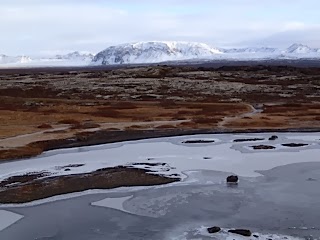
Skard lies between ice and fire. The roiling glacial river Thjorsa marks its western border, the foothills of the looming, cloud-shrouded volcano Hekla rise to the east. Skalholt is 15 miles away, as the raven flies; with two rivers to cross, it's not an easy horseback ride.

One day soon after Easter in 1207, the saga says, Herdis went to Skard to check on the farm there. With her went her son Ketil and daughter Halla, leaving Loft and his sister Thora at Skalholt. While she was there, the glacial river flooded. The ford across the Thjorsa became impassable.

Determined to return to Skalholt on the day arranged, Herdis hired a ferry. Ketil, then 16, and a priest named Bjorn crossed first, carrying over the riding gear and leading the horses, forcing them to swim behind the boat. One horse--Herdis's own--broke free of its rein and was swept down the river. Herdis did not respect the omen.


On the second trip, the wind gusted up. The ferry hit a shoal and flipped, spilling Herdis, her daughter Halla, and her niece Gudrun, as well as the deacon who oversaw Skard and a man named Sigfus, into the icy, turbulent water. Sigfus made it to land, exhausted. The others, while the priest and the boy watched, helpless, drowned. The women, especially, had no chance, weighed down as they were by their heavy wool gowns and cloaks, against a current strong enough to overcome a horse.

"When the news came to Bishop Pall's ears, suddenly, in the middle of the night," the saga says, "it seemed to everyone that God had nearly given him more than he could bear. He could not eat, he could not sleep, until the bodies were buried, though he tried to cheer up everyone else as much as he could."

The pathos of this description--"in the middle of the night ... he tried to cheer up everyone else"--suggests to some scholars that Loft, Pall's son, the one left at home, was the author of the saga. His brother Ketil died in 1215, about 22, but Loft lived to old age, entering a monastery late in life and dying in 1261, about 70 years old.

You can learn more about Bishop Pall and his family in Ivory Vikings. Read about it on my website, http://nancymariebrown.com, or check out these reviews:

"Briefly Noted," The New Yorker (November 2): http://www.newyorker.com/magazine/2015/11/02/briefly-noted-the-blue-guitar (scroll down)

"Bones of Contention," The Economist (August 29): http://www.economist.com/news/books-and-arts/21662487-bones-contention

"Review: Ivory Vikings," Minneapolis Star Tribune (August 29): http://www.startribune.com/review-ivory-vikings-by-nancy-marie-brown-the-mystery-of-the-lewis-chessmen/323230441/


Tuesday, June 16, 2015

Iceland's Independence Day

Today, June 17, Icelanders celebrate their independence day, on the birthday of Jon Sigurdsson, the leader of the nineteenth-century Icelandic independence movement. Jon was a saga scholar, before he became a politician. He worked briefly at the library in Copenhagen established by the great collector of medieval Icelandic manuscripts, Arni Magnusson.

So it's fitting that, on this day of Icelandic independence, we remember the role of the sagas in setting Icelanders free.

Reading the Icelandic sagas, you learn of Iceland's early days as a free state, from its founding in 874.

Reading the sagas, you learn how Iceland lost its independence in 1262 and became subject to Norway, which itself was later taken over by Denmark.

And reading the sagas--simply the act of reading and rereading them--is what united the nineteenth-century Icelanders, as I learned while researching Song of the Vikings, my biography of the saga master Snorri Sturluson.

Here's how I explained the connection between Icelandic sagas and Icelandic independence in Song of the Vikings:

In 1835 four Icelandic students founded a political magazine in Copenhagen. They printed their manifesto in the form of a poem, which "was exactly what was needed in order to unite the Icelandic people," says Karlsson in The History of Iceland (published in 2000 by the University of Minnesota Press).

The only one of their ancestors it evokes is Snorri:

"... Ah! but up on the lava where the Axe River plummets forever
into the Almanna Gorge, Althing is vanished and gone.
Snorri's old site is a sheep-pen; the Law Rock is hidden in heather,
blue with the berries that make boys--and the ravens--a feast.
Oh you children of Iceland, old and young men together!
See how your forefathers' fame faltered--and died from the earth!"

Four lines of this poem by Jonas Hallgrimsson (translated here by Dick Ringler) are engraved on a plaque now standing on the site of Snorri's booth in Thingvellir, the great rift valley in the south of Iceland where the Althing, the yearly parliament of chieftains, met during the Saga Age.


The Althing reconvened as a national parliament, with Danish permission, in 1845. In 1874 Iceland received a new constitution and, in 1904, home rule. One of its first demands was that Denmark return the manuscripts of the sagas that had been collected--mostly by the scholar Arni Magnusson--and brought to the royal library and that of the University of Copenhagen in the early 1700s. The Danes declined.

In 1918 Iceland became a sovereign state in a "personal union" with the Danish king--much like the situation in 1262, when the chieftains swore oaths of loyalty to King Hakon the Old. For its coat-of-arms the new nation turned once again to Snorri.

King Harald, Snorri wrote in Heimskringla, was angry at the Icelanders, who had composed lampoons about him. He ordered a "troll-wise man" to spy out the country's defenses. Disguised as a whale, the wizard swam close to Iceland’s eastern shore: "Then came a great dragon down from the dale" and "blew poison at him." He swam along the north coast, "but there came against him a bird so big that its wings neared the fells on both sides of it." The wizard-whale fled to the west: "Toward him came a great ox that waded out in the sea and began to bellow horribly." Swinging wide, he swam south, "but against him there came a great hill giant who had an iron staff in his hand and bore his head higher than the fells." King Harald was dissuaded from attacking. Iceland's coat-of-arms bears a dragon, an eagle, an ox, and a giant.


The Icelanders repeated their demands to "bring the manuscripts home." The Althing passed resolutions in 1930 and 1938, then their literary quest was interupted by World War II. In April 1940 Denmark was invaded by Germany; a month later Iceland was occupied by the British, one result being Iceland’s final break with Denmark. The independent Republic of Iceland was established at Thingvellir in 1944; in 1947 the Althing resolved, once again, to "bring the manuscripts home."

This time, Denmark formed a committee. In 1961 a list of manuscripts was drawn up, and Iceland agreed to give Denmark twenty-five years to deliver them. Ten years later—after being photographed and conserved—the first set steamed into Reykjavik harbor aboard a Danish coastguard cutter. Thousands of Icelanders stood by the docks. Thousands more watched via the first live outdoor broadcast of the state television station. Eventually 1,666 manuscripts and over 7,000 charters (1,350 of them originals, the rest copies) were returned from Arni Magnusson’s collection—slightly over half of it. Another 141 manuscripts were sent home from the Royal Library. The last arrived in Iceland in 1997.

"People still say: 'We want to see the manuscripts,'" wrote Gisli Sigurdsson and Vesteinn Olason in The Manuscripts of Iceland in 2004. The manuscripts "are at one and the same time the repository of medieval Icelandic culture and its visible symbol." They are Iceland's "main source of pride."

If you are in Iceland, a fitting way to celebrate June 17 would be to visit the Settlement Sagas exhibition of the Reykjavik City Museum.


Wednesday, May 20, 2015

Saga vs Novel

Juxtaposition is one of my favorite words. So I was understandably thrilled when a 2014 essay by Ben Yagoda in Slate, complaining "Does Novel Now Mean Any Book?" crossed my (virtual) desk at the same time as a 2002 academic paper by Torfi Tulinius of the University of Iceland called "Egils Saga and the Novel."

What is a novel? Seems no one knows. Yagoda, who writes nonfiction and only nonfiction, got his nose out of joint when someone called him a novelist. "I got on Twitter and sent out a tweet asking people if they were familiar with the 'novel = book' custom." He received numerous replies, including one from a very exasperated literary agent: "In queries: ALL THE TIME. People telling me of their 'nonfiction novel' or their 'fictional novel.'"

I admit that "fictional novel" is one phrase that makes me cringe.

That said, I'm the last person you should ask to define "novel." The more closely I look at the question, the harder it is for me to explain the difference between fiction and nonfiction, even though I've published both.

If you get your facts wrong when writing a novel--for example, if your Vikings eat potatoes or you kick your horse in the withers--your story fails.


But to write nonfiction you have to leave out a lot of what "really happened." You have to shape the truth. And you have to speculate (i.e., write fiction) to fill in the gaps between your facts.

And often what you thought was a historical fact you find, if you dig back far enough through your sources, was some prior writer's speculation.

That's especially true when you're writing, like I do, about the Middle Ages. There are an awful lot of gaps in what we know about the world a thousand years ago. And a lot of what we "know" comes from texts that, today, we might be inclined to call novels.

Like Egil's Saga.

Derived from the Icelandic verb "to say," the word "saga" implies neither fact nor fiction. Of the 140 known medieval Icelandic sagas, some are fantasies, some are biographies, some are chronicles--as fact-filled as any medieval text--some approach memoirs, and others may best be described as novels.

For hundreds of years, scholars have argued over whether the sagas are "history" or "fiction."

An Icelander writing in 1957 considered the sagas too good to be true: “A modern historian will for several reasons tend to brush these sagas aside as historical records," he said. "The narrative will rather give him the impression of the art of a novelist than of the scrupulous dullness of a chronicler.”

Archaeologists, too, dismiss the sagas as fiction, though there are notable exceptions. Jesse Byock of UCLA has led excavations in Iceland for twenty years; he and his colleague Davide Zori wrote in 2013, “We employ Iceland’s medieval writings as one of many datasets in our excavations, and the archaeological remains that we are excavating … appear to verify our method.” Of his team’s discovery of a Viking Age church and graveyard, he said, Egil’s Saga “led us to the site.”

Perhaps the greatest of the Icelandic Family Sagas, Egil's Saga may have been written by Snorri Sturluson, as I argued in Song of the Vikings: Snorri and the Making of Norse Myth. Much of my argument was based on Torfi Tulinius's analysis--though this particular paper, "Egils Saga and the Novel," somehow escaped me.


Egil's Saga, Torfi begins, is "a book born of other books." Among its themes are "the status of poetry in human life" and "the individual's need to define himself."

The world of the saga is "both same and different." It is not the 13th-century world of the author, but a fictional 10th-century world against which Snorri and his peers could "project their hopes and worries as well as their ideas about themselves."

The story is realistic--it is "set within a landscape everybody knows"--but it is not true. "It is probable that somebody called Egill actually lived at Borg in the 10th century," Torfi says. "Egils Saga, though, is a work of language." The characterization of this Egill and the events he takes part in may be "purely fictional."

"The originality of Egils Saga--and this is what makes it a novel--is that here it is the audience's own history and reality which are offered to interpretation," Torfi concludes. "However, no keys are given, except those which lie hidden in the text."

As Ben Yagoda documents, readers today have a hard time telling the difference between fictional-by-definition novels and nonfiction books. "An (unnamed) major metropolitan newspaper, in its obituary of Louis Zamperini, referred to Laura Hillenbrand's book about him, Unbroken, as a 'novel,'" he scoffs. An "actual class assignment from an actual (unnamed) school" referred to Barbara Ehrenreich's Nickel and Dimed and Jared Diamond's Guns, Germs, and Steel as novels.

Yagoda blames, in part, "the blurring of generic boundaries, and the fuzziness of 'truth' in the postmodern era," but, as any medievalist can tell you, that blurring and fuzziness has a long history.

In 800 years, who will know what parts of Unbroken are true and what parts were the writer's speculation? What moments of Louis Zamperini's life did she (of necessity) leave out? And what keys to interpretation lay hidden in the text? If someone else wrote a nonfiction book about Zamperini, would it be the same? Of course not.

A nonfiction book, like a novel, is "a work of language." Perhaps we should call them all sagas.

"Egils Saga and the Novel" by Torfi Tulinius was published in Snorri Sturluson and the Roots of Nordic Literature (Sofia, Bulgaria: University of Sofia, 2002). Download it at Academia.edu.

Read Yagoda's essay at http://www.slate.com/blogs/lexicon_valley/2014/08/04/novel_increasingly_used_to_mean_any_book_fiction_or_nonfiction.html


Wednesday, February 25, 2015

Michael Ridpath's "Where the Shadows Lie"


"Amid Iceland's wild, volcanic landscape, rumors swirl of an ancient manuscript inscribed with a long-lost saga about a ring of terrible power..."

Whoever wrote the jacket copy for Michael Ridpath's thriller Where the Shadows Lie, number one in his Fire & Ice series, might just as well have added, "This one's for you, Nancy," because, though I've never met Ridpath, I think he had me in mind as his perfect reader.

Rarely have I read a book about Iceland by a non-Icelander in which I can find nothing to complain about. (Okay, maybe the behavior of the golden plovers.) Ridpath may have grown up in Yorkshire and live in London, but it's clear he's visited Iceland--probably as many times as I have--and he hasn't just hung around Reykjavik and seen the standard tourist spots. He's read a lot of the books I have on my shelves, from Njal's Saga to Jesse Byock's Viking Age Iceland to J.R.R. Tolkien's Lord of the Rings, and he's mashed them all up inside a wholly believeable crime novel that has real people bumbling around in a real Iceland.

Here is an example. Our hero, Magnus, an Icelander who has grown up in Boston and is now a Boston police officer, and an Icelandic woman named Ingileif are driving through south Iceland, in the shadow of Mount Hekla:

At Ingileif's direction, Magnus turned off the road and along a dirt track, winding up through the hills and into a small valley. His police-issued Skoda strained to maintain traction: the road was in poor condition and in places very steep. After a bone-rattling eight kilometres they finally came across a small white farm with a red roof nestling in the hillside at the head of its own little valley. Beneath the farm the obligatory lush green home meadow stretched down to a fast-flowing stream. The rest of the grass in the valley lurked brown and lacklustre, where it wasn't still covered in snow.
Alfabrekka.
"'How fair the slopes are,'" Ingileif said.
Magnus smiled as he recognized the quotation from Njal's Saga. He finished it: "'Fairer than they have ever seemed to me before.'"

I've been in that car. I've had that interaction--though usually the Icelanders with me don't offer such an obvious quotation to complete.

And when the story continues, I recognize the farmhouse, the kitchen, the people there:

The father, an impossibly wizened man, stirred himself from a comfortable armchair, while the mother busied herself with coffee and cakes. A stove warmed the living room, which was chock full of Icelandic knick-knacks, including at least four miniature Icelandic flags.
And a giant high-definition television screen. Just to remind them that they were truly in Iceland.
The younger farmer who had greeted them did most of the talking. His name was Adalsteinn. And before they could ask him any questions he told them about his parents, the fact that he himself was single, the fact that the farm had been in the family for generations, and particularly the fact that farming these days was tough, very tough indeed.
The coffee was delicious, as were the cakes.

Michael Ridpath has met Icelanders and paid attention to their wisdom and depth, as well as to the obvious quirks and foibles most journalists seize upon. He understands how Icelanders feel about volcanoes and glaciers--as well as elves and trolls. Most importantly, he understands Icelandic sagas and the role they have played in Icelandic culture.

And not only in Icelandic culture. One of the reasons I wrote my biography of Snorri Sturluson, Song of the Vikings, was to reveal how, through Tolkien, medieval Icelandic literature has shaped modern American and British culture. A number of readers have told me how surprised they were to learn, as one put it, that Snorri Sturluson was the "granddaddy of Bilbo Baggins."

Ridpath makes the same point--effortlessly and convincingly--in Where the Shadows Lie, though he has the advantage of fiction where I had to stick to fact.

For centuries, a family of Icelanders has hidden away a saga--and the ring of power it refers to. One of the only people they allowed to read it was J.R.R. Tolkien, and it clearly inspired The Lord of the Rings. (They even have letters from Tolkien to prove it.) So when the economic crisis hits Iceland and one of the family members decides to bail out her business by selling the family saga, it finds a ready market in LOTR fans. One of them is a Silicon Valley billionaire. Another is a Yorkshire truck driver. A number of people get bashed in the head and/or plunge to their deaths beside waterfalls before Magnus, our Boston cop, solves the mystery. As he and the Yorkshire truck driver are rushing to prevent the final killing, the Yorkshireman says,

"'There's nothing wrong in being a Lord of the Rings fan… What is wrong is when you let it blind you to what's going on in the real world.' He looked around at the extraordinary countryside flashing through the mist around them. 'Although sometimes I find it hard to believe that this country is part of the real world.'"

"I know what you mean," Magnus says.

I know what he means too.


Learn more at http://www.michaelridpath.com/icelandic-series-home.html

Wednesday, September 3, 2014

Snorri and the Volcanoes


There’s a volcano erupting in Iceland again. They happen quite often—I saw one in 2010, when I took these photos, just before it shut down European airspace with clouds of ash.

Eruptions are a fact of life for Icelanders. A big one happened in 871 (plus or minus two years): The dark layer of ash it sprinkled over much of the country now helps archaeologists date the time of the first settlement of Iceland to just about that time, using a technique called tephrachronology. Another big eruption in 1104 laid down a layer of ash in a conveniently lighter color, which helps archaeologists bracket the Viking Age.

Geologists estimate ten volcanic eruptions per century took place between Iceland’s founding in the 870s and when the Icelandic sagas began to be written in the early 1200s. Then the frequency increased to about fifteen per century.

So why are eruptions essentially missing from the sagas?


Only once, in Kristnisaga, the Saga of Christianity, is an eruption a plot point. The chieftains were meeting in the year 1000 to debate whether Iceland should become Christian, as the king of Norway insisted. A rider broke into the proceedings to shout, “Earth fire! In Olfus!” A volcano had erupted on one of the chieftains’ farms.

“It is no wonder. The gods are angry at such talk,” people muttered.

“And what were the gods angry about,” said one chieftain, gesturing to the black, ropy lava all around, “when they burned the wasteland we’re standing on now?”


The great Icelandic writer Snorri Sturluson, subject of my book, Song of the Vikings, grew up in the shadow of a volcano. Hekla, the cloud-hooded mountain known in the Middle Ages as the Mouth of Hell, erupted twice during Snorri’s lifetime. Possibly three times, for the church annals record “darkness across the south” the year he turned five.

The annalist knew what caused that darkness. The Saga of Bishop Gudmund, written in the mid-1200s, contains this explanation (translated here by my friend Oren Falk of Cornell University):

“There are mountains in this land, which emit awful fire with the most violent hurling of stones, so that the crack and crash are heard throughout the country.… Such great darkness can follow downwind from this terror that, on midsummer at midday, one cannot make out one’s own hand.”


To the east of Snorri’s childhood home rose the ice cap of Eyjafjallajokull--from under which erupted the volcano I visited in 2010. Snorri would have seen only tier upon tier of vast blank whiteness, a glimmering dome mingling with the clouds so that on some days the horizon disappeared.

But Snorri’s contemporaries were aware that active volcanoes lurked beneath the ice. A thirteenth-century poet told how “glaciers blaze,” “coal-black crags burst,” “fire unleashes storms,” and “a marvelous mud begins to flow from the ground.” (Again, in Oren’s translation.)

Lava also spouted from the sea in Snorri’s lifetime, forming rugged black islands that rose above the waves only long enough for a few intrepid souls to row out and give them a name, the Fire Islands.

It is not surprising, then, that volcanoes also informed Snorri’s version of the creation of the world.


In the beginning, Snorri wrote in his Edda, there was nothing. No sand, no sea, no cooling wave. No earth, no heaven above. Nothing but the yawning empty gap, Ginnungagap. All was cold and grim.

Then came the giant Surt with a crashing noise, bright and burning. He bore a flaming sword. Rivers of fire flowed till they turned hard as slag from an iron-maker’s forge, then froze to ice.

The ice-rime grew, layer upon layer, till it bridged the mighty, magical gap.

Where the ice met sparks of flame and still-flowing lava from Surt’s home in the south, it thawed and dripped. Like an icicle it formed the first frost-giant, Ymir, and his cow.

Ymir drank the cow’s abundant milk. The cow licked the ice-rime, which was salty. It licked free a handsome man and his wife. They had three sons, one of whom was Odin, the ruler of heaven and earth, the greatest and most glorious of the gods: the All-father.

Odin and his brothers killed Ymir. From his giant body they fashioned the world: His flesh was the soil, his blood the sea. His bones and teeth became stones and scree. His hair were trees, his skull was the sky, his brain, clouds.

From his eyebrows they made Middle Earth, which they peopled with men, crafting the first man and woman from an ash tree and an elm they found on the seashore.


So Snorri explains the creation of the world in the beginning of his Edda. Partly he is quoting an older poem, the “Song of the Sibyl,” whose author he does not name. Partly he seems to be making it up—especially the bit about the world forming in a kind of volcanic eruption, and then freezing to ice.

This part of the myth cannot be ancient. The Scandinavian homelands--Norway, Sweden, and Denmark--are not volcanic. But there is nothing so characteristic of Iceland as the clash between fire and ice.

Wednesday, January 15, 2014

Burial Rites

A friend who is going to Iceland with me next summer, on her first trip there, gave me Hannah Kent's novel, Burial Rites, last October. We had both been thrilled with the early reviews, thrilled to see a book set in Iceland in 1828 getting so much attention.

But my friend had read Burial Rites before she gave it to me and, though she tried to hide it, I could tell she didn't like it. I had a lot to read already. I put it on my shelf and didn't open it until right before Christmas.

Once I started, I read it in a rush. It's a beautiful book, though a very sad one, about a young woman condemned to be beheaded for murders she may or may not have committed. Kent's lyrical writing drew me in and, though I intended to be critical and frowned at her mention of thorn bushes and brambles plucking at a woman's skirts (I've never seen thorn bushes and brambles in Iceland), there were very few mistakes of this kind. Kent had, indeed, visited the Iceland I knew, had read the same 18th- and 19th-century travelers' tales as I had, had read the Icelandic sagas.

I asked my friend why she didn't like the book. It was "claustrophobic," she said.

True. But to me that's proof of Kent's skill as a writer: She was able to make the reader feel the claustrophobic atmosphere of life inside a turf house on a farm a bare step above abject poverty in a country that has, in addition to its gloriously long summer days (when I visit), an equally long, dark winter.

In Iceland in 1828 there were no jails. So until her execution the convicted murderess, Agnes, is kept on a farm where the housewife, Margrét, chooses to treat her as a servant (she's sane and a good worker) instead of locking her up. But there's no real difference, when winter comes, between being a servant and being a prisoner on a poor Icelandic farm.

Here's a passage from Burial Rites:

Autumn fell upon the valley like a gasp. Margrét, lying awake in the extended gloom of the October morning, her lungs mossy with mucus, wondered at how the light had grown slow in coming; how it seemed to stagger through the window, as though weary from traveling such a long way. Already it seemed a struggle to rise. She'd wake in the chill night with Jón pressing his toes against her legs to warm them, and the farmhands were coming in from feeding the cow and horses with their noses and cheeks pink with the ice in the air. Her daughters had said that there was a frost every morning of their berrying trip, and snow had fallen during the round-up. Margrét had not gone, not trusting her lungs to last the long walk up over the mountain to find and herd the sheep from their summer pasture, but she'd sent everyone else. Except Agnes. She could not let her walk over the mountain. Not that she would flee. Agnes wasn't stupid. She knew this valley, and she knew what little escape it offered. She'd be seen. Everyone knew who she was.

As the story progresses, it's clear that Agnes is not the only person under a sentence of death. Everyone Agnes has ever cared about in the past has died--in childbirth, through illness or accident--and those the reader comes to care about, like Margrét with her bad lungs, are equally fragile.

I do have one complaint with Kent's approach. There's a bit of the medieval Laxdaela Saga plunked into the last quarter of Burial Rites. A line of the saga--"I was worst to the one I loved best"--is used as the epigraph. To someone, like me, who has studied Laxdaela Saga it's a puzzling inclusion. I can't imagine what someone who's never read Laxdaela Saga would make of it, but to me the comparison between Gudrún of Laxdaela Saga and Agnes is belittling to both stories. The motives of both women are reduced to mere jealousy, whereas there's no comparison between Kjartan (whose death Gudrún masterminded) and Natan (whom Agnes is convicted of killing). The Kjartan-Gudrún love story is tragically complex. Natan is just a womanizer, in Kent's rendition. I felt no loss at his death, rather that something foul had been cleaned from the beautiful, if desolate, farm where he and Agnes had lived. To make Agnes echo Gudrún, Kent needed to make Natan more rounded, more sensitive, more appealing, more like the prized and powerful member of society that Kjartan is--at whose death every reader weeps.

But then Burial Rites would have been a different book. And not, I don't think, a better one. As it is, I just skimmed the pages from Laxdaela Saga and continued on. If I ever meet Hannah Kent (and I hope I do, in Iceland), perhaps we can have a cup of tea and discuss her reading of Laxdaela Saga. It's the kind of thing people do all the time in Iceland: examine each other's understanding of the past.


Join me again next week at nancymariebrown.blogspot.com for another adventure in Iceland or the medieval world. And if you would like to go to Iceland with me next summer, check out the tours at America2Iceland.com.

Wednesday, January 8, 2014

The Faraway Nearby


Last June, on my way to Iceland for the 17th time, I read a luminous essay, "Summer in the Far North," in the magazine Mother Jones. It began, "One summer some years ago, on a peninsula jutting off another peninsula off the west coast of Iceland, I lived among strangers and birds."

The writer, Rebecca Solnit, loved the birds, especially the arctic terns: "The impeccable whiteness of their feathers, the sharpness of their scimitar wings, the fierceness of their cries, and the steepness of their dives were all enchanting." She wove a story out of these birds, who migrate from the Arctic to the Antarctic each year, living their entire lives in light.

She contrasted them to herself, finding she could not live without darkness--of which there is none, naturally, in Iceland in the summertime. Fleeing the midnight sun, Solnit found darkness in an art museum, in an installation by a young Icelandic artist, "a zigzag route of Sheetrock" that allowed in only slivers of light. Inside "Path" by Elín Hansdóttir--essentially a box inside the box of the building--Solnit could riff on "empathy." Her essay ends: "Few if any of us will travel like arctic terns in endless light, but in the dark we find ourselves and each other, if we reach out, if we keep going, if we listen, if we go deeper."

I was intrigued. Solnit was so evocative writing about Iceland's birds, I wondered what she'd say about the "strangers." I clicked on the link, "Buy this Book," The Faraway Nearby, from which the essay was excerpted. It arrived while I was in Iceland and sat on my "to read" shelf for several months, as I began writing a new book myself, one inspired by that light-filled trip to Iceland (#17) last June, a book that brought me back to Iceland for trip #18 in dark and gray November.

In early December, missing Iceland, I opened Solnit's book. I wanted a book about light and darkness and arctic terns and Icelanders. What I got was a book about a mother with Alzheimer's, a failed romance, a breast cancer diagnosis, fairy tales and Frankenstein, tale-telling in general, a heap of rotting apricots, Che Guevara, the Marquis de Sade, Peter Freuchen, Buddhism...

A reviewer for the New York Times (see http://www.nytimes.com/2013/08/18/books/review/the-faraway-nearby-by-rebecca-solnit.html), whom I did not consult until after I'd finished The Faraway Nearby and was still wondering what it was "about," explains that "Creating links between seemingly disparate ideas is Solnit's gift, her stock in trade. It's what gives her writing its eccentricity, its spirit and frenetic energy. This worked well in her popular 2005 book, A Field Guide to Getting Lost, which explored all that the unknown had to offer." The reviewer implies that it does not work so well in The Faraway Nearby. I'm not so sure. That heap of rotting apricots was quite thought-provoking. I liked the "wild mash-ups," as the reviewer named them, of, for example, Narnia and the Chinese artist Wu Daozi and Easter Island and the Road Runner cartoons.

What disappointed me was that Rebecca Solnit never really went to Iceland. Sure, she resided on the island for a time. But her "Iceland" is not my Iceland. She didn't meet any Icelanders.

Solnit was the first international writer-in-residence at an art museum in Stykkishólmur called the Library of Water. She writes:

I wandered around my temporary home on this island shaped like a heart, the volatile ice-covered heart that occasionally beat, with lava, boiling water, and steam in its veins. The farthest point I could reach on foot was Helgafell, the sugarloaf hill around which stories were wrapped like clouds, and where Gudrun Osvifursdottir was buried a thousand years before, the proud woman at the center of the Laxdaela Saga and all its slaughter and loss.

Once a farmer who spoke only Icelandic gave me a ride back from Helgafell in a rain; and cashiers spoke brusquely to me about money in the low-ceilinged, fluorescent-lit den that was the chain supermarket; and there was a librarian with some responsibility for the Library of Water who provided practical aid every now and again. Otherwise no one spoke to me because Iceland was not good at strangers ...

Helgafell, as I've written before on this blog, is my "thin place." See http://nancymariebrown.blogspot.com/2013/03/a-thin-place-in-iceland.html

In my first book, A Good Horse Has No Color, I described how a visit to Helgafell had inspired me to write; an excerpt is here: http://nancymariebrown.blogspot.com/2012/06/practical-education.html

I can guess who the "farmer who spoke only Icelandic" might be who gave Solnit a ride, since I have been friends with the farmer at Helgafell (who speaks only Icelandic) for 27 years. It's something he would do. If she had tried a few words of Icelandic on him--even the few words she includes here in her book, "Gudrun Osvifursdottir" and "Laxdaela Saga"--he would have tried to speak with her. I know, because I did that and he spoke with me.

I walked up to the door at Helgafell in 1986, knocked and said, "Snorri Godi, here?" I was greeted with a warm handshake and invited in for coffee. My husband waved his binoculars and said, "Hrafn" (Raven). Through some combination of English, Icelandic, and hand-waving, he conveyed to the family that had clustered around us that he had found a raven's nest on the side of the hill. Turns out the mother had been looking for that nest. After coffee and cakes, we took a field trip to see it. We were invited to stay for dinner (fresh trout from their lake) and to set up our tent in the yard. The family called up the local English teacher to come translate.

I decided right then to learn Icelandic so that I could speak to this remarkable family. But they are not the only Icelanders I've met who are "good at strangers."

A few days later, I got off a ferry in the driving rain and was struggling into my rainsuit when a car stopped and a stranger approached me. She knew a little English. "You look cold," she said. "Would you like coffee?" She motioned for us to follow the full car to a yellow house and, instead of birdwatching in the rain, we spent the afternoon warm and snug and well-fed, "talking" about birds with another large, extended family who spoke little or no English.

In 1992, I took the same ferry to the same island and knocked on the door of the yellow house. Our hostess was not there--turns out she shared this summerhouse with 13 siblings--but we were welcomed in and fed, regardless. That afternoon being sunny, a young nephew (who did speak English) offered to take us out in his small boat to see a colony of guillemots that nested on a nearby islet.


I have been to Iceland, as I said, 18 times--the 19th trip is already scheduled. I have never met a cold Icelander, an Icelander "not good at strangers." What I have met are the warmest and most hospitable people I can imagine. People who will not accept a gift without giving one in return. People who have piled gifts upon me--of food, of comfort, of stories, of adventures--that I can never repay except, I hope, by writing about them and the larger gifts Icelanders over the centuries have given to the world.

According to the New York Times, Rebecca Solnit's book is "loosely about storytelling." It's too bad she didn't discover the best and most influential storytellers in the world, the medieval Icelanders like Snorri Sturluson who gave us Norse mythology and the Icelandic sagas.

In Song of the Vikings, my biography of Snorri, I list some writers Iceland has inspired:

Thomas Gray, William Blake, Sir Walter Scott, the Brothers Grimm, Thomas Carlyle, Henry Wadsworth Longfellow, Alfred Lord Tennyson, Robert Browning, Richard Wagner, Matthew Arnold, Henrik Ibsen, William Morris, Thomas Hardy, Hugh MacDiarmid, J.R.R. Tolkien, Jorge Luis Borges, W.H. Auden, Gunther Grass, Gabriel Garcia Marquez, A.S. Byatt, Seamus Heaney, Jane Smiley, Alice Munro, Ivan Doig, Michael Chabon, and Neil Gaiman.

Through Tolkien, Snorri has inspired dozens of writers of fantasy, including Douglas Adams, Lloyd Alexander, Poul Anderson, Terry Brooks, David Eddings, Lester del Rey, J.V. Jones, Robert Jordan, Guy Gavriel Kay, Stephen King, Ursula K. LeGuin, George R.R. Martin, Anne McCaffrey, and J.K. Rowling.

These writers are just a beginning. There are many, many more--every day, I find more--Rebecca Solnit among them.

Join me again next Wednesday at nancymariebrown.blogspot.com for another adventure in Iceland or the medieval world. And if you would like to go to Iceland with me next summer (on my 19th trip), check out the tours at America2Iceland.com.

Wednesday, December 18, 2013

Music for Saint Thorlak's Day

Last November, I spent a few days at Skalholt, the medieval capital of Iceland and site of its first cathedral. While there, I began understanding the Icelanders' fondness for their patron saint, Thorlak Thorhallsson, who was bishop of Skalholt from 1178 to 1193 and declared a saint in 1198.

November days are very short in Iceland. Through a fluke of scheduling, I was completely alone in the cathedral guesthouse. It was eerie, walking around the grounds at night--even before the storm came--and I soon imagined I heard voices in the babbling of the brook and the whinny of a distance horse. There could, indeed, be a lot of ghosts at Skalholt: I knew its history. Though not a "believer" I found I had Saint Thorlak's name on my lips and rushed back inside, where a gift from the current bishop of Skalholt awaited me.

Since December 23rd is Saint Thorlak's Day, I thought I'd share that gift. But first, a bit about Thorlak, whom I met while researching Song of the Vikings, my biography of Snorri Sturluson.

Thorlak was a well-educated man: He studied at Paris, France and Lincoln, England. After that he returned to Iceland and "was ever at writing," his saga says. He dressed plainly, ate and drank like an ascetic (no meat, only water), and was rather dull company, the saga implies, noting that it "was a great misfortune that his speech was hard and slow." On the other hand, "he was so lucky in his brewing that the ale never burst that he had blessed."

Soon after Thorlak died, people began reporting miracles that occurred when they called on him for aid. These miracles provide a digest of the common Icelander's woes in the 12th century: Saint Thorlak cured stiff hands, sore throats, burning eyes, and gassy stomachs. He found lost hobbles, lost sheep, a sledgehammer, and a ring. He healed a horse ridden "unwarily where there was volcanic heat"; its legs "got so burned that people thought it would die." He healed a woman who "fell into a hot spring in Reykholt and got so severely burned that her flesh and skin came off with her clothes." He stemmed the flow of blood when a chieftain, soaking in his hot-tub, cut himself with a razor. He calmed storms and floods, resuscitated a drowned boy, quenched a house fire, and mesmerized a seal so a starving mother could kill it.

In Song of the Vikings I describe these miracles, along with the glorious translation of Bishop Thorlak—the ceremony by which he was officially recognized as Iceland's first saint in 1198.

The bishop's coffin, buried for five years, was dug up, dusted off, and carried into Skalholt Cathedral. Saint Thorlak's holy relics (his bones) were taken from the coffin, washed, and encased in a golden shrine. The priest Gudmund the Good, then 38, was a coffin-bearer; he chanted the Te Deum in his unforgettable voice. Twenty-year-old Snorri probably accompanied his foster-brothers Saemund and Orm, whom the saga says attended the ceremony. During the Mass which followed, Snorri would have marveled at the 230 expensive beeswax candles twinkling on the altar (all imported, since honeybees did not live in Iceland).

But what I didn't know when I wrote Song of the Vikings was that the music written for the ceremony still survives. On my recent trip to Skalholt, Bishop Kristjan Valur Ingolfsson lent me a recording of it by the early-music ensemble Voces Thules.

You can listen to part of it here: http://www.youtube.com/watch?v=emmG7Pl3mCU

As explained in the CD's liner notes, "Liturgical chants are a kind of soothing incantation, in which flow has an all-important role to play, like sailing effortlessly on the crest of the wave toward a nevertheless clear destination. The singing of music of this kind is the most intimate form of worship and meditation still to be preserved within the sanctuary of the Christian Church."

The six members of Voces Thules depended on the doctoral thesis of Robert Ottosson (1912-74) to understand how to reconstruct this chant from the 24 pages of manuscript in the archives. These manuscript pages are also online; you can see them at the Icelandic music website www.ismus.is. Click on "Handrit og prent," then on manuscript number "AM 241a fol. Þorlákstíðir," then on "Síður (24)" and the pages of manuscript will appear and you can scroll down through them.

The "Office of Saint Thorlak" was performed in 1998, for the first time in centuries, to mark the 800th anniversary of Bishop Thorlak's death. It was part of the Reykjavik Arts Festival that year, stretching over a day and a half and culminating in a High Mass, at which Kristjan Valur and another priest also sang.

I listened to Saint Thorlak's music at Skalholt on that dark November night, while the wind howled and the rain lashed against the windows and I was the only person in the entire guesthouse.

"The darkness flees, the light illuminates the mind, a devoted nation dances," the Office begins. "Let us prepare for the festival of jubilation and offer praise, cast out the darkness at the world's extreme."


Join me again next week at nancymariebrown.blogspot.com for another adventure in Iceland or the medieval world.

Wednesday, December 11, 2013

The Roskilde Viking Ship Museum

News of the terrible stormsurge that almost washed away the Viking Ship Museum in Roskilde, Denmark, earlier this month, brought up memories of my visit there in 2006, when I was researching my book The Far Traveler: Voyages of a Viking Woman.

Before then, when I imagined a Viking ship, I thought of the Gokstad ship, which I'm gazing at here in a photo from 1984. Found in the late 1800s in a burial mound in southern Norway, the Gokstad ship has the spareness and elegance of line that seem to me the epitome of a Viking ship. I’m not alone: closeups of its hull, head on, are reproduced on everything from magazine covers to Christmas ornaments as the emblem of the Vikings.

So I was disappointed at first to learn that the ship Gudrid the Far-Traveler sailed on to Vinland in North America did not look like this. Hers was a knarr, a cargo ship, like the replica Saga Siglar that sailed with copies of the Gokstad and Oseberg ships down the coast of North America in 1991. From the Ellis Island ferry, I had watched the three Viking ships sail into New York Harbor, side by side. In my notebook I wrote:  "Saga Siglar is so squat and tubby compared to the others. It’s as if someone cut her too short."

Saga Siglar (the name means "Saga Sailor") was based on a ship recovered from the seabottom near Skuldelev, Denmark, by Ole Crumlin-Pedersen, whom I met in 2006 at the Viking Ship Museum in Roskilde. Tall, fair, white-haired, and smartly dressed in sailor's white, Crumlin-Pedersen had recently retired from the museum that housed his accomplishments: scraps of five Viking ships in five different styles, from a fishing boat to a dragonship, and a dock full of replicas made to their patterns. Nine more ships—found sunk in the museum's own harbor when they were expanding their exhibit space—were then in various stages of processing. One, the largest by far, a slim dragonship that carried up to 40 pairs of oars, is now the centerpiece of the Viking exhibition that just closed in Copenhagen and will be opening in London in the spring.
Photo by Katrin Driscoll
With a childlike smile and a courtly bashfulness, Crumlin-Pedersen explained to me how he knew that the tubby model was what the sagas meant by a knarr. "It’s because of the nickname for women in the Icelandic sagas: Knarrarbringu. 'Knarr breast.' Look at it from the front. It comes right up like this—" He pantomimed a woman's tight waist and heavy breasts.

"The replica ships going to Vinland should not be based on Gokstad," he continued, more seriously, "they should be based on this knarr, on Skuldelev 1. Gokstad is a combined sailing and rowing vessel, for a large crew. Skuldelev 1 is definitely a cargo ship. There's only a few oars for turning the ship in the wind or in harbor—it's a pure sailing vessel. Six men, working day and night, could handle it. On the other hand, you could have any number of people on board. You could move a farm with livestock and goods—but you wouldn't take more than one farm. Maybe to go to Vinland you would have wanted a vessel slightly larger than Skuldelev 1, but it would have been this same type of vessel."
The five Skuldelev ships had been scuttled at the head of the fjord to keep raiders from the Danish royal residence at Roskilde. Legend had it that they dated from Queen Margarethe's reign in the 1400s. But when parts of the barricade were removed by fishermen in the 1950s, to clear a deeper passage for their motorboats, Crumlin-Pedersen thought the bits he saw were Viking work. Trained as a maritime engineer, he signed on as a deep-sea diver to map out the wrecks, then, after a stint in the Navy, was hired by the Danish National Museum as a ship archaeologist. The Skuldelev site would be his training ground.

"Underwater archaeology was only just starting then," he told me as we toured the docks and warehouses and hands-on exhibits outside of the museum proper. "I went to the first conferences in Italy and London, and my colleagues tried to convince me that I should come to the warm, clear water of the Mediterranean, not stay in the cold, muddy water here. I insisted in exploring the potential here. It turned out to be very rich.

Photo by Katrin Driscoll

"We had thought the site was so damaged we could do no harm," he continued. "We had no experience. We could start there and continue on to more important sites. The first year we cleared the passage and found not one, but two ships. The next year, it was not two but four. The next year it was not four but six." (Later they would learn that ships number 4 and 6 were parts of a single widely-scattered vessel.)

"So we built a coffer dam. Sometimes it's a good thing to come from another education. As an engineer, I could come up with ideas and principles for the retrieving of ships that have become standards all over the world."

The coffer dam drained the fjord around the site. Then the problem was to lift the shattered wood out of the mud, while keeping it from drying out and disintegrating. "You keep the wood in water all the time until it can be treated with polyethylene glycol," Crumlin-Pedersen explained. A type of plastic, polyethelene glycol crystallizes within the wood cells. This plasticized wood can then be heated and gently pressed back into shape. "That brings out the lines of the boat."

Those lines are so various, just among the replica ships afloat in Roskilde harbor, that it's hard to say they’re all "Viking ships." The tubby knarr, 52 feet long and a buxom 16 feet wide, is docked beside the dragonship Havhingsten ("The Sea Stallion"), 98 feet long but a slender 12 feet wide. A smaller cargo ship, a byrding of more "elegant" proportions, carried only four-and-a-half tons of cargo to the bigger knarr's 24 tons, while a smaller warship, called a snekke or "snake," could only handle 30 warriors to Sea Stallion's 80.

Photo by Katrin Driscoll

And then there's the toy-sized fishing boat, 37 feet long by 8 feet wide, on which Crumlin-Pedersen signed me up as an oarsman when a German TV personality wanted to take a Sunday-morning ride. Nicely maneuverable in the narrow harbor (even with a raw crew brand-new to the oars), it seemed precariously low to the waves once the sail was up. Yet when they compared the pattern of the tree-rings in the original ship's pine timbers to wood samples from throughout the Viking world, they found a perfect match with the wood of the Urnes Stave Church in Sognefjord, Norway; the ship had been built there and had sailed the 500 miles to Roskilde at least once. By the time it was sunk to blockade the fjord, it had been patched in several places and refitted to be a small cargo ship, the rowlocks taken off and an extra strake added to give it a little more height.

All five Skuldelev ship types, Crumlin-Pedersen believes, developed after 900 out of the basic Gokstad style. "The development of cargo vessels seems to be a very late one in Scandinavia," he explained over a lunch of pickled herring and brown bread in the museum’s dockside restaurant (right under which, he pointed out, another longship had been found, 20 feet longer than Sea Stallion). "They didn’t have proper cargo vessels until the 10th century. I think that's because it was too dangerous to go out with a load of valuable cargo without a sufficient number of people to protect your goods. The Gokstad ship was capable of carrying eight to 10 tons of cargo, but also a sufficient crew to defend it. Then in the 10th to 11th centuries, we have the development of cargo ships and the transformation of warships into ships that couldn't carry cargo. I see that as a sign of royal control of the sea. It was one of the main jobs of the king, to keep trade safe."

The cargo ships got tubbier (and more practical), the warships got longer and sleeker and swifter; the principal of their design, according to Crumlin-Pedersen, being the "sporting element": fierce competition among royal Viking crews. One of these late longships is 11 times longer than it is wide and made from enormous oak trees, each thin plank over 32 feet long. "For the really royal ships, the shipbuilder had access to trees no one else could touch," Crumlin-Pedersen told me. "Such a ship as this is an amazing machine!" Racing such a royal ship, he said, must have been the sporting experience of a lifetime.

To read about the Viking Ship Museum's battle with the stormsurge, and see some spectacular photos, go to the museum's website, here: http://www.vikingeskibsmuseet.dk/en/about-us/news-room/photo-series/billedserie-vikingeskibene-stod-stormen-igennem/#c15886

There's also a film about the storm, here: http://www.vikingeskibsmuseet.dk/en/about-us/news-room/photo-series/billedserie-stormen-time-for-time/film-om-stormen/#c15878


Join me again next Wednesday at nancymariebrown.blogspot.com for another adventure in Iceland or the medieval world.

Wednesday, November 20, 2013

The Saga Man: Arni Magnusson

Lovers of Icelandic sagas are celebrating these days: It's the 350th birthday of Arni Magnusson, the man who, more than anyone else, saved Iceland's medieval manuscripts.

Brought up at Snorri Sturluson’s ancestral estate of Hvamm in the west of Iceland, Arni went to Copenhagen in 1683, when he was 20 years old, and found work as a copyist and translator for Thomas Bartholin, Jr. With Arni's help, Bartholin published a 700-page history of the Danes in 1689. Drawing examples from Snorri’s Heimskringla, Egil’s Saga, and other sagas, Bartholin’s Danish Antiquities Concerning the Reasons for the Pagan Danes’ Disdain for Death made popular the Viking stereotype of the bold, blond, laugh-in-the-face-of-death hero.

Arni became a professor at the University of Copenhagen in 1701, and the next year the king sent him back to Iceland to gather statistics on his country’s land and people. His massive Land Register, compiled over ten years, describes every farm in Iceland, its size and shape, buildings, people, cows, sheep, horses, the bulk of butter and cloth it owed in tithes, the quality of its turf, peat, hay, and woodlots, its fishing and driftwood rights, and the extent of the property ruined by volcanic ash or sand or rendered useless by quagmires, bogs, erosion, or flooding.

Off the record, Arni asked every farmer about manuscripts—and poked about in every farmhouse. In his novel Iceland's Bell, Halldor Laxness imagines Arni searching every nook and cranny, even the stuffing of the mattress:

Dust and poison gushed up from the old and moldy hay within the woman’s bed as they began their search. Mixed up in the hay was all kinds of garbage, such as bottomless shoe-tatters, shoe-patches, old stocking legs, rotten rags of wadmal, pieces of cord, fibers, fragments of horseshoes, horns, bones, gills, fishtails hard as glass, broken wooden bolts and other scraps of wood, loom-weights, shells both flat and whorled, and starfish. 

There were often also scraps of parchment in hiding places like this: Arni collected every one. He found two leaves from a 13th-century manuscript with holes punched in them to make a flour sifter. He found sheets used as dress patterns, shoe soles, knee patches, and even the stiffening in a bishop’s mitre. He pieced them back into books: One 60-page manuscript came from eight different farms.

When Arni's collection was packed for shipping to Copenhagen in 1720, it filled 55 wooden chests and required 30 packhorses to carry it.

Then in 1728 Copenhagen caught fire. Half of the city was incinerated, including the university library. Arni, disbelieving that fate could be so cruel, refused to evacuate his private library until the fire reached the end of his street. He and two other Icelanders had time to rescue only the oldest books. The rest were lost, including, Arni cried, “books that will never and nowhere be found until doomsday.”

We can only guess what wonderful sagas they held.

But the rest of Arni's collection now fills two libraries named for him, the Arni Magnusson Institute in Iceland and the Arnamagnaean Institute in Copenhagen. The Icelandic one held its birthday celebration last week; Copenhagen's is coming up on Friday. (For details see http://nfi.ku.dk/kalender/arne350-seminar/) I'm looking forward to tipping a glass to Arni's memory.

Join me again next Wednesday at nancymariebrown.blogspot.com for another adventure in Iceland or the medieval world.

Wednesday, November 13, 2013

A Visit to Thingvellir

On a sunny day in Iceland, when I'm traveling east out of Rekjavik, it's almost impossible not to detour to Thingvellir, as I did last week.

Approaching these Assembly Plains in 1871, William Morris wrote, "My heart beats, so please you, as we near the brow of the pass, and all the infinite wonder, which came upon me when I came up on the deck of the [ship] to see Iceland for the first time, comes on me again now, for this is the heart of Iceland…"

In spite of his flowery Victorian prose style, Morris speaks for me too: My heart does beat faster when I see the great rift valley of Thingvellir beside its deep blue lake.

Here is where the tectonic plates are pulling apart, America getting infinitesimally farther from Europe with each passing year.


And here, on the tenth Thor's Day of summer each year from 930 to 1262, Icelands chieftains and their wives and children and followers gathered for the Althing, the General Assembly of all Iceland.


In the medieval Icelandic sagas--what Morris familiarly calls "those old stories"--the Althing is a grand party. Thousands of people stayed for two weeks in tents and turf-walled booths on the banks of the Axe River, drinking ale, telling tales, taking part in horse fights and wrestling matches, races and dice games, making wedding plans or finalizing divorces, witnessing court cases, and wrangling over the law.


Disputes between Icelanders of any rank could be settled at the Althing, by appeal to Iceland's laws. There was no king to enforce the laws. Instead, there were five law courts: one for each quarter of the country plus an appeals court, each with 36 judges. The judges were chosen by the chieftains, each chieftain being allowed to nominate or to veto a certain number.


Presiding over the courts was Iceland's only elected official, the Lawspeaker. The first Lawspeaker brought the laws of western Norway to Iceland in 930. For nearly two hundred years, until 1118, the Lawspeaker recited from memory one third of the law code at each Althing. After that, the laws were read aloud from a lawbook.


The place where he stood to recite, the Law Rock, is marked now by a flagpole. (Notice that the flag is hanging limp. It's almost never this calm in Iceland.) This height of land, with its backdrop of columnar basalt, formed a natural amphitheatre. The chieftains gathered below the Law Rock and, after the recitation, the laws were debated, adjusted, and agreed upon for, as it says in Njal's Saga, "With laws shall our land be built up, but with lawlessness laid waste."


There were laws concerning stolen horses, rented cows, dogs that bit, or bulls that ran amok in the neighbor's haystacks. There were laws about betrothals and divorces, buying sheep or claiming debts. There were laws concerning the welfare of orphans, widows, the sick, the handicapped, and the poor. There were laws about renting land or investing in a trading ship. There were numerous laws defining murder and homicide, setting the compensation a killer should pay the victim's family if he hoped to avoid being exiled from the island.

Of course, not everyone followed the laws and not every feud was peacefully settled. One of the great themes of the Icelandic sagas is what happens when someone defies the law.


Of Iceland in general, William Morris wrote, “It is an awful place: set aside the hope that the unseen sea gives you here, and the strange threatening change of the blue spiky mountains beyond the firth, and the rest seems emptiness and nothing else: a piece of turf under your feet, and the sky overhead, that's all; whatever solace your life is to have here must come out of yourself or these old stories, not over hopeful themselves."


Iceland is indeed an awful place: a place that fills me with awe. "Whatever solace your life is to have here must come out of yourself or these old stories." Is it different anywhere else?

Join me again next Wednesday at nancymariebrown.blogspot.com for another adventure in Iceland of the medieval world.