Showing posts with label Althing. Show all posts

Wednesday, November 13, 2013

A Visit to Thingvellir

On a sunny day in Iceland, when I'm traveling east out of Rekjavik, it's almost impossible not to detour to Thingvellir, as I did last week.

Approaching these Assembly Plains in 1871, William Morris wrote, "My heart beats, so please you, as we near the brow of the pass, and all the infinite wonder, which came upon me when I came up on the deck of the [ship] to see Iceland for the first time, comes on me again now, for this is the heart of Iceland…"

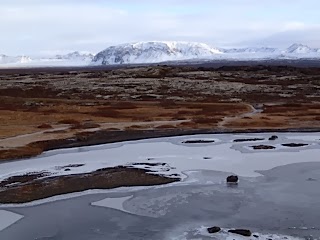
In spite of his flowery Victorian prose style, Morris speaks for me too: My heart does beat faster when I see the great rift valley of Thingvellir beside its deep blue lake.

Here is where the tectonic plates are pulling apart, America getting infinitesimally farther from Europe with each passing year.


And here, on the tenth Thor's Day of summer each year from 930 to 1262, Icelands chieftains and their wives and children and followers gathered for the Althing, the General Assembly of all Iceland.


In the medieval Icelandic sagas--what Morris familiarly calls "those old stories"--the Althing is a grand party. Thousands of people stayed for two weeks in tents and turf-walled booths on the banks of the Axe River, drinking ale, telling tales, taking part in horse fights and wrestling matches, races and dice games, making wedding plans or finalizing divorces, witnessing court cases, and wrangling over the law.


Disputes between Icelanders of any rank could be settled at the Althing, by appeal to Iceland's laws. There was no king to enforce the laws. Instead, there were five law courts: one for each quarter of the country plus an appeals court, each with 36 judges. The judges were chosen by the chieftains, each chieftain being allowed to nominate or to veto a certain number.


Presiding over the courts was Iceland's only elected official, the Lawspeaker. The first Lawspeaker brought the laws of western Norway to Iceland in 930. For nearly two hundred years, until 1118, the Lawspeaker recited from memory one third of the law code at each Althing. After that, the laws were read aloud from a lawbook.


The place where he stood to recite, the Law Rock, is marked now by a flagpole. (Notice that the flag is hanging limp. It's almost never this calm in Iceland.) This height of land, with its backdrop of columnar basalt, formed a natural amphitheatre. The chieftains gathered below the Law Rock and, after the recitation, the laws were debated, adjusted, and agreed upon for, as it says in Njal's Saga, "With laws shall our land be built up, but with lawlessness laid waste."


There were laws concerning stolen horses, rented cows, dogs that bit, or bulls that ran amok in the neighbor's haystacks. There were laws about betrothals and divorces, buying sheep or claiming debts. There were laws concerning the welfare of orphans, widows, the sick, the handicapped, and the poor. There were laws about renting land or investing in a trading ship. There were numerous laws defining murder and homicide, setting the compensation a killer should pay the victim's family if he hoped to avoid being exiled from the island.

Of course, not everyone followed the laws and not every feud was peacefully settled. One of the great themes of the Icelandic sagas is what happens when someone defies the law.


Of Iceland in general, William Morris wrote, “It is an awful place: set aside the hope that the unseen sea gives you here, and the strange threatening change of the blue spiky mountains beyond the firth, and the rest seems emptiness and nothing else: a piece of turf under your feet, and the sky overhead, that's all; whatever solace your life is to have here must come out of yourself or these old stories, not over hopeful themselves."


Iceland is indeed an awful place: a place that fills me with awe. "Whatever solace your life is to have here must come out of yourself or these old stories." Is it different anywhere else?

Join me again next Wednesday at nancymariebrown.blogspot.com for another adventure in Iceland of the medieval world.

Wednesday, September 25, 2013

The Death of Snorri Sturluson


In 2010, on the night of Snorri Sturluson’s murder, September 23, I sat on the stones surrounding his hot tub at Reykholt in western Iceland and dabbled my feet in the warm pool. The weather had turned: A cold mist replaced the sunshine of Thingvellir, where I’d walked, picking blueberries, that afternoon, memorizing the verse on the bronze plaque beside Snorri’s Althing booth, the place he called Valhalla. In English the lines run:

Snorri’s old site is a sheep-pen; the Law Rock is hidden in heather,
blue with the berries that make boys—and the ravens—a feast.

I knew the next two lines of this poem by Jónas Hallgrimsson (in the translation by Dick Ringler):

Oh you children of Iceland, old and young men together!
See how your forefathers’ fame faltered—and died from the earth!

And knew its fears were unsubstantiated: Researching Snorri Sturluson’s life for my book Song of the Vikings, I had concluded that Snorri, who lived from 1178 to 1241, was the single most influential writer of the Middle Ages.

For that we must thank the king of Norway, Hakon IV. Only fourteen when Snorri met him in 1218, King Hakon preferred the fashionably new French legends of King Arthur and the Knights of the Round Table to traditional Viking skaldic poetry and tales of the gods Odin, Loki, and Thor. Snorri must have been shocked. It also hit him in the pocketbook. Poetry was Iceland’s cultural capital, to use a term popularized by sociologists. It was all Snorri had to sell on the international market. Iceland’s other exports were wool and dried fish. The bright-colored alum-dyed cloth from England and Flanders was more highly prized, and Norway had ample fish.

Perhaps, Snorri thought, King Hakon was just ill-educated. He simply needed a good introduction to the lore of the North. Snorri began writing his books to teach the young king to appreciate his own heritage.

His motives were not pure. Snorri was not only a poet and lover of books. He was one of the richest men in Iceland, holder of seven chieftaincies, owner of five profitable estates and a harbor, husband of an heiress, lover of several mistresses, a fat man soon to go gouty, a hard drinker, a seeker of ease prone to soaking long hours in his hot-tub while sipping stout ale, not a Viking warrior by any stretch of the imagination, but clever. Crafty, cunning, and ambitious. A good businessman. So well-versed in the law that few other Icelanders could out-argue him. At age forty-two, he was at the height of his power.

His secret ambition was to rule Iceland—and he almost succeeded. On the quay at Bergen in 1220, departing for home, he tossed off a praise poem about the king’s regent, Earl Skuli, said to be the handsomest man in Norway for his long red-blond locks. In response, the earl gave him the ship he was to sail in and many other fine gifts. Young King Hakon honored Snorri with the title of landed man, or baron, one of only fifteen so-named. The king charged Snorri, too, with a mission: He was to bring Iceland—then an independent republic of some 50,000 souls—under Norwegian rule.

Or so says one version of the story. The other says nothing about a threat to Iceland’s independence. Snorri was not asked to sell out his country, simply to sort out a misunderstanding between some Icelandic farmers and a party of Norwegian traders. A small thing. A few killings to even out. A matter of law.

This trip to Norway was the turning point of Snorri’s life. One quick, persuasive speech to the king, along with one colorful poem pronounced on the quay at Bergen, would mar his reputation—and seal his doom. When he sailed to Norway in 1218 he was, by most calculations, the uncrowned king of Iceland. When he returned in 1220, he was a suspected traitor.

The voyage did not go well. It was late in the year to sail, and the weather in the North Atlantic was fierce. His new ship lost its mast within sight of Iceland; it wrecked on the Westman Islands off the southern coast. Snorri had himself and his bodyguard of a dozen men ferried over to the mainland with their Norwegian treasures. They borrowed horses and rode, bedecked in bright-colored cloth like courtiers, wearing gold and jewels and carrying shiny new weapons and sturdy shields, to the nearby estate of the bishop of Skalholt. There Baron Snorri’s new title was ridiculed. Some Icelanders even accused him of treason, of having sold out to the Norwegian king.

From then until his death in 1241, he would fight one battle after another (in the courts, or by proxy) to see who, if anyone, would be Earl of Iceland, deputy to Norway’s king. He would die in his nightshirt, cringing in his cellar, begging for his life before his enemies’ thugs. He did not live up to his Viking ideals, to the heroes portrayed in his books. He did not die with a laugh—or a poem—on his lips. His last words were “Don’t strike!” As the poet Jorge Luis Borges sums him up in a beautiful poem, the writer who “bequeathed a mythology / Of ice and fire” and “violent glory” to us was a coward: “On / Your head, your sickly face, falls the sword, / As it fell so often in your book.”

Yet his work remains. In the twenty turbulent years between his Norwegian triumph and his ignominious death, while scheming and plotting, blustering and fleeing, Snorri Sturluson did write his books: the Edda, Heimskringla, and Egil’s Saga. He covered hundreds of parchment pages with world-shaping words, encouraging his friends and kinsmen to cover hundreds of pages more.

I had come to Reykholt to keep vigil on the night of his death. The clouds crept up on me as I drove north from Thingvellir, slowly, on the torturous, washboard roads of Uxahryggir and Kaldidalur, alone for hours, no other cars, not even a bird, only the gleaming presence of Skjaldbreidur over my shoulder, the inverted smile of Ok, a chunk of rainbow here and there, a hidden stream, patches of dirty snow, a cairn. Now, at Reykholt, I sought darkness—some place I could see if the northern lights were shining in celebration of Snorri’s life and art.

Snorri’s Reykholt is much the same as it was in 1241, though nothing medieval but his hot-tub remains: Beside an imposing church is a school, hotel, and library. Up a spiral stair is a writer’s studio. But the modern designers were in love with light. Streetlamps and spotlights washed the night sky everywhere but here, at Snorri’s pool, tucked beneath the hill beside the school. I leaned back and looked up—no northern lights; the stars were faint, veiled in cloud. I imagined Snorri’s last moments.

His enemy (and former son-in-law) Gissur of Haukadal had spies watching Reykholt. Late at night on September 23, 1241, he rode up with seventy men. They broke into the building where Snorri slept. He leaped out of bed in his nightshirt and ran next door into the fine Norwegian-style loft-house he had built at the height of his power twenty years before. He was heading, perhaps, for his writing studio and the secret spiral stair that led from it down into a tunnel to his hot-tub and escape…

It is cold in Iceland in late September. The birch leaves are bright gold, the berry shrubs crimson, the songbirds have all flown. Swans flock in the marshlands, sounding their haunting note. Night falls quickly and lingers long, the wind has the bite of ice. An old fat man in his nightshirt, barefoot, would not get far in the cold and dark of a late-September night.

Snorri hid in a cellar. A priest gave him away. Gissur sent five men down.

I dried off my feet and headed back toward the Snorrastofa writer’s studio, which I had booked for five days. On the way I heard people oohing and aahing. They were halfway down the drive, looking up at the northern lights, they said. I saw nothing. “They’re breaking up now,” said a man standing in the road.

Turns out that I, like Snorri that fateful night 772 years ago, had been looking the wrong way.

Join me again next Wednesday at nancymariebrown.blogspot.com for another writing adventure in Iceland or the medieval world.

Wednesday, September 26, 2012

The Essential Iceland


“You cannot take the tunnel today,” proclaimed my friend Þórður.

It was too sunny. A brilliant sunny day in September of last year, and I was off on a roadtrip from Reykjavik to Reykholt, home of the greatest writer of the Middle Ages, the Icelandic chieftain Snorri Sturluson.

The fall colors were bright—as bright in Iceland as they are now, here in Vermont, something that surprised me.


So instead of taking the coast road north (and the time-saving tunnel under Hvalfjordur), I took Þórður's advice and drove inland from Iceland’s capital city to Thingvellir, where the ancient open-air parliament or Althing was held, and followed an old road north from there.


I was in the middle of writing Song of the Vikings, my biography of Snorri Sturluson, and I wanted to see the Iceland he saw. How better than in a jeep, driving the old road north from the Assembly Plains.


Snorri went this way on horseback. He was probably more comfortable on his smooth-gaited Icelandic horse than I was in my rented jeep. The road is washboarded—torturousmore than you can ask a set of shock-absorbers to handle.


The vast brown plain looks smooth from a distance, but it is full of broken ground, boulders, hidden streams, and crevices.


It’s desolate. One bus passed in two hours—a group of medieval studies students from the University of Iceland also taking advantage of this sunny day to tour from Thingvellir to Reykholt.


I pulled over to pee, and, of course, a second car came by, a regular car (not a jeep), and going rather fast, I thought, kicking up dust driving right into the sun. The old woman in the passenger’s seat looked horrified. She had a long, bumpy road to go.


A bit of silvery glacier, like an inverted smile. A raven kronking. A flock of little brown birds with wings of white. Patches of dirty old snow, of lichen burned a brilliant red. Long stretches of nothing but gold-brown rocks.


After three hours of slow driving and many stops for photos, I was very tired (too much of a good thing) and happy to come down into the valley and drive a paved road. There was grass beside the Geita, golden yellow with heavy seedheads, and red-leaved brush on the hillsides.


Along Hvitarsida, the White River snaked through golden birches tall as hedges. I came back a day or two later to picnic and watch the light play over the woodlands.


After a sprinkle of rain, Iceland’s autumn colors can be almost gaudy. As brilliant as the fall foliage in Vermont—though Iceland’s trees are too short to form that golden leafy canopy Vermont provides.


No waterfalls like this one in Vermont, though, with jets bursting out through the porous lava rock.


A rainbow welcomed me home to Reykholt, home of the 13th-century chieftain and writer, Snorri Sturluson. Song of the Vikings: Snorri and the Making of Norse Myths will be published October 30 by Palgrave Macmillan.

Join me again next Wednesday at nancymariebrown.blogspot.com for another writing adventure in Iceland or the medieval world.

Wednesday, July 4, 2012

Iceland's Passion for Liberty


Thingvellir, where Iceland's medieval parliament met.

Where does our concept of liberty come from? Scholars in the 1700s traced it to medieval Iceland.

Iceland was an anomaly in the Middle Ages. It bowed to no king.

The first settlers, coming to this cold and windy island outpost in the late 800s, had disliked the very idea of a king. Many had fled Norway, having lost their lands in the bloody civil war by which Harald Fair-Hair unified the country, becoming the first king of all Norway in about 885. As king, Harald claimed every farm and forest for himself, reapportioning the land to those who would pay taxes. He gave the Norwegians three choices: swear oaths of loyalty, leave, or face the consequences, which included torture, maiming, and death. Some who left went first to the British Isles, only to be pestered by kings and their oaths and their taxes there too. They sailed to Iceland to be free of such nonsense.

Iceland was settled by Vikings in the 800s.

But after fifty years of anarchy the Icelanders deemed some form of government to be, in fact, necessary, and in 930 a cabal of wealthy men worked out a way to share power. They divided the island into four quarters: North, South, East, and West. In each quarter, three spring assemblies were to be held (four in the larger North Quarter) to discuss local matters and to solve disputes. Each spring assembly would be governed by three chieftains, for a total of thirty-nine. To these posts, they appointed themselves.

The thirty-nine chieftains of Iceland were, in theory, equals, but some grew more powerful than others, for this new system of government was organized, not geographically, but by alliances. Uninhabited when it was discovered in 870, Iceland was home to at least 10,000 people by 930. (By 1262, when Iceland lost its independence, there would be 50,000.) There were no towns on the island, and would not be until the eighteenth century. Instead, Icelanders lived on scattered farms around the periphery of the island, which has at its center a vast, uninhabitable wasteland of volcanoes and glaciers. Some farms were immense, supporting up to a hundred people; others were as small as one nuclear family. Every farmer who owned at least one cow or boat or fishing net for each one of his dependents had to ally himself with a chieftain, paying him taxes, and, if requested, accompanying him to assemblies or fighting in his battles. The farmer could choose which of the thirty-nine chieftains he wanted to support, and he could change his allegiance once a year. But generally only the richer farmers dared annoy the local chieftain by choosing a more distant one.

Usually it paid to support a chieftain who lived close by. He was nearer to hand if the farmer was robbed, or his hay-store ran out in a harsh winter, and travel wasn’t so onerous when the farmer was invited to a Yule feast or summoned for a raid. Yet two chieftains often lived within a day’s ride of each other. In that case, it paid to choose the one who was less easily bullied, for the support of a chieftain was the only protection a family had from a rival clan. Only a chieftain could bring a lawsuit to one of the assemblies, and only a chieftain could answer it.

Thingvellir on a summer day.

In addition to the spring assemblies held in each quarter of the country, once a year, on the tenth Thor’s Day of summer, in the great rift valley of Thingvellir beside its deep blue lake, Iceland’s thirty-nine chieftains and their wives and children and followers gathered for the Althing, the General Assembly of all Iceland. The Althing was a grand party. Thousands of people stayed for two weeks in tents and turf-walled booths on the banks of the Axe River, drinking ale, telling tales, taking part in horse fights and wrestling matches, races and dice games, making wedding plans or finalizing divorces, witnessing court cases, and wrangling over the law.

Disputes between Icelanders of any rank could be settled at the Althing, by appeal to Iceland’s laws. There were five law courts: one for each quarter plus an appeals court, each with thirty-six judges. The judges were chosen by the chieftains, each chieftain being allowed to nominate or to veto a certain number. Presiding was Iceland’s only elected official, the Lawspeaker; he recited one third of the law code at each Althing. The place where he stood, called the Law Rock, was a height of land that formed a natural amphitheatre. The chieftains gathered around the Law Rock and, after the recitation, the laws were debated, adjusted, and agreed upon for, as the sagas say, “With laws shall our land be built up, but with lawlessness laid waste.”

Iceland’s medieval parliament was brought to the attention of the English-speaking world in the mid-1700s by Thomas Percy, bishop of Dromore and friend of Samuel Johnson and James Boswell. Percy translated a long work on the history and lore of the Norse written by Paul-Henri Mallet, the Swiss tutor to the Crown Prince of Denmark and later professor in Copenhagen. Mallet drew heavily from Snorri Sturluson’s Edda and the Poetic Edda, and from Snorri’s history of the Norwegian kings, Heimskringla. He amplified Snorri’s works with other Icelandic sagas and sources such as Tacitus, Saxo Grammaticus, the Anglo-Saxon Chronicle, Adam of Bremen, and Saxon law codes. He writes, “It will appear pretty extraordinary to hear a historian of Denmark cite, for his authorities, the writers of Iceland, a country cut off, as it were, from the rest of the world, and lying almost under the northern pole.” But Iceland’s medieval skalds, he declares, were “famous throughout the north for their songs.”

The white flagpole marks the Law Rock.

In Percy’s translation of Mallet, called Northern Antiquities, English readers found a world not only savage and sublime, but imbued with a passion for liberty. The religion of the Vikings was as “simple and martial as themselves,” Percy wrote. Their form of government was “dictated by good sense and liberty,” while their “restless unconquered spirit,” was “apt to take fire at the very mention of subjection and constraint.”

Or as Joseph Sterling wrote, prefacing his 1782 Icelandic Odes: “To them we are indebted for laying the foundation of that liberty which we now enjoy.”

This essay is excerpted from my book-in-progress, Song of the Vikings: Snorri and the Making of Norse Myths, due out from Palgrave Macmillan in October 2012. If you'd like me to visit your area on my book tour, please let me know.

Join me again next Wednesday at nancymariebrown.blogspot.com for another adventure in Iceland or the medieval world.