Showing posts with label Thingvellir. Show all posts

Tuesday, June 16, 2015

Iceland's Independence Day

Today, June 17, Icelanders celebrate their independence day, on the birthday of Jon Sigurdsson, the leader of the nineteenth-century Icelandic independence movement. Jon was a saga scholar, before he became a politician. He worked briefly at the library in Copenhagen established by the great collector of medieval Icelandic manuscripts, Arni Magnusson.

So it's fitting that, on this day of Icelandic independence, we remember the role of the sagas in setting Icelanders free.

Reading the Icelandic sagas, you learn of Iceland's early days as a free state, from its founding in 874.

Reading the sagas, you learn how Iceland lost its independence in 1262 and became subject to Norway, which itself was later taken over by Denmark.

And reading the sagas--simply the act of reading and rereading them--is what united the nineteenth-century Icelanders, as I learned while researching Song of the Vikings, my biography of the saga master Snorri Sturluson.

Here's how I explained the connection between Icelandic sagas and Icelandic independence in Song of the Vikings:

In 1835 four Icelandic students founded a political magazine in Copenhagen. They printed their manifesto in the form of a poem, which "was exactly what was needed in order to unite the Icelandic people," says Karlsson in The History of Iceland (published in 2000 by the University of Minnesota Press).

The only one of their ancestors it evokes is Snorri:

"... Ah! but up on the lava where the Axe River plummets forever
into the Almanna Gorge, Althing is vanished and gone.
Snorri's old site is a sheep-pen; the Law Rock is hidden in heather,
blue with the berries that make boys--and the ravens--a feast.
Oh you children of Iceland, old and young men together!
See how your forefathers' fame faltered--and died from the earth!"

Four lines of this poem by Jonas Hallgrimsson (translated here by Dick Ringler) are engraved on a plaque now standing on the site of Snorri's booth in Thingvellir, the great rift valley in the south of Iceland where the Althing, the yearly parliament of chieftains, met during the Saga Age.


The Althing reconvened as a national parliament, with Danish permission, in 1845. In 1874 Iceland received a new constitution and, in 1904, home rule. One of its first demands was that Denmark return the manuscripts of the sagas that had been collected--mostly by the scholar Arni Magnusson--and brought to the royal library and that of the University of Copenhagen in the early 1700s. The Danes declined.

In 1918 Iceland became a sovereign state in a "personal union" with the Danish king--much like the situation in 1262, when the chieftains swore oaths of loyalty to King Hakon the Old. For its coat-of-arms the new nation turned once again to Snorri.

King Harald, Snorri wrote in Heimskringla, was angry at the Icelanders, who had composed lampoons about him. He ordered a "troll-wise man" to spy out the country's defenses. Disguised as a whale, the wizard swam close to Iceland’s eastern shore: "Then came a great dragon down from the dale" and "blew poison at him." He swam along the north coast, "but there came against him a bird so big that its wings neared the fells on both sides of it." The wizard-whale fled to the west: "Toward him came a great ox that waded out in the sea and began to bellow horribly." Swinging wide, he swam south, "but against him there came a great hill giant who had an iron staff in his hand and bore his head higher than the fells." King Harald was dissuaded from attacking. Iceland's coat-of-arms bears a dragon, an eagle, an ox, and a giant.


The Icelanders repeated their demands to "bring the manuscripts home." The Althing passed resolutions in 1930 and 1938, then their literary quest was interupted by World War II. In April 1940 Denmark was invaded by Germany; a month later Iceland was occupied by the British, one result being Iceland’s final break with Denmark. The independent Republic of Iceland was established at Thingvellir in 1944; in 1947 the Althing resolved, once again, to "bring the manuscripts home."

This time, Denmark formed a committee. In 1961 a list of manuscripts was drawn up, and Iceland agreed to give Denmark twenty-five years to deliver them. Ten years later—after being photographed and conserved—the first set steamed into Reykjavik harbor aboard a Danish coastguard cutter. Thousands of Icelanders stood by the docks. Thousands more watched via the first live outdoor broadcast of the state television station. Eventually 1,666 manuscripts and over 7,000 charters (1,350 of them originals, the rest copies) were returned from Arni Magnusson’s collection—slightly over half of it. Another 141 manuscripts were sent home from the Royal Library. The last arrived in Iceland in 1997.

"People still say: 'We want to see the manuscripts,'" wrote Gisli Sigurdsson and Vesteinn Olason in The Manuscripts of Iceland in 2004. The manuscripts "are at one and the same time the repository of medieval Icelandic culture and its visible symbol." They are Iceland's "main source of pride."

If you are in Iceland, a fitting way to celebrate June 17 would be to visit the Settlement Sagas exhibition of the Reykjavik City Museum.


Wednesday, December 17, 2014

Touring with the Sagas

When some people go to Iceland for the first time, they want to see it all. In seven days they drive the entire Ring Road, bagging all the sights.

I'm a little different. I've been to Iceland 19 times, twice staying over three months, and I have yet to see huge swaths of the country. I've never been to the East Fjords. I've only glimpsed much of the north.

Instead, I've gone deep. I've gotten to know one corner of Iceland very well: the area between Borgarnes and the island of Flatey in Breiðafjorður, out to the tip of Snæfellsnes with its evocative glacier, and in to Surtshellir cave at the edge of the highlands. It's an area with a wonderful variety of landscapes--farms, fishing villages, lava fields, glaciers, beaches, waterfalls.


I like to stay on one farm for a week, traveling only as far as I can reach on foot or horseback or the occasional half day's drive. On various trips I've found a path through the lava that had long been lost, crouched behind a rock while a sea eagle strafed me, rode a horse across a swift salmon river (careful not to let the eddies dizzy me), collected crowberries, watched fox pups play, rescued trapped sheep, frightened myself in a pitch-dark cave, drank sweet water from the well in another, soaked in a wilderness hot pool, sunned on the flank of a volcano.

I'm not a naturalist: What drew me to this part of Iceland were the sagas, with their tales of sheep-farmers and sorcerors, horse fights and feuds, love and grief and hard times and strife. Tales of a satisfying life scratched from an unforgiving land. Tales tempered with poetry and grace.


I've sat where the wily chieftain of Helgafell, Snorri goði, sat, ten centuries before, pondering his next move. On horseback, I've ridden the route he followed to collect his father-in-law's corpse--and the one his namesake, Snorri Sturluson took to confer with his nephew a few nights before he died.

The first time I visited Iceland, in 1986, I went in search of Snorri goði, a character in two of my favorite sagas, Eyrbyggja Saga and Laxdæla Saga. I was then a graduate student studying medieval literature and simultaneously working for a science magazine; I wanted to write a historical novel about Snorri. That book was never published, but ten years later much of my research--done on horseback, as well as in libraries--found its way into my first published book, A Good Horse Has No Color: Searching Iceland for the Perfect Horse (Stackpole Books, 2001).


My second book about Iceland brought me back to Snæfellsnes. The Far Traveler: Voyages of a Viking Woman (Harcourt, 2007) uses medieval literature and modern archaeology to tell the story of Guðríður Þorbjarnardóttir and the Norse expeditions to North America. Guðriður grew up on the tip of Snæfellsnes, in the shadow of the glacier some people call the third most holy spot on earth. (Seeing it rise out of the sea is certainly one of my favorite views of Iceland). I've since retold Guðríður's story as a young adult novel, The Saga of Gudrid the Far-Traveler, which will be published by Namelos in the spring of 2015.


My most recent book, Song of the Vikings: Snorri and the Making of Norse Myths (Palgrave Macmillan, 2012) required me to get to know Borgarfjörður even better. This book is a biography of another Snorri--Snorri Sturluson, who lived at Borg and then at Reykholt, and by the end of his life in 1241 ruled most of the West Quarter of Iceland. At Borg he probably wrote Egils Saga, while at Reykholt he wrote the Edda, which contains almost everything we know about Norse mythology, as well as Heimskringla, his long collection of sagas about the kings of Norway from the ancient days of Oðin the Wizard-King through King Magnus Erlingsson in 1177.


The best way to research my books, I've found, is to walk through the landscape where history happened, to live where my subjects lived and face some of the same challenges. To cross rivers on horseback, for example, or climb a volcanic crater. To experience the midnight sun in summer, when the birdsong never stills, as well as the dark days of winter (though I must admit, I've let a very few of them stand in for the rest). 

In 2012 I was approached by the trekking company America2Iceland, which had just moved its base of operations to the farm of Staðarhús in Borgarfjörður. They wondered if I'd be willing to join their tours and share my love of Iceland's history and sagas. Together, we began developing a tour called "Song of the Vikings," after my book. The first year it was a riding trek circling through Snorri's domain. The next year we combined riding lessons for beginners with more sightseeing by bus, visiting saga sites and museums, and allowing more time to learn about Iceland's history and culture.


Next summer, by request, the tour will have no mandatory horseback riding (though, since we will be based at a horse farm with a resident riding teacher, optional lessons and trail riding can be added). From July 27 to August 2, we'll follow in Snorri Sturluson's footsteps, taking the chieftain's trail from Thingvellir, where he took part in the yearly assembly, to Reykholt, his main estate--now a research institute with an exhibition about his life.


We'll see the highest-volume hot spring in the world, discussing the value of hot springs in medieval Iceland--and how a fight over this one may have caused the sagas to be written. We'll meet the Icelandic horse and learn why the horse, not the dog, is "man's best friend" in Iceland. We'll visit the Settlement Center in Borgarnes and compare new theories about Iceland's settlement. We'll see the Egil's Saga exhibition there as well, and discuss how that saga reflects Snorri Sturluson's own life. We'll drive into the highlands to see the cave Surtshellir, named for the Fire Giant who will destroy the world at Ragnarök, and discuss the connections between Icelandic nature and Norse mythology. And we'll see how those myths are still vital in modern popular culture, by sharing some of the literature and art Snorri Sturluson inspired, from Wagner to Tolkien to Neil Gaiman.


This tour is limited to 12 people, so each will get my personal attention. For more information, or to sign up, see America2Iceland.com or contact Rebecca at America2Iceland by email at info@america2iceland.com or phone at 1-828-348-4257. I think this is the perfect tour for first-time visitors to Iceland. Even if you've been to Iceland before, you'll see it in a completely new light.


(A version of this essay was published in the December 15 edition of the Icelandic-Canadian newspaper, Lögberg-Heimskringla.)

Wednesday, November 13, 2013

A Visit to Thingvellir

On a sunny day in Iceland, when I'm traveling east out of Rekjavik, it's almost impossible not to detour to Thingvellir, as I did last week.

Approaching these Assembly Plains in 1871, William Morris wrote, "My heart beats, so please you, as we near the brow of the pass, and all the infinite wonder, which came upon me when I came up on the deck of the [ship] to see Iceland for the first time, comes on me again now, for this is the heart of Iceland…"

In spite of his flowery Victorian prose style, Morris speaks for me too: My heart does beat faster when I see the great rift valley of Thingvellir beside its deep blue lake.

Here is where the tectonic plates are pulling apart, America getting infinitesimally farther from Europe with each passing year.


And here, on the tenth Thor's Day of summer each year from 930 to 1262, Icelands chieftains and their wives and children and followers gathered for the Althing, the General Assembly of all Iceland.


In the medieval Icelandic sagas--what Morris familiarly calls "those old stories"--the Althing is a grand party. Thousands of people stayed for two weeks in tents and turf-walled booths on the banks of the Axe River, drinking ale, telling tales, taking part in horse fights and wrestling matches, races and dice games, making wedding plans or finalizing divorces, witnessing court cases, and wrangling over the law.


Disputes between Icelanders of any rank could be settled at the Althing, by appeal to Iceland's laws. There was no king to enforce the laws. Instead, there were five law courts: one for each quarter of the country plus an appeals court, each with 36 judges. The judges were chosen by the chieftains, each chieftain being allowed to nominate or to veto a certain number.


Presiding over the courts was Iceland's only elected official, the Lawspeaker. The first Lawspeaker brought the laws of western Norway to Iceland in 930. For nearly two hundred years, until 1118, the Lawspeaker recited from memory one third of the law code at each Althing. After that, the laws were read aloud from a lawbook.


The place where he stood to recite, the Law Rock, is marked now by a flagpole. (Notice that the flag is hanging limp. It's almost never this calm in Iceland.) This height of land, with its backdrop of columnar basalt, formed a natural amphitheatre. The chieftains gathered below the Law Rock and, after the recitation, the laws were debated, adjusted, and agreed upon for, as it says in Njal's Saga, "With laws shall our land be built up, but with lawlessness laid waste."


There were laws concerning stolen horses, rented cows, dogs that bit, or bulls that ran amok in the neighbor's haystacks. There were laws about betrothals and divorces, buying sheep or claiming debts. There were laws concerning the welfare of orphans, widows, the sick, the handicapped, and the poor. There were laws about renting land or investing in a trading ship. There were numerous laws defining murder and homicide, setting the compensation a killer should pay the victim's family if he hoped to avoid being exiled from the island.

Of course, not everyone followed the laws and not every feud was peacefully settled. One of the great themes of the Icelandic sagas is what happens when someone defies the law.


Of Iceland in general, William Morris wrote, “It is an awful place: set aside the hope that the unseen sea gives you here, and the strange threatening change of the blue spiky mountains beyond the firth, and the rest seems emptiness and nothing else: a piece of turf under your feet, and the sky overhead, that's all; whatever solace your life is to have here must come out of yourself or these old stories, not over hopeful themselves."


Iceland is indeed an awful place: a place that fills me with awe. "Whatever solace your life is to have here must come out of yourself or these old stories." Is it different anywhere else?

Join me again next Wednesday at nancymariebrown.blogspot.com for another adventure in Iceland of the medieval world.

Wednesday, September 25, 2013

The Death of Snorri Sturluson


In 2010, on the night of Snorri Sturluson’s murder, September 23, I sat on the stones surrounding his hot tub at Reykholt in western Iceland and dabbled my feet in the warm pool. The weather had turned: A cold mist replaced the sunshine of Thingvellir, where I’d walked, picking blueberries, that afternoon, memorizing the verse on the bronze plaque beside Snorri’s Althing booth, the place he called Valhalla. In English the lines run:

Snorri’s old site is a sheep-pen; the Law Rock is hidden in heather,
blue with the berries that make boys—and the ravens—a feast.

I knew the next two lines of this poem by Jónas Hallgrimsson (in the translation by Dick Ringler):

Oh you children of Iceland, old and young men together!
See how your forefathers’ fame faltered—and died from the earth!

And knew its fears were unsubstantiated: Researching Snorri Sturluson’s life for my book Song of the Vikings, I had concluded that Snorri, who lived from 1178 to 1241, was the single most influential writer of the Middle Ages.

For that we must thank the king of Norway, Hakon IV. Only fourteen when Snorri met him in 1218, King Hakon preferred the fashionably new French legends of King Arthur and the Knights of the Round Table to traditional Viking skaldic poetry and tales of the gods Odin, Loki, and Thor. Snorri must have been shocked. It also hit him in the pocketbook. Poetry was Iceland’s cultural capital, to use a term popularized by sociologists. It was all Snorri had to sell on the international market. Iceland’s other exports were wool and dried fish. The bright-colored alum-dyed cloth from England and Flanders was more highly prized, and Norway had ample fish.

Perhaps, Snorri thought, King Hakon was just ill-educated. He simply needed a good introduction to the lore of the North. Snorri began writing his books to teach the young king to appreciate his own heritage.

His motives were not pure. Snorri was not only a poet and lover of books. He was one of the richest men in Iceland, holder of seven chieftaincies, owner of five profitable estates and a harbor, husband of an heiress, lover of several mistresses, a fat man soon to go gouty, a hard drinker, a seeker of ease prone to soaking long hours in his hot-tub while sipping stout ale, not a Viking warrior by any stretch of the imagination, but clever. Crafty, cunning, and ambitious. A good businessman. So well-versed in the law that few other Icelanders could out-argue him. At age forty-two, he was at the height of his power.

His secret ambition was to rule Iceland—and he almost succeeded. On the quay at Bergen in 1220, departing for home, he tossed off a praise poem about the king’s regent, Earl Skuli, said to be the handsomest man in Norway for his long red-blond locks. In response, the earl gave him the ship he was to sail in and many other fine gifts. Young King Hakon honored Snorri with the title of landed man, or baron, one of only fifteen so-named. The king charged Snorri, too, with a mission: He was to bring Iceland—then an independent republic of some 50,000 souls—under Norwegian rule.

Or so says one version of the story. The other says nothing about a threat to Iceland’s independence. Snorri was not asked to sell out his country, simply to sort out a misunderstanding between some Icelandic farmers and a party of Norwegian traders. A small thing. A few killings to even out. A matter of law.

This trip to Norway was the turning point of Snorri’s life. One quick, persuasive speech to the king, along with one colorful poem pronounced on the quay at Bergen, would mar his reputation—and seal his doom. When he sailed to Norway in 1218 he was, by most calculations, the uncrowned king of Iceland. When he returned in 1220, he was a suspected traitor.

The voyage did not go well. It was late in the year to sail, and the weather in the North Atlantic was fierce. His new ship lost its mast within sight of Iceland; it wrecked on the Westman Islands off the southern coast. Snorri had himself and his bodyguard of a dozen men ferried over to the mainland with their Norwegian treasures. They borrowed horses and rode, bedecked in bright-colored cloth like courtiers, wearing gold and jewels and carrying shiny new weapons and sturdy shields, to the nearby estate of the bishop of Skalholt. There Baron Snorri’s new title was ridiculed. Some Icelanders even accused him of treason, of having sold out to the Norwegian king.

From then until his death in 1241, he would fight one battle after another (in the courts, or by proxy) to see who, if anyone, would be Earl of Iceland, deputy to Norway’s king. He would die in his nightshirt, cringing in his cellar, begging for his life before his enemies’ thugs. He did not live up to his Viking ideals, to the heroes portrayed in his books. He did not die with a laugh—or a poem—on his lips. His last words were “Don’t strike!” As the poet Jorge Luis Borges sums him up in a beautiful poem, the writer who “bequeathed a mythology / Of ice and fire” and “violent glory” to us was a coward: “On / Your head, your sickly face, falls the sword, / As it fell so often in your book.”

Yet his work remains. In the twenty turbulent years between his Norwegian triumph and his ignominious death, while scheming and plotting, blustering and fleeing, Snorri Sturluson did write his books: the Edda, Heimskringla, and Egil’s Saga. He covered hundreds of parchment pages with world-shaping words, encouraging his friends and kinsmen to cover hundreds of pages more.

I had come to Reykholt to keep vigil on the night of his death. The clouds crept up on me as I drove north from Thingvellir, slowly, on the torturous, washboard roads of Uxahryggir and Kaldidalur, alone for hours, no other cars, not even a bird, only the gleaming presence of Skjaldbreidur over my shoulder, the inverted smile of Ok, a chunk of rainbow here and there, a hidden stream, patches of dirty snow, a cairn. Now, at Reykholt, I sought darkness—some place I could see if the northern lights were shining in celebration of Snorri’s life and art.

Snorri’s Reykholt is much the same as it was in 1241, though nothing medieval but his hot-tub remains: Beside an imposing church is a school, hotel, and library. Up a spiral stair is a writer’s studio. But the modern designers were in love with light. Streetlamps and spotlights washed the night sky everywhere but here, at Snorri’s pool, tucked beneath the hill beside the school. I leaned back and looked up—no northern lights; the stars were faint, veiled in cloud. I imagined Snorri’s last moments.

His enemy (and former son-in-law) Gissur of Haukadal had spies watching Reykholt. Late at night on September 23, 1241, he rode up with seventy men. They broke into the building where Snorri slept. He leaped out of bed in his nightshirt and ran next door into the fine Norwegian-style loft-house he had built at the height of his power twenty years before. He was heading, perhaps, for his writing studio and the secret spiral stair that led from it down into a tunnel to his hot-tub and escape…

It is cold in Iceland in late September. The birch leaves are bright gold, the berry shrubs crimson, the songbirds have all flown. Swans flock in the marshlands, sounding their haunting note. Night falls quickly and lingers long, the wind has the bite of ice. An old fat man in his nightshirt, barefoot, would not get far in the cold and dark of a late-September night.

Snorri hid in a cellar. A priest gave him away. Gissur sent five men down.

I dried off my feet and headed back toward the Snorrastofa writer’s studio, which I had booked for five days. On the way I heard people oohing and aahing. They were halfway down the drive, looking up at the northern lights, they said. I saw nothing. “They’re breaking up now,” said a man standing in the road.

Turns out that I, like Snorri that fateful night 772 years ago, had been looking the wrong way.

Join me again next Wednesday at nancymariebrown.blogspot.com for another writing adventure in Iceland or the medieval world.


Wednesday, September 26, 2012

The Essential Iceland


“You cannot take the tunnel today,” proclaimed my friend Þórður.

It was too sunny. A brilliant sunny day in September of last year, and I was off on a roadtrip from Reykjavik to Reykholt, home of the greatest writer of the Middle Ages, the Icelandic chieftain Snorri Sturluson.

The fall colors were bright—as bright in Iceland as they are now, here in Vermont, something that surprised me.


So instead of taking the coast road north (and the time-saving tunnel under Hvalfjordur), I took Þórður's advice and drove inland from Iceland’s capital city to Thingvellir, where the ancient open-air parliament or Althing was held, and followed an old road north from there.


I was in the middle of writing Song of the Vikings, my biography of Snorri Sturluson, and I wanted to see the Iceland he saw. How better than in a jeep, driving the old road north from the Assembly Plains.


Snorri went this way on horseback. He was probably more comfortable on his smooth-gaited Icelandic horse than I was in my rented jeep. The road is washboarded—torturousmore than you can ask a set of shock-absorbers to handle.


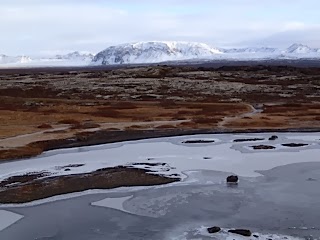
The vast brown plain looks smooth from a distance, but it is full of broken ground, boulders, hidden streams, and crevices.


It’s desolate. One bus passed in two hours—a group of medieval studies students from the University of Iceland also taking advantage of this sunny day to tour from Thingvellir to Reykholt.


I pulled over to pee, and, of course, a second car came by, a regular car (not a jeep), and going rather fast, I thought, kicking up dust driving right into the sun. The old woman in the passenger’s seat looked horrified. She had a long, bumpy road to go.


A bit of silvery glacier, like an inverted smile. A raven kronking. A flock of little brown birds with wings of white. Patches of dirty old snow, of lichen burned a brilliant red. Long stretches of nothing but gold-brown rocks.


After three hours of slow driving and many stops for photos, I was very tired (too much of a good thing) and happy to come down into the valley and drive a paved road. There was grass beside the Geita, golden yellow with heavy seedheads, and red-leaved brush on the hillsides.


Along Hvitarsida, the White River snaked through golden birches tall as hedges. I came back a day or two later to picnic and watch the light play over the woodlands.


After a sprinkle of rain, Iceland’s autumn colors can be almost gaudy. As brilliant as the fall foliage in Vermont—though Iceland’s trees are too short to form that golden leafy canopy Vermont provides.


No waterfalls like this one in Vermont, though, with jets bursting out through the porous lava rock.


A rainbow welcomed me home to Reykholt, home of the 13th-century chieftain and writer, Snorri Sturluson. Song of the Vikings: Snorri and the Making of Norse Myths will be published October 30 by Palgrave Macmillan.

Join me again next Wednesday at nancymariebrown.blogspot.com for another writing adventure in Iceland or the medieval world.