Each year I lead a week-long tour to West Iceland called "Sagas & Vikings." So I took it personally when an article on Iceland Monitor, the English language website of Iceland's newspaper Morgunblaðið, called it "exaggerated or distorted" to speak about Vikings in Iceland.
I disagree. Iceland, to me, is the best place in the world to learn about Vikings. I've been going there for the past 30 years for that very purpose.
What does "Viking" mean? "Raider" or "plunderer" are medieval synonyms for Viking; some translators use the term "pirate," which tends to make my head spin. (Think Captain Hook, eye-patch, aargh.)
But I use "Viking," like many other modern scholars, to describe any Norse-speaker during the Viking Age, which is traditionally dated from 783 to 1066.
And raiding was not the sole defining characteristic of the age: Exploration was just as significant.
I feel quite justified, for instance, in calling my book about the Norse explorations of North America The Far Traveler: Voyages of a Viking Woman. In fact, one of my goals in that book was to redefine the word "Viking" to include the role of women.
Few people have trouble imagining Leif Eiriksson, who discovered America in around the year 1000, as a Viking. Every representation of him that I have ever seen includes a spear or large axe--like this one in front of Hallgrimskirkja in Reykjavik. But why does Leif get all the credit? After his first sight of the New World, he never went back Gudrid, Leif's sister-in-law, was the real explorer. She tried to settle there twice, with two different husbands. If you want to learn about Viking explorers, put Gudrid the Far-Traveler at the top of your list.
Gudrid's voyages appear in two of the medieval Icelandic sagas, written a hundred or more years after her death. The article in Iceland Monitor suggests the importance of the Icelandic sagas is "exaggerated or distorted" too, and again, I disagree. As I point out in Ivory Vikings, more medieval literature exists in Icelandic than in any other European language except Latin.
If you want to learn about Vikings and the Viking Age, medieval Icelandic literature is your best--and often your only--source. Without the works of Snorri Sturluson alone, as I wrote in Song of the Vikings, we would know next to nothing about Viking Age culture.
Because of Snorri’s Edda, tiny Iceland has had an enormous impact on our modern world. All the stories we know of the Vikings’ pagan religion, the Norse myths of Valhalla and the valkyries, of one-eyed Odin and the well of wisdom, of red-bearded Thor and his hammer of might, of two-faced Loki and the death of beautiful Baldur, of lovesick Freyr and lovely Freyja, the rainbow bridge, the great ash tree Yggdrasil, the world-wrapping Midgard Serpent, Heimdall’s horn, the eight-legged horse Sleipnir, Ragnarok or the Twilight of the Gods…
All the stories we know of the gods whom we still honor with the names Tuesday, Wednesday, Thursday, and Friday—for all of these stories Snorri is our main, and sometimes our only, source.
Snorri wrote his Edda originally to teach the young King Hakon (here on the left) the ins and outs of Viking poetry. For the Vikings were not only fierce warriors, they were very subtle artists. Because of the work of Snorri and his followers, we know the names of over 200 Viking skálds. We can read hundreds of their verses: In the standard edition, they fill 1,000 two-column pages. What skalds thought important enough to put into words provides most of what we know today about the inner lives of people in the Viking Age.
We also know the history of Scandinavia in the Viking Age almost entirely through Snorri. His second book, Heimskringla, is a set of sixteen sagas about Norse kings and earls, both pagan and Christian, from the ancient days of Odin the Wizard-King through King Magnus, who was deposed in 1177, the year before Snorri’s birth. Through his vivid portraits of kings and sea-kings, raiders and traders in these sagas, Snorri created the Viking image so prevalent today.
In his third book, Egil’s Saga, Snorri expanded the archetype, creating the two competing heroic types who would give Norse culture its lasting appeal. The perfect Viking is tall, blond, and blue-eyed, a stellar athlete, a courageous fighter, an independent, honorable man who laughs in the face of danger, dying with a poem or quip on his lips. He is like Egil’s brother and uncle in this saga. Or he is like Egil, his father, and his grandfather: dark and ugly, a werewolf, a wizard, a poet, a crafty schemer who knows every promise is contingent—in fact, somewhat like Snorri himself, as he is portrayed in a saga written by his nephew.
On my "Sagas & Vikings" tour, we visit many of the places Snorri lived and wrote about, as well as the site of Gudrid's birth. We discuss the two competing stories of Iceland's settlement by Vikings--explorers and raiders both--and learn how they negotiated a society with no king. We see saga manuscripts and archaeological sites and talk about what that word "Viking" really means in the landscape that inspired our best--and often only--descriptions of Viking life. I hope you'll join me.
For more information on this year's "Sagas & Vikings" tour, see Hestaland.net. The tour is limited to 12 people. Horseback riding is optional.
Wanderer, storyteller, wise, half-blind, with a wonderful horse.
By Nancy Marie Brown
Showing posts with label Edda. Show all posts
Wednesday, February 8, 2017
Wednesday, November 30, 2016
That Stern High World
"Icelandic studies may be more than a mere cultural discipline; they may contribute to the positive exaltation of those who pass through them into that stern high world where our forefathers lived and died with fearless eyes and undefeated hearts." – Watson Kirkconnell, OC FRSC (1895–1977)
When the Icelandic-Canadian newspaper Lögberg-Heimskringla sent that snippet of wisdom out over its Facebook page last November, it struck a chord--though one with a bit of dissonance.
I do rather like the idea that my many years of studying Icelandic sagas have resulted in my "positive exaltation," and I think I know what Kirkconnell means by "that stern high world."
It's rather like what J.R.R. Tolkien and C.S. Lewis characterized by the term "Northernness." As I wrote in Song of the Vikings, these writers of high fantasy were not only drawn to the Norse mythology's dragons and dwarves, fair elves and werewolves, wandering wizards, and trolls that turned into stone, but to their portrayal of men with a bitter courage who stood fast on the side of Right and Good even when there was no hope at all.
According to Tolkien, this theory of courage was "the great contribution of early Northern literature." It is a "creed of unyielding will," the heroes refusing to give up even when they know the monsters will win.
For that is the big difference between the Norse Ragnarok and the Christian Doomsday. Odin and the human army of Valhalla do not win. They have no hope of winning. They are doomed and they know it.
There's a "shadow of despair" about these heroes, Tolkien noted, an "intense emotion of regret" as in his own fantasy world. For even if Middle-earth is saved from the evil forces of Sauron, the elves must leave; magic will dwindle. Still men and elves, dwarves, wizards, and hobbits fight and die for the Good and the Right.
But there's a big gap--a Ginnungagap--between Kirkconnell's "fearless eyes and undefeated hearts" and Tolkien's despair and regret.
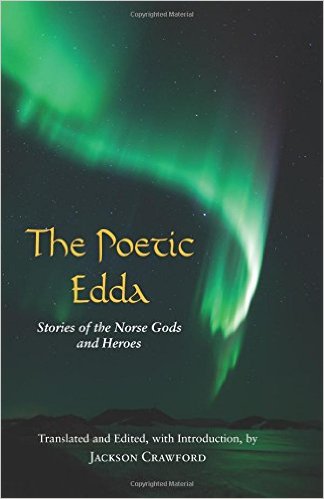
In the introduction to his new translation of the poems of the Poetic Edda (Hackett Publishing, 2015), Jackson Crawford attempts to bridge that gap, pointing out that many of these heroic and mythological poems allude to "the belief that each person has an inevitable, fixed date of death, decided by the shadowy goddesses of fate called the Norns."
Sigurd is not afraid of fighting the dragon Fafnir because nothing he can do (or not do) will change the date of his death. If he kills the dragon, it was fated to be so. If the dragon kills him, ditto. All he can do is "manage his own wealth / till his fated death-day"--with all the good things in life wrapped up in that one word "wealth."
Likewise Sorli can shrug off losing the battle by saying, "But we fought well, /... We earned honor here, / though we are fated to die today-- / a man will not live one day longer / than the Norns have decided."
Writes Crawford, "The characters in these myths are marching toward their doom, unable to change course or to step off their predetermined path even if they fight it the entire way." But are they hopeless? despairing? We, the readers of these myths, may despair for them, but "the gods and heroes alike are actively engaged in courageously combating the inevitable," Crawford writes. "This code of boldness and the defiance of fate must have stirred something in the Norse audience in their barren farmsteads ... just as it may stir a modern audience faced with the seemingly hopeless circumstances of life in the crowded, postindustrial world of today."
We may no longer believe in the Norns, but it's still true that each one of us is fated to die. It does no good to live in fear of it. Why not instead spend our days earning honor? Our methods may be a little different than Sorli's or Sigurd's or Frodo's, but it's still a stern high world out there.
When the Icelandic-Canadian newspaper Lögberg-Heimskringla sent that snippet of wisdom out over its Facebook page last November, it struck a chord--though one with a bit of dissonance.
I do rather like the idea that my many years of studying Icelandic sagas have resulted in my "positive exaltation," and I think I know what Kirkconnell means by "that stern high world."
It's rather like what J.R.R. Tolkien and C.S. Lewis characterized by the term "Northernness." As I wrote in Song of the Vikings, these writers of high fantasy were not only drawn to the Norse mythology's dragons and dwarves, fair elves and werewolves, wandering wizards, and trolls that turned into stone, but to their portrayal of men with a bitter courage who stood fast on the side of Right and Good even when there was no hope at all.
According to Tolkien, this theory of courage was "the great contribution of early Northern literature." It is a "creed of unyielding will," the heroes refusing to give up even when they know the monsters will win.
For that is the big difference between the Norse Ragnarok and the Christian Doomsday. Odin and the human army of Valhalla do not win. They have no hope of winning. They are doomed and they know it.
There's a "shadow of despair" about these heroes, Tolkien noted, an "intense emotion of regret" as in his own fantasy world. For even if Middle-earth is saved from the evil forces of Sauron, the elves must leave; magic will dwindle. Still men and elves, dwarves, wizards, and hobbits fight and die for the Good and the Right.
But there's a big gap--a Ginnungagap--between Kirkconnell's "fearless eyes and undefeated hearts" and Tolkien's despair and regret.
In the introduction to his new translation of the poems of the Poetic Edda (Hackett Publishing, 2015), Jackson Crawford attempts to bridge that gap, pointing out that many of these heroic and mythological poems allude to "the belief that each person has an inevitable, fixed date of death, decided by the shadowy goddesses of fate called the Norns."
Sigurd is not afraid of fighting the dragon Fafnir because nothing he can do (or not do) will change the date of his death. If he kills the dragon, it was fated to be so. If the dragon kills him, ditto. All he can do is "manage his own wealth / till his fated death-day"--with all the good things in life wrapped up in that one word "wealth."
Likewise Sorli can shrug off losing the battle by saying, "But we fought well, /... We earned honor here, / though we are fated to die today-- / a man will not live one day longer / than the Norns have decided."
Writes Crawford, "The characters in these myths are marching toward their doom, unable to change course or to step off their predetermined path even if they fight it the entire way." But are they hopeless? despairing? We, the readers of these myths, may despair for them, but "the gods and heroes alike are actively engaged in courageously combating the inevitable," Crawford writes. "This code of boldness and the defiance of fate must have stirred something in the Norse audience in their barren farmsteads ... just as it may stir a modern audience faced with the seemingly hopeless circumstances of life in the crowded, postindustrial world of today."We may no longer believe in the Norns, but it's still true that each one of us is fated to die. It does no good to live in fear of it. Why not instead spend our days earning honor? Our methods may be a little different than Sorli's or Sigurd's or Frodo's, but it's still a stern high world out there.
Wednesday, October 28, 2015
Go Berserk in 5 Easy Lessons
1. Take off your shirt.
"Berserk" comes from an Old Norse word meaning "bare-shirt" or, maybe, "bear-shirt." Snorri Sturluson, the 13th-century Icelander who is our main source of Viking lore, isn't clear. (Maybe on purpose; for more on Snorri, read my biography of him, Song of the Vikings).
In his Edda, Snorri defines berserks as warriors dedicated to the Norse god Odin. Immune to fire and iron, berserks "wore no armor." They were mad as dogs and strong as bears, he says, but cites a 9th-century poem that dresses them in wolf skins:
The berserks howled,
battle was on their minds,
the wolf-skins growled
and shook their spears.
Whatever it really means, berserk is the name that has stuck.
2. Brew your own beer.
Berserks could work themselves into a battle frenzy. Ancient texts say they did so by drinking bear's blood or by means of ritual dancing. Modern scholars used to favor magic mushrooms--especially the poisonous fly agaric. But the latest theory is beer.
Don't be misled by the various modern brews called Berserk Beer, like this one.
Gruit, or beer made without hops, was current in the Viking Age. To keep it fresh, brewers added various herbs. Some were psychotropic. Beer made with sweet gale or bog myrtle, for example, has been described as a "stupefying narcotic." It speeds up the effect of alcohol on the brain, but also makes the heart function more efficiently and the blood to flow faster.
Unfortunately, it leaves a "whopping headache," says Stephen Law, a professor at the University of Central Oklahoma. That's real berserk beer.
Find recipes at http://www.gruitale.com.
3. Bite your shield, not your tongue.
That 9th-century poem is the earliest reference to berserks, though classical sources describe warrior cults in early Germanic societies. In the poem, the berserks "bear bloody shields" and hack through the shields of their enemies, but the act that has come to define "going berserk" is not bearing or hacking, but biting the shield.
Take a look at the shield-biting rooks from the famous Lewis chess sets in the British Museum. That's the expression to practice in front of your mirror.
Keep in mind that shield-biting is an activity not without some danger. The Saga of Grettir the Strong, written in Iceland in the 1300s, is almost an anti-saga, in which the values of the Viking Age are indicted. Grettir takes no guff from berserks. This one was on horseback: "He began to howl loudly and bit the rim of his shield and pushed the shield all the way into his mouth and snapped at the corner of the shield and carried on furiously." Grettir ran at him and kicked the shield. It "shot up into the berserk's mouth and ripped apart his jaws and his jawbone flopped down on his chest." End of berserk.
4. Laugh in the face of death.
Your fate is already set, the Vikings believed. (For a simple explanation of the Viking belief system, see Karl Siegfried's Norse Mythology blog, especially here.) The norns know when and how you will die—you can't change the cloth they weave.
Plus, the only way to reach Valhalla and a glorious afterlife is to die fighting. Die of old age and you'll never feast in Odin's hall. No beautiful Valkyries will serve you mead. Instead you'll spend eternity in damp, dark, dreary Hel, where the plates are named "hunger" and the beds "sickness." Why not laugh in battle?
5. Give up chess.
One early Icelandic saga, the Saga of the Heath-Killings, includes a chess-playing berserk who woos a girl over the game while her father pretends it is just not happening. (Berserks were not good sons-in-law.) Chess and romance were well linked by the time this saga was written, in about 1200. But whether or not chess was known in the north in the Viking Age is still up for debate.
In any case, its tactics are all wrong. Chess is a symmetrical game, with the two sides even and facing each other. Battle in the Viking Age usually wasn't symmetrical. To learn battle strategy, the better game for a berserk to play is hnefatafl. (For the rules, look here).
In this asymmetrical game a single hnefi (the word means "fist") and his band of berserks fight against a leaderless horde of enemies that outnumbers them two to one. It's a very Viking scenario. The hnefi wins, not by strength, but by strategy, sacrificing some of his berserks so that he can reach the rim of the board—and victory.
"Go Berserk in 5 Easy Lessons" first appeared on The History Reader Blog. The information is drawn from my book, Ivory Vikings: The Mystery of the Most Famous Chessmen in the World and the Woman Who Made Them. Read more about Ivory Vikings on my website, http://nancymariebrown.com, or check out these reviews:
The New Yorker (November 2): http://www.newyorker.com/magazine/2015/11/02/briefly-noted-the-blue-guitar (scroll down)
The Economist (August 29):
http://www.economist.com/news/books-and-arts/21662487-bones-contention
Minneapolis Star Tribune (August 29):
http://www.startribune.com/review-ivory-vikings-by-nancy-marie-brown-the-mystery-of-the-lewis-chessmen/323230441/
Wednesday, September 3, 2014
Snorri and the Volcanoes
There’s a volcano erupting in Iceland again. They happen quite often—I saw one in 2010, when I took these photos, just before it shut down European airspace with clouds of ash.
Eruptions are a fact of life for Icelanders. A big one happened in 871 (plus or minus two years): The dark layer of ash it sprinkled over much of the country now helps archaeologists date the time of the first settlement of Iceland to just about that time, using a technique called tephrachronology. Another big eruption in 1104 laid down a layer of ash in a conveniently lighter color, which helps archaeologists bracket the Viking Age.
Geologists estimate ten volcanic eruptions per century took place between Iceland’s founding in the 870s and when the Icelandic sagas began to be written in the early 1200s. Then the frequency increased to about fifteen per century.
So why are eruptions essentially missing from the sagas?
“It is no wonder. The gods are angry at such talk,” people muttered.
“And what were the gods angry about,” said one chieftain, gesturing to the black, ropy lava all around, “when they burned the wasteland we’re standing on now?”
The annalist knew what caused that darkness. The Saga of Bishop Gudmund, written in the mid-1200s, contains this explanation (translated here by my friend Oren Falk of Cornell University):
“There are mountains in this land, which emit awful fire with the most violent hurling of stones, so that the crack and crash are heard throughout the country.… Such great darkness can follow downwind from this terror that, on midsummer at midday, one cannot make out one’s own hand.”
But Snorri’s contemporaries were aware that active volcanoes lurked beneath the ice. A thirteenth-century poet told how “glaciers blaze,” “coal-black crags burst,” “fire unleashes storms,” and “a marvelous mud begins to flow from the ground.” (Again, in Oren’s translation.)
Lava also spouted from the sea in Snorri’s lifetime, forming rugged black islands that rose above the waves only long enough for a few intrepid souls to row out and give them a name, the Fire Islands.
It is not surprising, then, that volcanoes also informed Snorri’s version of the creation of the world.
Then came the giant Surt with a crashing noise, bright and burning. He bore a flaming sword. Rivers of fire flowed till they turned hard as slag from an iron-maker’s forge, then froze to ice.
The ice-rime grew, layer upon layer, till it bridged the mighty, magical gap.
Where the ice met sparks of flame and still-flowing lava from Surt’s home in the south, it thawed and dripped. Like an icicle it formed the first frost-giant, Ymir, and his cow.
Ymir drank the cow’s abundant milk. The cow licked the ice-rime, which was salty. It licked free a handsome man and his wife. They had three sons, one of whom was Odin, the ruler of heaven and earth, the greatest and most glorious of the gods: the All-father.
Odin and his brothers killed Ymir. From his giant body they fashioned the world: His flesh was the soil, his blood the sea. His bones and teeth became stones and scree. His hair were trees, his skull was the sky, his brain, clouds.
From his eyebrows they made Middle Earth, which they peopled with men, crafting the first man and woman from an ash tree and an elm they found on the seashore.
This part of the myth cannot be ancient. The Scandinavian homelands--Norway, Sweden, and Denmark--are not volcanic. But there is nothing so characteristic of Iceland as the clash between fire and ice.
Labels:
Edda,
Eyjafjallajokull,
Gudmund the Good,
Hekla,
Icelandic sagas,
Norse mythology,
Norse myths,
saga,
sagas,
Snorri,
Snorri Sturluson,
Song of the Vikings,
travel,
volcano,
volcanoes
Wednesday, August 6, 2014
Save the Icelandic Goat
When the Vikings settled Iceland in the late 800s, they brought sheep, cows, horses, goats, pigs, hens, geese, dogs, cats, mice, lice, fleas, beetles … Archaeologists have found signs of all these in the detritus of a Viking Age house.
Go to Iceland today and you can ride a Viking horse. You can buy a sweater made from Viking sheep's wool. You can eat cheese from the milk of Viking cows and--if you hurry--Viking goats.
We could also talk about Viking dogs and Viking chickens, but it's the goats I'm worried about.
There's only one farm left in Iceland that specializes in raising Icelandic goats, and it's going on the auction block next month. Háafell in Borgarfjord--aka the Icelandic Goat Conservation Center, www.geitur.is--is in foreclosure. Unless they can raise $90,000 in a month, their 400 goats will go to the slaughterhouse. That's about half the total population of Icelandic goats in the world.
If Háafell fails, we'll lose an important link to the Viking world.
Thor the Thunder god will not be happy.
Goat is what Thor eats for dinner, according to Snorri's Edda. The two goats that pull Thor's chariot allow him to butcher and boil them every night. Provided that he saves every bone and wraps them up in the skins, unbroken, the goats will come back to life in the morning.
The heroes in Valhalla will also not be happy. There, a magic goat produces endless vats of mead instead of milk for them to drink.
And what, without goats, would make the goddess Skadi laugh?
In one of Snorri's funniest tales, Loki was caught by a giant eagle who dragged him through treetops and bounced him on stony ground. "Stop!" cried Loki, "and I'll give you the goddess Idunn and her golden apples, source of the gods’ immortal youth."
The gods began to grow old and gray. Forced to confess, Loki was ordered to retrieve Idunn. He borrowed Freyja’s falcon cloak and flew to Giantland. Learning the giant was out, Loki turned Idunn into a nut, clasped her in his talons, and took off for Asgard. When the giant came home to find his prize missing, he transformed into giant-eagle shape and went after Loki, "and he caused a storm-wind by his flying."
The gods stacked a great pile of wood in the yard of Asgard. As soon as Loki the falcon flew over the wall, they torched the stack. The giant eagle's feathers caught fire. He fell to earth, in giant form, and Thor killed him with one whack of his hammer.
It's to compensate for this killing that the giant’s daughter Skadi was allowed to marry one of the gods. She also demanded they make her laugh; she considered it quite impossible. "Then Loki did as follows: he tied a cord round the beard of a certain nanny-goat and the other end round his own testicles, and they drew each other back and forth and both squealed loudly. Then Loki let himself drop in Skadi’s lap, and she laughed."
If that's not a reason to save the Icelandic goat from extinction, I don't know what is. Click here to go to the IndieGoGo site and get yourself a coffee mug:
Tuesday, July 1, 2014
The Names of the Week
Have you ever wondered why Hump Day was named “Wednesday”? Or where the names Tuesday, Thursday, and Friday come from? These days of the week were named for the ancient gods Woden (or Odin), Tyr, and Thor, and the goddess Frigg or Freyja.
If it weren’t for that 13th-century Icelandic chieftain, Snorri Sturluson, we wouldn’t know much about these old gods. In about 1220, to impress a teenage Norwegian king—the same king who, 20 years later, ordered him killed—Snorri wrote a book of Norse myths called the Edda. Along with a collection of mythological poems (also confusingly called the Edda), Snorri’s book contains almost everything we know about the gods we still honor each week with the names Tuesday, Wednesday, Thursday, and Friday.
Tuesday is named for Tyr, the one-handed god of war. According to Snorri, Tyr stuck his hand in the mouth of a giant wolf. He was guaranteeing the gods wouldn’t double-cross the wolf when they bound him with a leash made from six things: “the noise a cat makes when it moves, the beard of a woman, the roots of a mountain, the sinews of a bear, the breath of a fish, and the spittle of a bird.” Of course, the gods were lying to the wolf. They had no intention of freeing him again. So he bit off Tyr’s hand. Tyr “is not called a peace-maker” now, says Snorri, in the translation by Jean Young.
Wednesday is named for Odin, "the highest and oldest of the gods," the one with the most names and the most stories. Odin owns the hall Valhalla. He directs the Valkyries, who chose the slain on the field of battle. He is the god of poets and storytellers, the god of beer and brewing. He has two ravens, Thought and Memory, that keep him apprised of the news. I've written about the God of Wednesday (obviously) a number of times on this blog.
See, for example, the story of Odin's eight-legged horse, Sleipnir, here: http://nancymariebrown.blogspot.com/2012/11/seven-norse-myths-we-wouldnt-have_21.html
Or the story of the mead of poetry, here: http://nancymariebrown.blogspot.com/2012/12/seven-norse-myths-we-wouldnt-have.html
As Snorri says, "It will be impossible for you to be called a well-informed person if you cannot relate some of these great events."
Friday is named for Freyja (or maybe for Frigg, but Snorri doesn’t tell us much about Frigg). Freyja is "the most renowned of the goddesses." She drives a chariot drawn by two cats and enjoys love poems. She cries golden tears, wears expensive jewelry, and is not particularly faithful to her husband. "It is good to call on her for help in love affairs," Snorri says.
Why should we care about these old stories? In 1909, a translator called the two Eddas “the wellspring of Western culture.” That may be an exaggeration, but the Eddas are the source of much of our modern popular culture.
The Marvel comic character Thor—and the blockbuster movies about him—are obviously based on the Eddas.
J.R.R. Tolkien’s The Hobbit and The Lord of the Rings were inspired by the Eddas—and so, of course, were Peter Jackson’s films, not to mention all the fantasy-themed movies, books, and games that feature wandering wizards, fair elves and werewolves, valkyrie-like women, magic swords and talismans, talking dragons and dwarf smiths, heroes that understand the speech of birds, or trolls that turn into stone.
The Gothic novel, too, has been traced back to the Eddas.
Their influence is even felt in “high” culture, stretching from Thomas Gray (better known for “Elegy in a Country Churchyard”) in the 1750s to our latest Nobel prizewinner, Alice Munro.
And, of course, the names of these gods are on our lips four days out of every week.
Wednesday, September 25, 2013
The Death of Snorri Sturluson
In 2010, on the night of Snorri Sturluson’s murder, September 23, I sat on the stones surrounding his hot tub at Reykholt in western Iceland and dabbled my feet in the warm pool. The weather had turned: A cold mist replaced the sunshine of Thingvellir, where I’d walked, picking blueberries, that afternoon, memorizing the verse on the bronze plaque beside Snorri’s Althing booth, the place he called Valhalla. In English the lines run:
Snorri’s old site is a sheep-pen; the Law Rock is hidden in heather,
blue with the berries that make boys—and the ravens—a feast.
I knew the next two lines of this poem by Jónas Hallgrimsson (in the translation by Dick Ringler):
Oh you children of Iceland, old and young men together!
See how your forefathers’ fame faltered—and died from the earth!
And knew its fears were unsubstantiated: Researching Snorri Sturluson’s life for my book Song of the Vikings, I had concluded that Snorri, who lived from 1178 to 1241, was the single most influential writer of the Middle Ages.
For that we must thank the king of Norway, Hakon IV. Only fourteen when Snorri met him in 1218, King Hakon preferred the fashionably new French legends of King Arthur and the Knights of the Round Table to traditional Viking skaldic poetry and tales of the gods Odin, Loki, and Thor. Snorri must have been shocked. It also hit him in the pocketbook. Poetry was Iceland’s cultural capital, to use a term popularized by sociologists. It was all Snorri had to sell on the international market. Iceland’s other exports were wool and dried fish. The bright-colored alum-dyed cloth from England and Flanders was more highly prized, and Norway had ample fish.
Perhaps, Snorri thought, King Hakon was just ill-educated. He simply needed a good introduction to the lore of the North. Snorri began writing his books to teach the young king to appreciate his own heritage.
His motives were not pure. Snorri was not only a poet and lover of books. He was one of the richest men in Iceland, holder of seven chieftaincies, owner of five profitable estates and a harbor, husband of an heiress, lover of several mistresses, a fat man soon to go gouty, a hard drinker, a seeker of ease prone to soaking long hours in his hot-tub while sipping stout ale, not a Viking warrior by any stretch of the imagination, but clever. Crafty, cunning, and ambitious. A good businessman. So well-versed in the law that few other Icelanders could out-argue him. At age forty-two, he was at the height of his power.
His secret ambition was to rule Iceland—and he almost succeeded. On the quay at Bergen in 1220, departing for home, he tossed off a praise poem about the king’s regent, Earl Skuli, said to be the handsomest man in Norway for his long red-blond locks. In response, the earl gave him the ship he was to sail in and many other fine gifts. Young King Hakon honored Snorri with the title of landed man, or baron, one of only fifteen so-named. The king charged Snorri, too, with a mission: He was to bring Iceland—then an independent republic of some 50,000 souls—under Norwegian rule.
Or so says one version of the story. The other says nothing about a threat to Iceland’s independence. Snorri was not asked to sell out his country, simply to sort out a misunderstanding between some Icelandic farmers and a party of Norwegian traders. A small thing. A few killings to even out. A matter of law.
This trip to Norway was the turning point of Snorri’s life. One quick, persuasive speech to the king, along with one colorful poem pronounced on the quay at Bergen, would mar his reputation—and seal his doom. When he sailed to Norway in 1218 he was, by most calculations, the uncrowned king of Iceland. When he returned in 1220, he was a suspected traitor.
The voyage did not go well. It was late in the year to sail, and the weather in the North Atlantic was fierce. His new ship lost its mast within sight of Iceland; it wrecked on the Westman Islands off the southern coast. Snorri had himself and his bodyguard of a dozen men ferried over to the mainland with their Norwegian treasures. They borrowed horses and rode, bedecked in bright-colored cloth like courtiers, wearing gold and jewels and carrying shiny new weapons and sturdy shields, to the nearby estate of the bishop of Skalholt. There Baron Snorri’s new title was ridiculed. Some Icelanders even accused him of treason, of having sold out to the Norwegian king.
From then until his death in 1241, he would fight one battle after another (in the courts, or by proxy) to see who, if anyone, would be Earl of Iceland, deputy to Norway’s king. He would die in his nightshirt, cringing in his cellar, begging for his life before his enemies’ thugs. He did not live up to his Viking ideals, to the heroes portrayed in his books. He did not die with a laugh—or a poem—on his lips. His last words were “Don’t strike!” As the poet Jorge Luis Borges sums him up in a beautiful poem, the writer who “bequeathed a mythology / Of ice and fire” and “violent glory” to us was a coward: “On / Your head, your sickly face, falls the sword, / As it fell so often in your book.”
Yet his work remains. In the twenty turbulent years between his Norwegian triumph and his ignominious death, while scheming and plotting, blustering and fleeing, Snorri Sturluson did write his books: the Edda, Heimskringla, and Egil’s Saga. He covered hundreds of parchment pages with world-shaping words, encouraging his friends and kinsmen to cover hundreds of pages more.
I had come to Reykholt to keep vigil on the night of his death. The clouds crept up on me as I drove north from Thingvellir, slowly, on the torturous, washboard roads of Uxahryggir and Kaldidalur, alone for hours, no other cars, not even a bird, only the gleaming presence of Skjaldbreidur over my shoulder, the inverted smile of Ok, a chunk of rainbow here and there, a hidden stream, patches of dirty snow, a cairn. Now, at Reykholt, I sought darkness—some place I could see if the northern lights were shining in celebration of Snorri’s life and art.
Snorri’s Reykholt is much the same as it was in 1241, though nothing medieval but his hot-tub remains: Beside an imposing church is a school, hotel, and library. Up a spiral stair is a writer’s studio. But the modern designers were in love with light. Streetlamps and spotlights washed the night sky everywhere but here, at Snorri’s pool, tucked beneath the hill beside the school. I leaned back and looked up—no northern lights; the stars were faint, veiled in cloud. I imagined Snorri’s last moments.
His enemy (and former son-in-law) Gissur of Haukadal had spies watching Reykholt. Late at night on September 23, 1241, he rode up with seventy men. They broke into the building where Snorri slept. He leaped out of bed in his nightshirt and ran next door into the fine Norwegian-style loft-house he had built at the height of his power twenty years before. He was heading, perhaps, for his writing studio and the secret spiral stair that led from it down into a tunnel to his hot-tub and escape…
It is cold in Iceland in late September. The birch leaves are bright gold, the berry shrubs crimson, the songbirds have all flown. Swans flock in the marshlands, sounding their haunting note. Night falls quickly and lingers long, the wind has the bite of ice. An old fat man in his nightshirt, barefoot, would not get far in the cold and dark of a late-September night.
Snorri hid in a cellar. A priest gave him away. Gissur sent five men down.
I dried off my feet and headed back toward the Snorrastofa writer’s studio, which I had booked for five days. On the way I heard people oohing and aahing. They were halfway down the drive, looking up at the northern lights, they said. I saw nothing. “They’re breaking up now,” said a man standing in the road.
Turns out that I, like Snorri that fateful night 772 years ago, had been looking the wrong way.
Join me again next Wednesday at nancymariebrown.blogspot.com for another writing adventure in Iceland or the medieval world.
Labels:
Althing,
Edda,
Egil,
Heimskringla,
Iceland,
Icelandic sagas,
medieval,
Middle Ages,
Norse myths,
Old Norse,
Reykholt,
saga,
sagas,
Snorri,
Snorri Sturluson,
Song of the Vikings,
Thingvellir,
travel,
Viking
Wednesday, May 15, 2013
Songs of the Vikings
"I know giants of ages past, … I know how nine roots form nine worlds / below the Earth where the Ash Tree rises..."
Labels:
Edda,
folktales,
medieval,
Norse mythology,
Norse myths,
Odin,
Old Norse,
poetry,
saga,
skald,
Snorri Sturluson,
Song of the Vikings,
Terry Gunnell,
The Hobbit,
Tolkien,
Valhalla
Wednesday, April 3, 2013
Wagner and Iceland
Wagner's grand opera cycle Der Ring des Nibelungen returns to the Metropolitan Opera in New York on Saturday in Robert LePage's excitingly technological production. We all know the story, with its stirring Wotan, evil dwarf Alberich, tragic valkyrie Brünnhilde, heroic Siegfried and the cruel dragon he slays. It's the German National Epic.
Monday, March 25, 2013
Valkyrie or Shield-Maiden?
Last December, a man named Morten Skovsby found a small face peering up at him from a lump of frozen dirt. He'd been working with a group of amateur archaeologists using a metal detector near the village of Hårby in Denmark. His find, cleaned up, was an intricately detailed amulet made of gilded silver, about an inch tall, in the shape of a beautiful woman with long hair twisted into a ponytail. She carried a sword and shield.
She was immediately dubbed a "valkyrie." Why?
Because Snorri Sturluson, writing between 1220 and 1241, described valkyries as semi-goddesses with shield and sword (or spear) who accompanied dead heroes to Odin's feast-hall,Valhalla, and there served them mead.
In Heimskringla, Snorri quoted a poem by Eyvind Skald-spoiler (his nickname might mean "plagiarist") about the death of King Hakon the Good in 960. Although Hakon was a Christian king, the poet pictures him, not meeting St Peter at the Pearly Gates, but being carried off by valkyries to Valhalla. In Erling Monsen's translation, it reads:
Gauta-Tyr sent the Valkyries / Gondul and Skogul / To choose amonst the kings / Which of Yngvi’s race / Should go to Odin / And be in Valhalla …
Gondul said / As she took a spear shaft, / “The Aesir’s following grows, / When Hakon the High / Goes with so great an army / To the burg of the gods.”
The king heard / What the battlemaids said, / Those quick horsewomen, / They were ready to strike, / As they sat helmeted, / With shields by their side….
Said the rich Skogul, / “Gondul and I shall ride / To the gods’ green home / To tell Odin / That quickly the prince / Comes himself to see him.”
“Hermod and Bragi,” / Said the war father Odin, / “Go forth to meet Hakon, / For that warrior king / Is called hither to the hall.”…
Note that Eyvind doesn't call these battlemaids beautiful. Snorri doesn't either, in so many words. But by making being served mead by a valkyrie one of the perks of dying in battle, as Snorri does when describing Valhalla in his Edda, he makes it pretty easy for later readers to make that assumption.
It's not the only possibility. Eyvind, in fact, is in the minority when he makes the valkyries dignified horsewomen.
Poems and sagas written before--and after--Snorri's time describe the valkyries as monsters. They are troll women of gigantic size who ride wolves and pour troughs of blood over a battlefield. They row a boat through the sky, trailing a rain of blood. They are known by their “evil smell.”
In the part of Sturlunga Saga written by Snorri's nephew Saga-Sturla in the 1270s, and in which Snorri plays a major role, we learn of the dream of a man named Haflidi Hoskuldsson. According to Julia McGrew's translation:
"In the winter after Christmas he dreamed … he was in Fagraskogar and seemed to be looking up along Hitardal, where he saw a group of men riding down from inland. A woman rode at the head of their company, large and evil-looking, in her hand a cloth which hung down in tatters and dripped blood. Another group was coming against them from Svarfhol; they met one another west of Hraun, and fought. The woman then brandished the cloth over each man’s head, and when the ragged ends touched a man’s neck she jerked off his head. She said:
I move with bloody cloth,
I strike men into fire,
I laugh when I see them go
To that loathly place I know."
Snorri didn’t care for that kind of monstrous valkyrie. I think it's a reflection of the popularity of his works--over those of his nephew, among others--that the image of the valkyrie we hold in our heads today so closely matches that of the little gilded silver amulet Morten Skovsky found in Hårby last December.
But there's another assumption we make when calling this amulet a valkyrie. Valkyries, all the poets and saga-writers agree, are not human. They are semi-goddesses--or trolls--but not real women. Why could this little amulet not depict a real woman? A true shield-maiden?
There are examples of women warriors in the sagas, too. The most famous is Hervor who, in an extremely spooky poem known as "The Waking of Angantyr," travels to the isle of Samsey to conjure her dead father up from his grave and get his sword, Tyrfing, which was made by the dwarfs. In Patricia Terry's translation, it says:
Now she saw the fire from the grave mounds and the living dead standing outside. She went toward then and was not frightened, passing through the fire as if it were smoke until she came to the berserks' graves. Then she said: … "May you writhe within your ribs, your barrow an anthill where you rot, unless you let me wield Dvalin's weapon--why should dead hands hold that sword?"
Replies her father,
"You are not at all like other people if you go to grave-mounds at night, helmed, in ring-mail, spear in hand, to stand here, warlike, and wake us in our halls."
Says Hervor,
"Men always thought me human enough before I set out to seek you here."
Before this amulet was found at Hårby, as Christopher Abram points out in his 2011 book, Myths of the Pagan North, other images have been labeled "valkyries." Writes Abram, "there has been a tendency to identify any female figure on an artefact found in a grave as a valkyrie: it is supposed that these objects were supposed to symbolize the dead person’s passage to Valhalla, or helped ensure it. Yet these so-called valkyries are most often found in women’s graves—the graves of people who would not go to Valhalla, which was reserved for the bravest and mightiest of (male) fighters. These female figures are sometimes depicted holding a cup. From the myths we know that one of the roles played by the valkyries was to serve mead or beer in Valhalla; but high-status women were also expected to honor their guests with drink here on earth. This depiction could, in other words, relate to a perfectly ordinary aspect of a woman’s life, rather than to the hyper-masculine cult of Odin."
Could it not also be true that carrying a sword and shield was "a perfectly ordinary aspect of a woman's life" in the Viking Age, and we've just been too biased against the idea of real women warriors to accept it?
Join me again next Wednesday at nancymariebrown.blogspot.com for another adventure in Iceland or the medieval world.
Wednesday, February 6, 2013
Making Middle Earth
When I wrote earlier about
the Norse creation story, as told by Snorri Sturluson
in his Edda, I described how the god
Odin and his brothers fashioned the world out of the body of the frost giant
Ymir:
His flesh was the soil, his
blood the sea. His bones and teeth became stones and scree. His hair were
trees, his skull was the sky, his brain, clouds. From his eyebrows they made
Middle Earth, which they peopled with men, crafting the first man and woman
from driftwood they found on the seashore.
From his eyebrows? Notice how quickly I skipped over that. Middle Earth is clearly the
place where men and women live. Elsewhere Snorri says the earth (or the world,
depending on the translator) is round. Now whether you think of it as “round”
as a disc (as some scholars still do, in spite of the overwhelming evidence
that medieval people knew the world was a sphere [link to Flat Earth blog]) or “round”
as an apple (as the Norse did in Snorri’s day, according to the 13th-century
encyclopedia called The King’s Mirror),
it’s still hard to imagine the world we live in as being made from eyebrows.
So what is Snorri’s “Middle
Earth”?
Kevin Wanner of the
University of Western Michigan has a brilliant answer. Wanner was one of the
scholars who most influenced my understanding of Snorri Sturluson as a writer.
Somehow I missed his 2009 article, “Off-Center: Considering Directional
Valances in Norse Cosmography,” when I was working on my biography of Snorri, Song of the Vikings.
Admittedly, the part that’s
snagged my interest now is not Wanner’s main argument. It’s the definition of
the Old Norse word Miðgarðr, which I’ve always seen translated into the
Tolkienish Middle Earth.
As Wanner notes, forms of
this word appear in many northern languages. In Old English, for example, middangeard is clearly the Latin mundus, the world as a whole. But Old
Norse writers (Snorri included) usually use the word heimr to refer to the world as a whole. So what really is Miðgarðr?
The first part, mið, isn’t
contested. It means “middle.”
But garðr, Wanner points out, has
two meanings. One is the cognate “yard,” in the sense of an enclosure. The
second is “fence” or “fortification.”
Writes Wanner, “As incredible as it may seem in light of the typical
understanding and use of the term among scholars, there is not one occurrence
of ‘Miðgarðr’ in Snorri’s Edda or
eddic poetry in which the second element of the name unambiguously carries the
sense of yard or enclosure.” There are many cases, on the other hand, of garðr meaning a fortification.
Instead of “Middle Earth,” Wanner concludes, Miðgarðr might just mean “fence down the middle.”
Go back to those giant eyebrows—which Wanner explains could instead be
eyelashes. In either case, think of two arcs of hair. Bushy eyebrows. Spiky
eyelashes. A fence of giant hair.
It makes perfect sense if you add another part that I skipped over when
retelling Snorri’s creation story: the reason why Odin and his brothers made Miðgarðr. The gods had already given
lands on the shore of the sea to the giants, Snorri writes. Then, because of
the “hostility of the giants,” they made Miðgarðr—the
fence down the middle—to protect the people they were about to fashion from
driftwood.
Now whether this fence was an arc, a circle, or a wiggly line I’ll leave it
to Wanner to convince you. His paper was published in Speculum (2009): 36-72.
Join me again next Wednesday at
nancymariebrown.blogspot.com for another writing adventure in Iceland or the
medieval world.
Subscribe to:
Posts (Atom)