Showing posts with label Surtshellir. Show all posts

Wednesday, December 17, 2014

Touring with the Sagas

When some people go to Iceland for the first time, they want to see it all. In seven days they drive the entire Ring Road, bagging all the sights.

I'm a little different. I've been to Iceland 19 times, twice staying over three months, and I have yet to see huge swaths of the country. I've never been to the East Fjords. I've only glimpsed much of the north.

Instead, I've gone deep. I've gotten to know one corner of Iceland very well: the area between Borgarnes and the island of Flatey in Breiðafjorður, out to the tip of Snæfellsnes with its evocative glacier, and in to Surtshellir cave at the edge of the highlands. It's an area with a wonderful variety of landscapes--farms, fishing villages, lava fields, glaciers, beaches, waterfalls.


I like to stay on one farm for a week, traveling only as far as I can reach on foot or horseback or the occasional half day's drive. On various trips I've found a path through the lava that had long been lost, crouched behind a rock while a sea eagle strafed me, rode a horse across a swift salmon river (careful not to let the eddies dizzy me), collected crowberries, watched fox pups play, rescued trapped sheep, frightened myself in a pitch-dark cave, drank sweet water from the well in another, soaked in a wilderness hot pool, sunned on the flank of a volcano.

I'm not a naturalist: What drew me to this part of Iceland were the sagas, with their tales of sheep-farmers and sorcerors, horse fights and feuds, love and grief and hard times and strife. Tales of a satisfying life scratched from an unforgiving land. Tales tempered with poetry and grace.


I've sat where the wily chieftain of Helgafell, Snorri goði, sat, ten centuries before, pondering his next move. On horseback, I've ridden the route he followed to collect his father-in-law's corpse--and the one his namesake, Snorri Sturluson took to confer with his nephew a few nights before he died.

The first time I visited Iceland, in 1986, I went in search of Snorri goði, a character in two of my favorite sagas, Eyrbyggja Saga and Laxdæla Saga. I was then a graduate student studying medieval literature and simultaneously working for a science magazine; I wanted to write a historical novel about Snorri. That book was never published, but ten years later much of my research--done on horseback, as well as in libraries--found its way into my first published book, A Good Horse Has No Color: Searching Iceland for the Perfect Horse (Stackpole Books, 2001).


My second book about Iceland brought me back to Snæfellsnes. The Far Traveler: Voyages of a Viking Woman (Harcourt, 2007) uses medieval literature and modern archaeology to tell the story of Guðríður Þorbjarnardóttir and the Norse expeditions to North America. Guðriður grew up on the tip of Snæfellsnes, in the shadow of the glacier some people call the third most holy spot on earth. (Seeing it rise out of the sea is certainly one of my favorite views of Iceland). I've since retold Guðríður's story as a young adult novel, The Saga of Gudrid the Far-Traveler, which will be published by Namelos in the spring of 2015.


My most recent book, Song of the Vikings: Snorri and the Making of Norse Myths (Palgrave Macmillan, 2012) required me to get to know Borgarfjörður even better. This book is a biography of another Snorri--Snorri Sturluson, who lived at Borg and then at Reykholt, and by the end of his life in 1241 ruled most of the West Quarter of Iceland. At Borg he probably wrote Egils Saga, while at Reykholt he wrote the Edda, which contains almost everything we know about Norse mythology, as well as Heimskringla, his long collection of sagas about the kings of Norway from the ancient days of Oðin the Wizard-King through King Magnus Erlingsson in 1177.


The best way to research my books, I've found, is to walk through the landscape where history happened, to live where my subjects lived and face some of the same challenges. To cross rivers on horseback, for example, or climb a volcanic crater. To experience the midnight sun in summer, when the birdsong never stills, as well as the dark days of winter (though I must admit, I've let a very few of them stand in for the rest). 

In 2012 I was approached by the trekking company America2Iceland, which had just moved its base of operations to the farm of Staðarhús in Borgarfjörður. They wondered if I'd be willing to join their tours and share my love of Iceland's history and sagas. Together, we began developing a tour called "Song of the Vikings," after my book. The first year it was a riding trek circling through Snorri's domain. The next year we combined riding lessons for beginners with more sightseeing by bus, visiting saga sites and museums, and allowing more time to learn about Iceland's history and culture.


Next summer, by request, the tour will have no mandatory horseback riding (though, since we will be based at a horse farm with a resident riding teacher, optional lessons and trail riding can be added). From July 27 to August 2, we'll follow in Snorri Sturluson's footsteps, taking the chieftain's trail from Thingvellir, where he took part in the yearly assembly, to Reykholt, his main estate--now a research institute with an exhibition about his life.


We'll see the highest-volume hot spring in the world, discussing the value of hot springs in medieval Iceland--and how a fight over this one may have caused the sagas to be written. We'll meet the Icelandic horse and learn why the horse, not the dog, is "man's best friend" in Iceland. We'll visit the Settlement Center in Borgarnes and compare new theories about Iceland's settlement. We'll see the Egil's Saga exhibition there as well, and discuss how that saga reflects Snorri Sturluson's own life. We'll drive into the highlands to see the cave Surtshellir, named for the Fire Giant who will destroy the world at Ragnarök, and discuss the connections between Icelandic nature and Norse mythology. And we'll see how those myths are still vital in modern popular culture, by sharing some of the literature and art Snorri Sturluson inspired, from Wagner to Tolkien to Neil Gaiman.


This tour is limited to 12 people, so each will get my personal attention. For more information, or to sign up, see America2Iceland.com or contact Rebecca at America2Iceland by email at info@america2iceland.com or phone at 1-828-348-4257. I think this is the perfect tour for first-time visitors to Iceland. Even if you've been to Iceland before, you'll see it in a completely new light.


(A version of this essay was published in the December 15 edition of the Icelandic-Canadian newspaper, Lögberg-Heimskringla.)

Wednesday, September 11, 2013

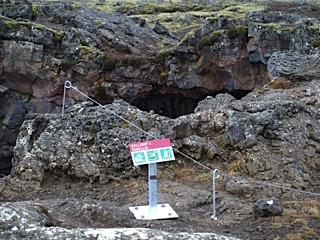
Surtshellir: The Outlaw's Cave


To explore the Outlaw's Cave, my friend told me, you need "a headlamp and serious shoes." I had a headlamp, though it malfunctioned and would only point straight down. On my feet I had rubber Wellington books--not up to clambering over hummocks of toaster-sized lava-rubble without twisting an ankle. I didn't make it far into the cave.

I never saw the statues a local artist had placed there--eerie faces carved of rock, I'd heard.

I missed the ice formations that apparently linger year round.

I gave up well before I reached the outlaws' hideout, thoroughly freaked out by being alone in the unimaginable dark, some 30 feet under a lava field on the fringe of Iceland's uninhabitable interior. If I cried for help, no one would hear.

Usually cavers don't come to Surtshellir alone. And most are more courageous than I. In fact, so many tourists have reached the outlaws' hideout, some 600 feet along this lava tube, that Icelandic archaeologists have launched a rescue excavation to learn what they can about the outlaws' house before the evidence disappears. As archaeologist Guðmundur Ólafsson  and his colleagues noted in 2004, tourists "were removing bones from it as souvenirs."

Surtshellir means "the cave of Surtr," the Norse fire-giant who will destroy the world. The lava in which the cave is found flowed shortly after Iceland was settled in the 870s. A mile-long tube, or tunnel, the cave was formed by thicker lava congealing around a faster flowing central stream that eventually ran out. At its broadest, the tube is about 45 feet wide and 30 feet high, though it shrinks down to about 6 feet high. In some places it branches out into side tunnels. In other places, the roof has fallen in, leaving large holes to the sky.

Beneath one of these sky holes, about 300 feet from the cave's mouth, the outlaws built a wall about 8 feet high and 43 feet long. Another 300 feet along a side passage stands "a unique drystone structure with an associated midden," or garbage dump, according to the archaeologists.

One of the first books written in Iceland, the Landnámabók or Book of Settlements (from about 1130) notes that outlaws lived in in the lava field near Surtshellir in the late 900s. Two of the Icelandic sagas (written in the 1200s and 1300s) describe the outlaws' downfall, when a posse of chieftains decided to wipe them out.

In the 1700s century, two Icelanders explored the cave and found what they thought was the outlaws' hut. Two centuries later, the Icelandic novelist Halldor Laxness visited the cave and had his souvenir cow-bone dated by radiocarbon (carbon-14) testing in 1971. The dates he got spanned Iceland's Golden Age, from its founding in 870 to when it became a colony of Norway in 1264.

Since 1971, radiocarbon dating has improved. In 2004, Guðmundur Ólafsson and his colleagues dated some cow-bones from the midden to between 690 and 960.

The science of tephrochronology is also new since Halldor Laxness's effort; it uses the Greenland ice cores and other sources of information to date the layers of volcanic ash, or tephra, found like stripes in Iceland's soil. The lava field around Surtshellir rests on top of a tephra layer from an eruption dated to 871 (plus or minus 2 years).

That means the earliest date for outlaws to have lived in the cave (and left cow-bones in their garbage) is about 880. A range of 880 to 960, Guðmundur Ólafsson notes, is roughly consistent with the stories in the Icelandic sagas.

Which is why Guðmundur is a little puzzled by what he and his colleagues found in the cave in 2013, according to a recent report from Iceland Review.

With Kevin Smith from Brown University and Agnes Stefánsdóttir of Iceland's Cultural Heritage Agency, Guðmundur had made a 3D scan of the Outlaw's Cave in 2012. This year, the team returned--with huge lights--to excavate the cave floor. "Because there's an increased flow of tourists to the cave, we considered it necessary to save these remains before they're completely destroyed," Guðmundur told Iceland Review. 

They didn't find much besides animal bones. The outlaws weren't wealthy and they didn't live there long. But along with a few beads and scales made of lead, the archaeologists found "a small metal cross, probably made of lead but maybe of silver," Guðmundur said.

A cross? Although Iceland officially converted to Christianity in the year 1000, some of its first settlers were Christian. But the outlaws of Surtshellir? "The general view," said Guðmundur, "is that outlaws resided there around the year 1000, or in the 11th century, maybe. But they must have been Christian and that is a little strange."

The piles of bones they left, however, prove that they were a serious nuisance to the surrounding farms. There was no sign, in the form of fishbones or birdbones, that the outlaws even tried to support themselves by foraging. All the bones came from adult cows, horses, pigs, and sheep that could be rustled--or extorted--from the nearby farms.

But neither were the outlaws living rich. They worked over those bones, getting every bit of meat off them, breaking them for the marrow. It must have been a hard life, deep underground, cold and damp, with a long, treacherous way to lug your firewood or face the unimaginable dark.

They had no headlamps. No serious shoes. And did I mention the constant annoying drip-drip-drip of water from the roof? Christian or pagan, there must have been a lot of praying going on in the Outlaws' Cave.

Join me again next week at nancymariebrown.blogspot.com for another adventure in Iceland or the medieval world.