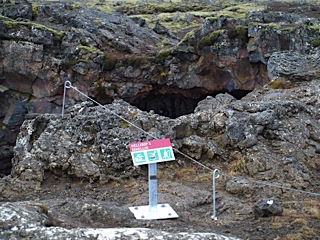
To explore the Outlaw's Cave, my friend told me, you need "a headlamp and serious shoes." I had a headlamp, though it malfunctioned and would only point straight down. On my feet I had rubber Wellington books--not up to clambering over hummocks of toaster-sized lava-rubble without twisting an ankle. I didn't make it far into the cave.
I never saw the statues a local artist had placed there--eerie faces carved of rock, I'd heard.
I missed the ice formations that apparently linger year round.
I gave up well before I reached the outlaws' hideout, thoroughly freaked out by being alone in the unimaginable dark, some 30 feet under a lava field on the fringe of Iceland's uninhabitable interior. If I cried for help, no one would hear.
Usually cavers don't come to Surtshellir alone. And most are more courageous than I. In fact, so many tourists have reached the outlaws' hideout, some 600 feet along this lava tube, that Icelandic archaeologists have launched a rescue excavation to learn what they can about the outlaws' house before the evidence disappears. As
archaeologist Guðmundur Ólafsson and his colleagues noted in 2004, tourists "were removing bones from it as souvenirs."
Surtshellir means "the cave of Surtr," the Norse fire-giant who will destroy the world. The lava in which the cave is found flowed shortly after Iceland was settled in the 870s. A mile-long tube, or tunnel, the cave was formed by thicker lava congealing around a faster flowing central stream that eventually ran out. At its broadest, the tube is about 45 feet wide and 30 feet high, though it shrinks down to about 6 feet high. In some places it branches out into side tunnels. In other places, the roof has fallen in, leaving large holes to the sky.
Beneath one of these sky holes, about 300 feet from the cave's mouth, the outlaws built a wall about 8 feet high and 43 feet long. Another 300 feet along a side passage stands "a unique drystone structure with an associated midden," or garbage dump, according to the archaeologists.
One of the first books written in Iceland, the
Landnámabók or
Book of Settlements (from about 1130) notes that outlaws lived in in the lava field near Surtshellir in the late 900s. Two of the Icelandic sagas (written in the 1200s and 1300s) describe the outlaws' downfall, when a posse of chieftains decided to wipe them out.
In the 1700s century, two Icelanders explored the cave and found what they thought was the outlaws' hut. Two centuries later, the Icelandic novelist Halldor Laxness visited the cave and had his souvenir cow-bone dated by radiocarbon (carbon-14) testing in 1971. The dates he got spanned Iceland's Golden Age, from its founding in 870 to when it became a colony of Norway in 1264.
Since 1971, radiocarbon dating has improved. In 2004, Guðmundur Ólafsson and his colleagues dated some cow-bones from the midden to between 690 and 960.
The science of tephrochronology is also new since Halldor Laxness's effort; it uses the Greenland ice cores and other sources of information to date the layers of volcanic ash, or tephra, found like stripes in Iceland's soil. The lava field around Surtshellir rests on top of a tephra layer from an eruption dated to 871 (plus or minus 2 years).
That means the earliest date for outlaws to have lived in the cave (and left cow-bones in their garbage) is about 880. A range of 880 to 960, Guðmundur Ólafsson notes, is roughly consistent with the stories in the Icelandic sagas.
Which is why Guðmundur is a little puzzled by what he and his colleagues found in the cave in 2013,
according to a recent report from Iceland Review.
With Kevin Smith from Brown University and Agnes Stefánsdóttir of Iceland's Cultural Heritage Agency, Guðmundur had made a 3D scan of the Outlaw's Cave in 2012. This year, the team returned--with huge lights--to excavate the cave floor. "Because there's an increased flow of tourists to the cave, we considered it necessary to save these remains before they're completely destroyed," Guðmundur told
Iceland Review.
They didn't find much besides animal bones. The outlaws weren't wealthy and they didn't live there long. But along with a few beads and scales made of lead, the archaeologists found "a small metal cross, probably made of lead but maybe of silver," Guðmundur said.
A cross? Although Iceland officially converted to Christianity in the year 1000, some of its first settlers were Christian. But the outlaws of Surtshellir? "The general view," said Guðmundur, "is that outlaws resided there around the year 1000, or in the 11th century, maybe. But they must have been Christian and that is a little strange."

The piles of bones they left, however, prove that they were a serious nuisance to the surrounding farms. There was no sign, in the form of fishbones or birdbones, that the outlaws even tried to support themselves by foraging. All the bones came from adult cows, horses, pigs, and sheep that could be rustled--or extorted--from the nearby farms.
But neither were the outlaws living rich. They worked over those bones, getting every bit of meat off them, breaking them for the marrow. It must have been a hard life, deep underground, cold and damp, with a long, treacherous way to lug your firewood or face the unimaginable dark.
They had no headlamps. No serious shoes. And did I mention the constant annoying
drip-drip-drip of water from the roof? Christian or pagan, there must have been a lot of praying going on in the Outlaws' Cave.
Join me again next week at nancymariebrown.blogspot.com for another adventure in Iceland or the medieval world.