Showing posts with label parchment. Show all posts

Wednesday, November 20, 2013

The Saga Man: Arni Magnusson

Lovers of Icelandic sagas are celebrating these days: It's the 350th birthday of Arni Magnusson, the man who, more than anyone else, saved Iceland's medieval manuscripts.

Brought up at Snorri Sturluson’s ancestral estate of Hvamm in the west of Iceland, Arni went to Copenhagen in 1683, when he was 20 years old, and found work as a copyist and translator for Thomas Bartholin, Jr. With Arni's help, Bartholin published a 700-page history of the Danes in 1689. Drawing examples from Snorri’s Heimskringla, Egil’s Saga, and other sagas, Bartholin’s Danish Antiquities Concerning the Reasons for the Pagan Danes’ Disdain for Death made popular the Viking stereotype of the bold, blond, laugh-in-the-face-of-death hero.

Arni became a professor at the University of Copenhagen in 1701, and the next year the king sent him back to Iceland to gather statistics on his country’s land and people. His massive Land Register, compiled over ten years, describes every farm in Iceland, its size and shape, buildings, people, cows, sheep, horses, the bulk of butter and cloth it owed in tithes, the quality of its turf, peat, hay, and woodlots, its fishing and driftwood rights, and the extent of the property ruined by volcanic ash or sand or rendered useless by quagmires, bogs, erosion, or flooding.

Off the record, Arni asked every farmer about manuscripts—and poked about in every farmhouse. In his novel Iceland's Bell, Halldor Laxness imagines Arni searching every nook and cranny, even the stuffing of the mattress:

Dust and poison gushed up from the old and moldy hay within the woman’s bed as they began their search. Mixed up in the hay was all kinds of garbage, such as bottomless shoe-tatters, shoe-patches, old stocking legs, rotten rags of wadmal, pieces of cord, fibers, fragments of horseshoes, horns, bones, gills, fishtails hard as glass, broken wooden bolts and other scraps of wood, loom-weights, shells both flat and whorled, and starfish. 

There were often also scraps of parchment in hiding places like this: Arni collected every one. He found two leaves from a 13th-century manuscript with holes punched in them to make a flour sifter. He found sheets used as dress patterns, shoe soles, knee patches, and even the stiffening in a bishop’s mitre. He pieced them back into books: One 60-page manuscript came from eight different farms.

When Arni's collection was packed for shipping to Copenhagen in 1720, it filled 55 wooden chests and required 30 packhorses to carry it.

Then in 1728 Copenhagen caught fire. Half of the city was incinerated, including the university library. Arni, disbelieving that fate could be so cruel, refused to evacuate his private library until the fire reached the end of his street. He and two other Icelanders had time to rescue only the oldest books. The rest were lost, including, Arni cried, “books that will never and nowhere be found until doomsday.”

We can only guess what wonderful sagas they held.

But the rest of Arni's collection now fills two libraries named for him, the Arni Magnusson Institute in Iceland and the Arnamagnaean Institute in Copenhagen. The Icelandic one held its birthday celebration last week; Copenhagen's is coming up on Friday. (For details see http://nfi.ku.dk/kalender/arne350-seminar/) I'm looking forward to tipping a glass to Arni's memory.

Join me again next Wednesday at nancymariebrown.blogspot.com for another adventure in Iceland or the medieval world.

Wednesday, August 14, 2013

Purple Parchment and the Cave of Smoo

In the year 997, the excommunicated archbishop of Reims sent the Holy Roman Emperor a kingly gift: a copy of Boethius's On Arithmetic written in gold and silver inks on purple parchment. It had the desired effect. As I wrote in The Abacus and the Cross: The Story of the Pope Who Brought the Light of Science to the Dark Ages, my biography of that archbishop, the 17-year-old emperor summoned Gerbert of Aurillac to court with the plea, "Pray explain to us the book on arithmetic." Archbishop Gerbert became the emperor's tutor, friend, counselor--and ultimately, through the emperor's influence, Pope Sylvester II, the pope of the Year 1000.

Earlier in this blog, I described how parchment and ink were made in the Middle Ages. (See "How to Make a Medieval Book, Part I" and "How to Make a Medieval Book, Part II.")

But purple parchment? How did they color the parchment purple? I hadn't given that much thought.

Then the other day, researching something quite unrelated--the Viking settlements in northern Scotland--I stumbled upon the answer.

In 1992, a team of archaeologists led by Tony Pollard excavated four neighboring caves in a narrow inlet in Sutherland, one being the famous Smoo Cave. (See the great website, from which these photos of the cave were taken, at www.smoocave.org) In 2005, Pollard posted their report online at www.sair.org.uk/sair18.

"Smoo" comes from the Old Norse word smuga, which Cleasby-Vigfusson, the classic Old Icelandic dictionary, defines as "a narrow cleft to creep through, a hole." The related verb is smjúga, "to creep through a hole" of which the past tense is smaug. Bells are now going off in the heads of all Tolkien readers--but I won't be following that digression any farther.


Back to Smoo Cave. Surprisingly, I had visited the cave in 1995. Two balding Scotsmen with rat tails and earrings took me on a river raft under a low stone arch, across a pool into which a sun-sparkled waterfall fell. In the dark cave, it was a real surprise. We disembarked in the dry inner reaches of the cave and had a geology lesson. The outer, larger cavern was made by the sea: the hole, wider at the bottom than the top, is a blowhole. The inner caverns were made by an underground river that feeds from a large lake. The waterfall only runs when there’s been rain—today’s fall is last night’s rain.

As Pollard points out, Smoo Cave has been a tourist attraction since at least the early 1700s. One practical-minded traveler described it as "stretching pretty far underground with a natural vault above." Inside, "there is room enough for 500 men to exercise their arms." (I'm imagining jumping jacks here--but maybe he means to practice their shooting?) There's "a harbor for big boats" at the cave's mouth, a pool full of trout, and "a spring of excellent water."

Earlier visitors also valued the cave for its usefulness--not its surprising bright waterfall. Pollard and his crew of archeologists found signs that Vikings had used Smoo Cave as a fishing camp, as well as a place to sit out a storm and repair a boat. They may have stopped here on their way from the Orkney Islands to Dublin. They butchered animals and cooked them. They ate dried fish they'd brought with them. They ground grain. They carved pins and knife handles and other useful objects out of antler and bone.

But the most interesting thing the Vikings did at Smoo and its neighboring caves was collect and crack open whelks. These were not just any whelks, but Nucella lapillus, also known as Purpura lapillus, the source since antiquity of a purple dye. These whelks are not edible, and they were not used as fish bait, Pollard says. "It is clear that purple dye was being extracted from the shells recovered from the cave."

The whelks, Pollard writes, "had been split from the second and third whorl and also split from the shoulder to the base.... This would have facilitated the removal of the animal from its shell to extract the ink."

In 1895, archaeologists found "Purpura-mounds" in Connemara, Ireland. The shells in the mounds had been broken exactly like those in Smoo Cave, though in Ireland there were many more of them. One heap measured 165 by 45 feet. In one square foot, the researchers counted two hundred whelks. Purpura-mounds have also been found in Cornwall, England, but Smoo Cave is the first record from Scotland, although the whelk is common there.

To learn how to make the dye known as Tyrean purple, Pollard refers the reader to the 1919 book, Shells as Evidence of the Migrations of Early Culture by J.W. Jackson. Like Pollard's own report, Jackson's book is available online. (Historical research is so easy these days!)

Jackson, in turn, cites the first-century Roman writer Pliny to explain that "the precious liquid was obtained from a transparent branching vessel behind the neck of the animal and that at first the material was of the colour and consistency of thick cream."

Several kinds of whelks produced purple dye. Small ones were smashed together in a mortar; if large, "the animal was taken out entire, usually by breaking a hole in the side of the shell, and the sac containing the colouring matter was taken out, either while the animal was still alive, or as soon as possible after death, as otherwise the quality of the dye was impaired." The sacs were salted, allowed to sit for three days, then boiled and frequently skimmed. Exposed to the sun, the fluid (smelling like garlic) slowly changed color, from creamy to yellow, green, blue, and finally a purplish red. After ten days, the dye was ready to use.

To dye wool, a clean fleece was dunked into the boiling dye pot and left to soak for five hours. It was taken out, cooled, and the wool plucked off and carded, only to be "thrown in again, until it had fully imbibed the colour" (still smelling like garlic--one reason the wearers of royal purple robes wore so much perfume, suggests Jackson). It took between one and two pounds of liquid dye to color a half-pound of yarn.

To turn parchment purple, Jackson says, the dye was used as a paint, applied with a brush. The "magnificent and expensive style of writing" on purple parchment with gold and silver inks was mostly confined to sacred texts. Jackson cites an English Bible and a Gospel book, another book of the Gospels commissioned by Louis the Pious, king of France from 814 to 840, and a Book of Prayers, "bound in ivory and studded with gems" owned by his son, King Charles the Bald.

It's significant that Gerbert of Aurillac, who would become "The Scientist Pope," owned a mathematical treatise made in this "magnificent" style. The book still exists in the Staatsbibliothek Bamberg in Germany, where it is catalogued as MS Bamberg Class. 5 (HJ.IV.12), but we don't know how it came into Gerbert's possession. Like the gem-studded prayer book, On Arithmetic was commissioned by King Charles the Bald in about 832. But the dedicatory verses apply equally to the young emperor Otto III as to King Charles, and scholars long thought Gerbert (known as a poet) had written them. Otto III may have thought so too, for he answered the gift with a verse.

Join me again next Wednesday at nancymariebrown.blogspot.com for another adventure in Iceland or the medieval world.

Wednesday, April 18, 2012

How to Make a Medieval Book, Part II


As I said last week, for me the hardest part of writing a book is deciding what to say. But in the Middle Ages, as I learned when researching the technology of book-making for The Abacus and the Cross, a lot more work was involved. Last week, we learned how to make the parchment for your book’s pages. Here’s how to make your ink and bind your book.


Ink
At the monastery of Saint Columban in Bobbio, Italy—which once held the greatest Christian library of the tenth century, with 690 books—Jessica Lavelli runs a project for schoolchildren called CoolTour. After they understand how to make parchment (see How to Make a Book: Part I), Lavelli’s pupils get to make their own manuscript. They copy a page from a tenth-century life of the founder of Bobbio, the Irish Saint Colomban. The page begins, Beatus ergo Columbanus, and the initial “B,” taking up a third of the page, is a maze of Celtic knotwork in red, blue, green, and black. For Beatus, the pupils substitute their own names; they fill out the rest of the line any way they like.


Lavelli does not supply authentic medieval inks. “The kids write their names using goose quills and common black ink. Then we give them paintbrushes, and vinegar and egg white to mix the colors, which we buy at an artists’ shop. The colors are not easy to find,” she added, “and it can get very expensive if you want to make your own.”


In the Middle Ages, black ink was made from oak galls—the black bubbles you find on an oak twig where the gall wasp has stung it to lay its eggs. The galls were ground, cooked in wine, and mixed with iron sulfate and gum arabic. Oak galls contain gallic acid, which causes collagen to contract; instead of sitting on the surface, the ink etches the words into the parchment. Crushed iron sulfate (often found together with pyrite) makes the ink black; gum arabic, the sap of the acacia tree, makes it thick. Another recipe called for vinegar and rind of pomegranate. Egg white (preserved by a sprig of cloves) and fish glue were used, in addition to gum arabic, to thicken colors; other common ingredients were ear wax, pine rosin, lye, stale urine, and horse dung.


To make the red ink commonly used for titles, you have to grind and cook “flake-white,” a white crust that forms on lead sheets hung above a pot of simmering wine. To make green, you need copper filings, ground egg yolks, quicklime, tartar sediment, common salt, strong vinegar, and boy’s urine. An expensive blue was made by grinding up lapis lazuli; a cheaper variety could be made from the woad plant, which contains the same chemical as indigo. Yellows were made from the plants weld or saffron, or from unripe buckthorn berries. Purple came from the herb turnsole, brick red from madder root, and pink from brazilwood, while earth colors came from filtered and roasted dirt.


The parchment made, the ink mixed, an expert scribe could write at the rate of forty strokes (five to six words) a minute, which over a six-hour day adds up to two hundred lines per day. Michael Gullick, in Making the Medieval Book, came up with these numbers by counting the lines in a manuscript that a scribe claimed to have written entirely by his own hand in a month. Doubting that anyone could maintain that speed, Gullick asked the calligrapher Donald Jackson for a second opinion. Jackson had worked with quill and parchment for thirty years. He copied lines from the manuscript, taking into account the height of the strokes, the line length, and “the finesse and skill of the scribe.” Jackson estimated the maximum possible speed at twenty-five lines an hour. If the scribe really finished the book in a month, he concluded, he had worked eight hours a day every single day.


And that was just for the text. Illustrations and the fancy initial capitals, like the B for Beatus, were usually done by a different monk, who specialized in drawing. A scholar who examined one luxurious book of psalms found it to be the work of three scribes, a rubricator (who did just the red titles), and nine artists.


Bookbinding
Finally the finished pages were sewn into quires (often gathered together with the text of several other books on the same or different topics) and bound between boards of oak or beech. The inside of each board was covered with a fly leaf or pastedown, a piece of fresh parchment or (more often) one recycled from an unwanted manuscript. Sometimes these old sheets were cleaned first, by soaking them in whey or orange juice and scraping off the inks and colors; fortunately, this was not always done—more than one precious leaf has been saved because it was recycled.


The outsides of the boards were covered in leather (alum-tawed pig’s leather was preferred, because it was white) and fitted with metal clasps to keep the book from popping open. Then it would be locked away in a wooden bookchest to protect it—not from thieves, who could open the chest with an axe, so much as from borrowers who might “forget” to return it. For a book was a very valuable thing. A historian who tried to calculate exactly how valuable, found a law book that was bought for eight denaris: the price of ninety-six two-pound loaves of bread.


The bread I buy from a local bakery is about $5.00 a loaf, making the cost of that law book today about $480. My book The Abacus and the Cross, on the other hand, costs $28—in hardback. The paperback, due out in October, will be only $17, just a little more than three loaves of bread.


If you visit Bobbio, check out CoolTour and say hello to Jessica for me:


For an overnight stay, I recommend the farm guesthouse San Martino. It is (of course!) a horse farm within walking distance of the town:


Bobbio has also been recently identified as the town painted in the background of the Mona Lisa. As one newspaper said, “brace for tourists”!


Photos: Detail of a Bobbio manuscript and portrait of a scribe, both from the CoolTour Bobbio website.


Join me again next Wednesday for an excursion into the medieval world at nancymariebrown.blogspot.com

Wednesday, April 11, 2012

How to Make a Medieval Book


For me, the hardest part of making a book is deciding what to say. In the Middle Ages, there was more to it than that, as I learned when researching the technology of book-making for The Abacus and the Cross. This week and next, I’ll share what I found out.


CoolTour Bobbio: 
Today the greatest Christian library of the early Middle Ages—at the Italian monastery of Bobbio—is empty. Half of its 690 books went to Milan in the 1400s; from there, in the 1600s, some were sent to the Vatican. In 1803, after Napoleon shut down the monastery, the remaining manuscripts were auctioned off. Many were bought by the National Library of Turin, which burned down in 1904. “We don’t have even one to show the kids,” Jessica Lavelli told me. “The library in Milan will not even lend us one.”

An energetic young woman committed to Bobbio’s reputation as the library that “saved civilization” (Thomas Cahill, author of How the Irish Saved Civilization, visited Bobbio, which was founded by an Irish monk), Lavelli makes up with imagination what she lacks in resources. She calls her project CoolTour. From October to March, she invites one school group a week into the monastery and teaches them how to make a manuscript; in April and May, it’s thirty kids a day. “They come from all over northern Italy: Milan, Genova, Brescia, Parma, Cremona. Anywhere that’s less than two hours by bus.”

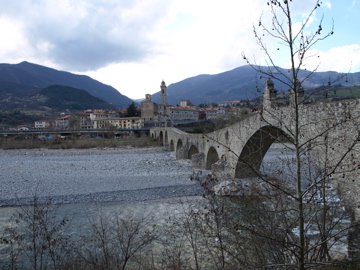
After a tour of the ancient walled town, with its castle on the hill and its hump-backed Roman bridge over the rushing river Trebbia, the children march through the arched gate behind the basilica and into the high-walled monastery complex. They pass through the cloister, its shady, columned arcades opening onto a sunny square where the monks would have had their herb garden, into a pair of bright classrooms; there they are issued goose quills, ink, and parchment. They learn the history of script from hieroglyphics to computer typesetting and how to make a book starting with the sheep.


Parchment: 
In one corner stands a sample of parchment stretched on a drying frame. “I got a sheepskin from a brasserie, a butcher, last spring,” Lavelli told me. “In Italy, it’s common to eat sheep for Easter, so they had many skins. A lamb would be half this size. From one sheep you can get two pages—four sides when it’s folded. From a lamb you only get one.”

How did she learn to make parchment? “From a book. We found a book and tried to do it. It’s a very long process. It takes four days to prepare and one week to dry, so after about ten days we can cut out our page. You dry it not in the sun or in the dark, but in the penumbra. We put it here”—she motioned toward a shady niche in the cloister where high walls block the sun from three directions. “The smell of the skin is not good,” she added, wrinkling her nose. “When it stops smelling, it’s dry.”

According to Pliny’s Natural History, written in the first century A.D., parchment—in Latin, pergamenum—was invented for the king of Pergamos (modern Bergama, Turkey) to break the Egyptian monopoly on papyrus. The sedge used for papyrus was common only on the banks of the Nile. Sheepskins were everywhere.

 The oldest known recipe for turning sheepskin into parchment was written in the Italian city of Lucca at the end of the eighth century. “Place it in limewater,” it says, “and leave it there for three days and extend it on a frame and scrape it on both sides with a razor and leave it to dry, then do any kind of smoothing that you want.”  A twelfth-century manuscript offers more precise—but still somewhat mysterious—instructions on how “to make parchment from goatskins as it is done in Bologna”; this process takes twenty-four days plus drying. Book conservator Leandro Gottscher compared the two methods during a series of experiments one hot summer in Rome in the 1990s. Both made acceptable parchment, though the shorter soaking time made for harder work scraping off the hair.

The limewater is the key to the process. It was made by burning crushed limestone (or marble, chalk, or shells) in a kiln to make quicklime, placing that in a vat or barrel, and adding a little water. The limewater would seethe and bubble and be ready in about ten minutes. Gottscher spread a pulp of limewater onto the skin, folded it, and set it aside for a few days. Other experimenters prefer to dilute the limewater until it is milky and soak the skin. The lime eats into the epidermis, the outer layers of the skin, loosening the hair on one side and the fat on the other.

To remove the hair, rinse off the lime and pull or pluck out whatever hair you can. (Gloves are a good idea—any remaining lime will eat into your skin too.) Next lay the skin over a log or trestle and rub it with a wooden hone, a bone spatula, or a dull knife, a procedure called scudding.

To remove the fat, the hairless skin can be dunked in fresh limewater or rubbed with lime powder, then spread on the trestle, hair-side down, and scudded again. Lean sheep make better parchment than fat ones; excess fat makes the parchment slippery and the ink doesn’t stick. On the other hand, parchment that is scraped too thin can become wrinkly and transparent.

The dehaired and defatted skin is soaked again and stretched onto a wooden frame to dry. To avoid tearing holes, first wrap a corner of skin around a pebble (called a pippin), tie one end of a cord around the pippin and another to a wooden peg in the frame. As the skin dries, tighten the pegs.

While leather-making is a chemical process, parchment-making is a physical process. What’s left after all the soaking and scudding is mostly collagen, long spiraling proteins that form tough, elastic fibers. As the skin dries, these fibers try to shrink. Stopped by the frame, instead the fibers’ structure begins to change.

When it’s dry, the parchment is scraped again, still on the frame, with a crescent-shaped blade called a lunellum (“little moon”), powdered again with lime or chalk to bleach it, and rubbed thoroughly on both sides with a pumice stone to raise a nap. Then it is taken down and cut into sheets of a standard size. The first sheet is easy: a rectangle that, folded, could become four pages of a large book (or eight pages of a small one). Then the cutter has to become creative: A sheepskin is not square. Where the head, legs, and tail were cut off, the skin curves. Scholars often come across manuscript pages with a corner missing—where a page runs into a neck hole. Other blemishes are insect bites (little holes), wounds on the animal (bigger holes), and gashes (where the knife slipped during the flaying); some of these are sewn up, but usually the scribe just wrote around them.

The color of parchment depends partly on the process and partly on the animal it came from. Low-grade parchment could be dark pinkish-brown with a chalky surface, peppered with hair follicles, streaked with scrape marks, or so thin that the ink bled through. Sheepskin, well cured, was “butter-white” or yellowish, but still sometimes greasy or shiny. Goatskin was greyish. Calfskin was the whitest, though the veins could be prominent. The parchment Jessica Lavelli made to show her pupils at Bobbio had a large brown spot. She shrugged. “It was a spotted sheep! I didn’t think it would matter.”


If you visit Bobbio, check out CoolTour and say hello to Jessica for me:

For an overnight stay, I recommend the farm guesthouse San Martino. It is (of course!) a horse farm within walking distance of the town:

Bobbio has also been recently identified as the town painted in the background of the Mona Lisa. As one newspaper said, “brace for tourists”!

Photos: Saint Luke at his writing desk, from Bernward's Evangelary (Dom Museum Hildesheim). The town of Bobbio, Italy. Portrait of a scribe from the CoolTour Bobbio website. Detail of a Bobbio manuscript, also from CoolTour Bobbio.