In the midst of World War II, with the Nazis extolling their Viking heritage, the Swedish writer Frans G. Bengtsson began writing "a story that people could enjoy reading, like The Three Musketeers or the Odyssey."
Bengtsson had made his literary reputation with the biography of an 18th-century king. But for this story he tried a new genre, the historical novel, and a new period of time. His Vikings are common men, smart, witty, and open-minded. "When encountering a Jew who allies with the Vikings and leads them to treasure beyond their dreams, they are duly grateful," notes one critic. "Bengtsson in effect throws the Viking heritage back in the Nazis' face."
His effect on that Viking heritage, however, was not benign. His story, Rode Orm, is one of the most-read and most-loved books in Swedish, and has been translated into over twenty languages; in English it's The Long Ships.
Part of the story takes place on the East Way, which the red-haired Orm travels in a lapstrake ship with 24 pairs of oars. Based on the Oseberg ship’s 15 pairs of oars or the Gokstad ship’s 16, such a mighty vessel would stretch nearly 100 feet long and weigh 16 to 18 tons, empty. To cross the many portages between the Baltic Sea and the Black Sea, Red Orm’s "cheerful crew" threw great logs in front of the prow and hauled the boat along these rollers "in exchange for swigs of 'dragging beer,'" Bengtsson wrote.
This, say experimental archaeologists, is "unproven," "improbable," and—after several tries with replica ships—"not possible."
But Bengtsson's fiction burned itself into popular memory. Early scholars were convinced, too: A drawing of dozens of men attempting to roll a mighty ship on loose logs illustrates the eastern voyages in the classic compendium The Viking from 1966.
"Seldom has anything been surrounded by so much myth and fantasy" as the Viking ship, notes Gunilla Larsson; her 2007 Ph.D. thesis, Ship and Society: Maritime Ideology in Late Iron Age Sweden, completely changes our understanding of the Vikings' eastern voyages.
Like the myth of the Viking housewife with her keys, which I wrote about last week, the myth of the mighty Viking ship is so common it's taken to be true. But the facts do not back it up.
In the 1990s, archaeologists attempted several times to take replica Viking ships between rivers or across isthmuses using the log-rolling method. They failed. They scaled down their ships. They still failed. Their ships were a half to a third the length of Red Orm's mighty ship. They weighed only one to two tons, not 16 tons. Yet they could not be cheerfully hauled by their crews, no matter how much beer was provided. The task was inefficient even when horses—or wheels or winches or wagons—were added.
We think bigger is better, but it's not.
The beautiful Oseberg ship with its spiral prow and the sleek Gokstad ship, praised as an "ideal form" and "a poem carved in wood," have been considered the classic Viking ships from the time they were first unearthed. Images of these Norwegian ships grace uncountable books on Viking Age history, uncountable museum exhibitions, uncountable souvenirs in Scandinavian gift shops.
But a third ship of equal importance for understanding the Viking Age was discovered in 1898, after Gokstad (1880) and before Oseberg (1903), by a Swedish farmer digging a ditch to dry out a boggy meadow. He axed through the wreck and laid his drain pipes. The landowner, a bit of an antiquarian, decided to rescue the boat and pulled the pieces of old wood out of the ground. His collection founded a local museum, but the boat pieces lay ignored in the attic—unmarked, unnumbered, with no drawings to say how they had lain in the earth when found—until 1980, when a radiocarbon survey of the museum's contents dated them to the 11th century. Their great age was confirmed by tree-ring data, which found the wood for the boat had been cut before 1070.
In the 1990s, archaeologist Gunilla Larsson took on the task of puzzling the pieces back into a boat. She had bits of much of the hull: of the keel, the stem and stern and five wide strakes, even some of the wooden rail attached to the gunwale. She had most of the frames, one bite, and two knees. About 2 feet in the middle of the boat was missing: where the ditch went through. The iron rivets had rusted away, but the rivet holes in the wood were easy to see and, since the distance between them varied, the parts could only go together one way. The wood itself had been flattened by time, but it was still sturdy enough to be soaked in hot water and bent into shape—the same technique the original boatbuilder had used.
When she had solved this 3D jigsaw puzzle, she engaged the National Maritime Museum in Stockholm to help her mount the pieces on an iron frame; the Viks Boat went on display in 1996.
Then she created a replica, Tälja, and tested it by sailing, rowing, and portaging around Lake Malaren. Tälja glided up shallow streams, its pliable planks bending and sliding over rocks. With only the power of its crew, it was easily portaged from one watershed to the next, from Lake Malaren to Lake Vanern in the west, itself draining into the Kattegat.
A second Viks Boat replica, Fornkåre, was built in 2012 and taken on the Vikings' East Way from Lake Malaren to Novgorod the first year, then south, by rivers and lakes, some 250 miles through Russia the second year. Concludes Fornkåre’s builder and captain, Lennart Widerberg, "The vessel proved itself capable of traveling this ancient route" from Birka to Byzantium.
The Viks Boat is 31 feet long—longer than two earlier replicas that failed the East Way portage test—and about 7 feet wide, comfortable for a crew of 8 to 10. Its replicas passed the portage test for two reasons. First, they were built, like the original, with strakes that were radially split, not sawn. The resulting board is easy to bend and hard to break—at less than half an inch thick. The resulting boat is equally seaworthy at almost half the weight of the same size boat built with the same lapstrake technique, but using sawn boards. Empty, the Viks Boat replicas weigh only half a ton—about as much as a horse.
The second reason the Viks Boat replicas proved adequate for the East Way was that archaeologists had set aside Frans Bengtsson’s fantastical log-rolling technique for crossing from stream to stream.
By studying the ways the Sami had portaged their dugout canoes through the waterways of Sweden and Finland throughout history, the archaeologists began to see signs of similar portage-ways around Lake Malaren. They built some themselves and had teams race replica ships through an obstacle course of portage types: smooth grassy paths, log-lined roads or ditches (with the logs aligned in the direction of travel), and bogs layered with branches. A team of two adults and seven 17-year-olds finished a winding, half-mile course with Talja in an hour. When the portage was straight over 4-inch-thick logs sunk into the mud so they didn’t shift, the boat raced at 150 feet a minute.
The beauty of the Gokstad ship, its poetic quality, comes from its curves, the hull swelling out from the gunwale then tightly back in, making a distinctive V-shape down to the deep, straight keel. These concave curves improve the ship’s sailing ability at sea. But the keel cuts too deep to float a shallow, stony stream like those that connect the Baltic to the Black Sea.
Over a portage, even the minimal keel of the Viks Boat replicas needed to be protected with an easily replaceable covering of birch, as had been found on the original. The Old Norse name for this false keel was drag. To "set a drag under someone's pride" was to encourage arrogance.
Historians and archaeologists of the Viking Age have long benefited from an ideological false keel. With the Viks Boat taking its rightful place as an exemplar of the Viking ship, it's time to knock off that damaged drag and replace it. Says Larsson, "We should get used to a completely different picture of the Scandinavian traveling eastward in the Viking Age, one that is far from the traditional image of the male Viking warrior in the prow of a big warship."
This essay was excerpted from my book The Real Valkyrie: The Hidden History of Viking Warrior Women. To learn more, see the related posts on this blog (click here) or my page at Macmillan.com.
Click on the title to download and read Gunilla Larsson's 2007 Ph.D. thesis, Ship and Society: Maritime Ideology in Late Iron Age Sweden. I highly recommend it.
Disclosure: I am an affiliate of Bookshop.org and may earn a commission if you click through and purchase the books mentioned here.
Wanderer, storyteller, wise, half-blind, with a wonderful horse.
By Nancy Marie Brown
Showing posts with label Viking ship. Show all posts
Wednesday, November 10, 2021
Wednesday, September 22, 2021
Did Vikings Get Seasick?
I get seasick. Really seasick. So to write about sailing a Viking ship, as I've done extensively in my new book, The Real Valkyrie, as well as in my earlier books about Gudrid the Far-Traveler's exploration of North America around the year 1000, I didn't try to recreate a Viking voyage.
Sure, I got on Viking ships. I rowed the Viking fishing boat Kraka Fyr in Roskilde harbor. (You can read about that adventure here.)
And I tooled around the harbor of Newport, Rhode Island in Gaia, a replica of the Gokstad ship. (See "A Viking Ship at Midnight," here.)
But mostly, I visited Viking ships in museums and read books by and about other people who had tried to recreate voyages in replica Viking ships.
One of my favorite passages is from Hodding Carter's A Viking Voyage: In which an unlikely crew of adventurers attempts an epic journey to the New World. (Really, the subtitle tells you all you need to know.) This scene (greatly abbreviated here) takes place just before their replica knarr, called Snorri, had to be towed back to Greenland by the Coast Guard Canada.
Writes Carter: "Each swell that rocked Snorri, each wave that slapped her across the sheer plank and sprayed over the foredeck--I cherished them all. We were finally attempting something ancient. We had left the safety net of land and civilization. For the Vikings, this had been THE moment ... I felt unbound. 'This is THE MOMENT,' I kept telling myself. I suddenly fell in love not only with sailing but also with the ocean. I liked being at its mercy. ... The water shifted colors again and again. ... Sounds competed for attention. ... I could not sleep that night. ... I knew then why Leif and the others sailed west--not for wood or new land, but merely to feel so much at once. ... By seven the next evening we were more than 130 miles from Greenland, adrift. All that bashing and groaning I had so cherished had taken its toll. Some of the crew were falling apart. Rob was retching wherever he stood. Others were nearly as sick. Snorri was faring even worse. Our huge rudder had loosened a supporting crossbeam, a thigh-thick piece of wooden framing, by constantly pulling forward on it, instantly creating four holes in the bottom of the boat. Water gushed in..."
No need to read farther, I thought. I'm not going to cross an ocean on a Viking ship. Not me.
Several years later, between the publication of The Far Traveler (2007) and that of my YA novel based on that research, The Saga of Gudrid the Far-Traveler (2015), I had the good fortune to meet the retching Rob of Carter's story. When I asked him about his seasickness, he laughed it off. “Great way to lose 40 or 50 pounds.” (You can read more about Rob Stevens, the boatbuilder who built the knarr replica for Carter, here.)
As I said then, I would rather fall off a horse (and I have, repeatedly; read about that here) than be seasick.
But from what archaeologists reexamining the Gokstad ship discovered recently, it seems the bigger hazard for a sailor on a Viking ship was getting bored.
Photo caption: Hanne Lovise Aannestad of the Museum of Cultural History in Oslo points at the footprint on a board of the Gokstad ship. The footprint is enhanced by Science Nordic (photo by Hanne Jakobsen/Per Byhring)
According to a 2013 story in Science Nordic, carved into the original floorboards of this Viking ship buried in about 900 in the blue clay of southern Norway are two footprints. They were discovered in 2009, when museum workers were preparing to transfer the floorboards into a new exhibit space.
"My guess is that some time or another a person was bored and simply traced his foot with his knife. It's a kind of an 'I was here' message," researcher Hanne Lovise Aannestad of the Museum of Cultural History in Oslo told Science Nordic.
The footprints are quite small--smaller than Aannestad's--perhaps a girl's? The more distinct of the two prints is a right foot, bare. It even includes toenails. A weaker outline of a left foot appears on another plank. Was it the same girl's? Since the loose floorboards were scattered when the ship was excavated, it's impossible to say. So there might have been two bored young people on the Gokstad ship.
Or maybe they were trying to take their minds off being seasick.
To learn how I used those footprints to tell the story of a warrior woman sailing to Birka in the 10th century, see Chapter 13 of my book The Real Valkyrie: The Hidden History of Viking Warrior Women. To learn more about the book, see the related posts on this blog (here) or my page at Macmillan.com.
Disclosure: I am an affiliate of Bookshop.org and I may earn a commission if you click through and purchase the books mentioned here.
Sure, I got on Viking ships. I rowed the Viking fishing boat Kraka Fyr in Roskilde harbor. (You can read about that adventure here.)
And I tooled around the harbor of Newport, Rhode Island in Gaia, a replica of the Gokstad ship. (See "A Viking Ship at Midnight," here.)
But mostly, I visited Viking ships in museums and read books by and about other people who had tried to recreate voyages in replica Viking ships.
One of my favorite passages is from Hodding Carter's A Viking Voyage: In which an unlikely crew of adventurers attempts an epic journey to the New World. (Really, the subtitle tells you all you need to know.) This scene (greatly abbreviated here) takes place just before their replica knarr, called Snorri, had to be towed back to Greenland by the Coast Guard Canada.
Writes Carter: "Each swell that rocked Snorri, each wave that slapped her across the sheer plank and sprayed over the foredeck--I cherished them all. We were finally attempting something ancient. We had left the safety net of land and civilization. For the Vikings, this had been THE moment ... I felt unbound. 'This is THE MOMENT,' I kept telling myself. I suddenly fell in love not only with sailing but also with the ocean. I liked being at its mercy. ... The water shifted colors again and again. ... Sounds competed for attention. ... I could not sleep that night. ... I knew then why Leif and the others sailed west--not for wood or new land, but merely to feel so much at once. ... By seven the next evening we were more than 130 miles from Greenland, adrift. All that bashing and groaning I had so cherished had taken its toll. Some of the crew were falling apart. Rob was retching wherever he stood. Others were nearly as sick. Snorri was faring even worse. Our huge rudder had loosened a supporting crossbeam, a thigh-thick piece of wooden framing, by constantly pulling forward on it, instantly creating four holes in the bottom of the boat. Water gushed in..."
No need to read farther, I thought. I'm not going to cross an ocean on a Viking ship. Not me.
Several years later, between the publication of The Far Traveler (2007) and that of my YA novel based on that research, The Saga of Gudrid the Far-Traveler (2015), I had the good fortune to meet the retching Rob of Carter's story. When I asked him about his seasickness, he laughed it off. “Great way to lose 40 or 50 pounds.” (You can read more about Rob Stevens, the boatbuilder who built the knarr replica for Carter, here.)
As I said then, I would rather fall off a horse (and I have, repeatedly; read about that here) than be seasick.
But from what archaeologists reexamining the Gokstad ship discovered recently, it seems the bigger hazard for a sailor on a Viking ship was getting bored.
Photo caption: Hanne Lovise Aannestad of the Museum of Cultural History in Oslo points at the footprint on a board of the Gokstad ship. The footprint is enhanced by Science Nordic (photo by Hanne Jakobsen/Per Byhring)
According to a 2013 story in Science Nordic, carved into the original floorboards of this Viking ship buried in about 900 in the blue clay of southern Norway are two footprints. They were discovered in 2009, when museum workers were preparing to transfer the floorboards into a new exhibit space.
"My guess is that some time or another a person was bored and simply traced his foot with his knife. It's a kind of an 'I was here' message," researcher Hanne Lovise Aannestad of the Museum of Cultural History in Oslo told Science Nordic.
The footprints are quite small--smaller than Aannestad's--perhaps a girl's? The more distinct of the two prints is a right foot, bare. It even includes toenails. A weaker outline of a left foot appears on another plank. Was it the same girl's? Since the loose floorboards were scattered when the ship was excavated, it's impossible to say. So there might have been two bored young people on the Gokstad ship.
Or maybe they were trying to take their minds off being seasick.
To learn how I used those footprints to tell the story of a warrior woman sailing to Birka in the 10th century, see Chapter 13 of my book The Real Valkyrie: The Hidden History of Viking Warrior Women. To learn more about the book, see the related posts on this blog (here) or my page at Macmillan.com.
Disclosure: I am an affiliate of Bookshop.org and I may earn a commission if you click through and purchase the books mentioned here.
Wednesday, March 2, 2016
The Sunstone, or how did Vikings navigate?
Elise Skalwold graciously calls it a typo. In her article "Double Trouble: Navigating Birefringence", she explains in scientific detail how the Vikings could use a crystal called a "sunstone" to navigate when out of sight of land. At the end of the article, she calls out my book:
"That ancient Viking mariners made such voyages sans modern instrumentation inspires awe in many, not least of all me, as I have traveled in those waters in more modern craft, as well as been out on a replica of a cabinless sea-faring longboat. For a glimpse into the Viking sea-faring world, the authors recommend The Far Traveler: Voyages of a Viking Woman by Nancy Marie Brown, but in regards to the sunstone, beware the typo which identifies it as 'Icelandic feldspar.'"
It should be "Iceland spar."
I'm not the only one to make this mistake, Elise told me when we met last October at Cornell University. The name "sunstone" is commonly used in English to refer to completely different minerals in the feldspar family, particularly a translucent type known as "aventurescent feldspar." This feldspar is sunny because it contains tiny, flat mineral inclusions that, when the stone is turned the right way toward the light, give off a bright flash.
This sunstone is not the Viking sunstone. The Viking sunstone is more bizarre even than that.
Elise came to listen to me lecture on my latest book, Ivory Vikings, but also to give me a quick lesson in mineral identification. For Elise is a consulting gemologist. In her backpack, she had samples of Iceland spar and a copy of the book Secrets of the Viking Navigators, by Leif K. Karlsen, which she generously gave to me.
My reaction to the crystal she set in my palm that afternoon was very much like Karlsen's. He writes, "In a natural world that is filled with rare and exquisite examples of incredible uniqueness, sunstones defy the rational mind."
It is ice-clear. But worse, it looks machined. Living in a modern world I simply can't look at it properly. My eyes tell me it has been cut, that it's manmade, that it's fake.
And it's not. No wonder the Icelandic Saga of Hrafn Sveinbjarnarson considers the gift of a sunstone equal to that of a pair of fine stallions.
"Sunstones," Karlsen writes, "are roughly the shape of a three-dimensional parallelogram. All sunstones, without exception, have the same geometric shape and the same angularity. Take a large sunstone and break it into smaller pieces and you will have pieces with the exact same angles and geometry as the original. Additionally, every face of the stone has a tilt of 11.5 degrees."
Imagine finding something like that on an Icelandic mountainside. Just looking at it, you'd know it was magical.
And the Vikings did find sunstones there. Karlsen names three places in Iceland where the crystals are readily found. He even visited one, the site of an old mine. "In the days before synthetics," he notes, "this mineral was also used for various types of scientific optical equipment such as microscope lenses." Karlsen met an old man named Gisli who had worked at the mine in 1937 and offered to take him there.
"After some rough driving on gravel roads with several unbridged rivers and streams and then cross-country where there were no roads, we arrived safely at our destination," Karlsen writes. "We climbed up to a plateau about 400 feet up the mountain. ... Gisli pointed out numerous pieces of Iceland spar that had washed out of the vein higher in the mountain and then tumbled down the mountain in the scree. Some of the stones were clear and shiny where they had broken along the facets of the crystal as they fell. Others had an opaque surface due to weathering and abrasion. Many of the pieces we saw were at least 1.5 x 2 x 1 inches ... large and clear enough to be used for navigation."
How did the sunstone work? If you want the technical answer, read "Double Trouble: Navigating Birefringence."
But if you just want the gist of it, Karlsen presents it as a short story in his book, Secrets of the Viking Navigators. During a fictional Viking voyage, the navigator teaches his younger brother "the secrets of the sunstone."
"To use the sunstone," he says, "you must place a small spot of pine tar on top of the stone, on the side which faces towards the sky. When you are using the crystal for the first time, place a small wooden pointer along either one of the longest sides. This will be a guide for which side to point toward the brightest part of the sky. Then you must hold the stone overhead and view the stone from underneath. Notice the double image of the black dot? ... When you rotate the stone slightly back and forth, holding it flat, you will see that one spot fades and the other becomes darker. When the two images appear to be equal in value, note the position of the stone and the direction of the pointer. This is the true bearing to the sun."
Karlsen tried it out on a replica Viking ship sailing the coast of Norway in 1996. Playing the part of the navigator, he was able to teach each of his crew members how to use the sunstone--and confirmed their results with modern instruments.
Its optical magic is most impressive under conditions of "Arctic sea smoke," when very cold air moves over warmer water and the ship is wrapped in fog almost to the top of its mast. "When the light from the rising or setting sun was lost in the fog bank, but the zenith was clear," he writes, "the navigator could tell the exact position of the sun by using the sunstone, even though the sun itself was unseen."
I'll remember that the next time I imagine a Viking voyage.
"Double Trouble: Navigating Birefringence," by Elise A. Skalwold and William Bassett, was published in late 2015 by the Mineralogical Society of American and is available online here: http://www.minsocam.org/msa/openaccess_publications/#Skalwold_01
Leif K. Karlsen's Secrets of the Viking Navigators was published in Seattle by One Earth Press in 2003.
For more on The Far Traveler, see my website at: https://www.nasw.org/users/nmb/books.html#FT
"That ancient Viking mariners made such voyages sans modern instrumentation inspires awe in many, not least of all me, as I have traveled in those waters in more modern craft, as well as been out on a replica of a cabinless sea-faring longboat. For a glimpse into the Viking sea-faring world, the authors recommend The Far Traveler: Voyages of a Viking Woman by Nancy Marie Brown, but in regards to the sunstone, beware the typo which identifies it as 'Icelandic feldspar.'"
It should be "Iceland spar."
I'm not the only one to make this mistake, Elise told me when we met last October at Cornell University. The name "sunstone" is commonly used in English to refer to completely different minerals in the feldspar family, particularly a translucent type known as "aventurescent feldspar." This feldspar is sunny because it contains tiny, flat mineral inclusions that, when the stone is turned the right way toward the light, give off a bright flash.
This sunstone is not the Viking sunstone. The Viking sunstone is more bizarre even than that.
Elise came to listen to me lecture on my latest book, Ivory Vikings, but also to give me a quick lesson in mineral identification. For Elise is a consulting gemologist. In her backpack, she had samples of Iceland spar and a copy of the book Secrets of the Viking Navigators, by Leif K. Karlsen, which she generously gave to me.
It is ice-clear. But worse, it looks machined. Living in a modern world I simply can't look at it properly. My eyes tell me it has been cut, that it's manmade, that it's fake.
And it's not. No wonder the Icelandic Saga of Hrafn Sveinbjarnarson considers the gift of a sunstone equal to that of a pair of fine stallions.
"Sunstones," Karlsen writes, "are roughly the shape of a three-dimensional parallelogram. All sunstones, without exception, have the same geometric shape and the same angularity. Take a large sunstone and break it into smaller pieces and you will have pieces with the exact same angles and geometry as the original. Additionally, every face of the stone has a tilt of 11.5 degrees."
Imagine finding something like that on an Icelandic mountainside. Just looking at it, you'd know it was magical.
And the Vikings did find sunstones there. Karlsen names three places in Iceland where the crystals are readily found. He even visited one, the site of an old mine. "In the days before synthetics," he notes, "this mineral was also used for various types of scientific optical equipment such as microscope lenses." Karlsen met an old man named Gisli who had worked at the mine in 1937 and offered to take him there.
"After some rough driving on gravel roads with several unbridged rivers and streams and then cross-country where there were no roads, we arrived safely at our destination," Karlsen writes. "We climbed up to a plateau about 400 feet up the mountain. ... Gisli pointed out numerous pieces of Iceland spar that had washed out of the vein higher in the mountain and then tumbled down the mountain in the scree. Some of the stones were clear and shiny where they had broken along the facets of the crystal as they fell. Others had an opaque surface due to weathering and abrasion. Many of the pieces we saw were at least 1.5 x 2 x 1 inches ... large and clear enough to be used for navigation."
But if you just want the gist of it, Karlsen presents it as a short story in his book, Secrets of the Viking Navigators. During a fictional Viking voyage, the navigator teaches his younger brother "the secrets of the sunstone."
"To use the sunstone," he says, "you must place a small spot of pine tar on top of the stone, on the side which faces towards the sky. When you are using the crystal for the first time, place a small wooden pointer along either one of the longest sides. This will be a guide for which side to point toward the brightest part of the sky. Then you must hold the stone overhead and view the stone from underneath. Notice the double image of the black dot? ... When you rotate the stone slightly back and forth, holding it flat, you will see that one spot fades and the other becomes darker. When the two images appear to be equal in value, note the position of the stone and the direction of the pointer. This is the true bearing to the sun."
Karlsen tried it out on a replica Viking ship sailing the coast of Norway in 1996. Playing the part of the navigator, he was able to teach each of his crew members how to use the sunstone--and confirmed their results with modern instruments.
Its optical magic is most impressive under conditions of "Arctic sea smoke," when very cold air moves over warmer water and the ship is wrapped in fog almost to the top of its mast. "When the light from the rising or setting sun was lost in the fog bank, but the zenith was clear," he writes, "the navigator could tell the exact position of the sun by using the sunstone, even though the sun itself was unseen."I'll remember that the next time I imagine a Viking voyage.
"Double Trouble: Navigating Birefringence," by Elise A. Skalwold and William Bassett, was published in late 2015 by the Mineralogical Society of American and is available online here: http://www.minsocam.org/msa/openaccess_publications/#Skalwold_01
Leif K. Karlsen's Secrets of the Viking Navigators was published in Seattle by One Earth Press in 2003.
For more on The Far Traveler, see my website at: https://www.nasw.org/users/nmb/books.html#FT
Wednesday, April 15, 2015
Gudrid's Voyage to Sandnes
As I wrote last week, I did much of the research for my new novel, The Saga of Gudrid the Far-Traveler, several years ago when I was writing my nonfiction book about Gudrid, The Far Traveler: Voyages of a Viking Woman.
One research trip that became a crucial scene in the novel was an actual voyage. I went by boat down the Lysufjord from Nuuk, the capital of Greenland, to Sandnes, the farm Gudrid and her husband Thorstein Eiriksson returned to after their failed voyage to Vinland--and the farm where Thorstein subsequently died, so spookily.
The boat was owned by my friend Kristjana Motzfeldt and piloted by her friend Tobias, since Kristjana was on her way to Denmark.
"You have a map, you know where you want to go, good, good," she said, brushing away my doubts. "Tobias will get you there"--despite the fact that he spoke no English (or Icelandic) and I spoke no Greenlandic (or Danish). His wife Rusina would be going, too, I learned as we reached the boat at 8:00 Saturday morning. "Beautiful!" she said, with an expansive wave of one hand, as we passed the dramatic mountains that marked the harbor mouth. It was her favorite (and almost her only) English word.
The Motzfeldts' boat was a seal-hunting boat, half enclosed. It had two seats, for pilot and copilot, a two-sleeper cabin in the bow, and an open rear deck large enough for landing a seal or two. It had two engines and a large gas tank. Cruising along at about eight knots, drinking coffee and eating Danish pastries, I realized that sailing to Sandnes in a Viking ship would have taken amazing skill.
The narrow Lysufjord (named for a kind of cod) heads due east for most of its length, the ice-gray mountains falling straight into the sea, with no beaches, no harbors, no skerries, no bays, nowhere to find safety if the wind should turn contrary--or the ship should sink. The cliffs' snow-streaks and striations puzzle the mind; the eye wants to find a meaning in the pattern. I began to see huge faces as the hours passed and the view refused to change. The sky was overcast, the silver sea glassy calm. A sense of distance eluded me until I saw a boat the size of ours looking like a speck, a seabird, between us and the gray cliff face. Ahead lay endless iterations of the same humped mountain, hill upon hill: I could see no passage in.
Finally, after almost four hours, the fjord divided in two. A dome-shaped mountain lay straight ahead, a low rocky toe reached in from our left. As we turned the point into shadow, the boat began humping the waves, "swimming like a seal," as Kristjana had warned me it might if the wind turned against us.
But the sides of the fjord soon softened. The snow had disappeared. Red-brown brush clung to gentler slopes, and here and there above a narrow beach were bright yellow-gold patches of grass that looked man-made: they were straight-edged, rectangular. You could spot Norse ruins from far away, I had read, if you looked for the lushest grass.
The water grew greener, more shallow. Birds were feeding along the edge of a sandbar, seemingly in the middle of the fjord. We went slowly onward, rolling sideways and, I soon realized, hugging the wrong shore. Across to the north I could see another great swath of winter-gold grass and the landmark I’d read about: "a small round rocky hillock, … a fine vantage place for looking for scattered sheep in the valley."
Creeping along the edge of the sandbar, we had to retreat back down the fjord quite a ways before we could come close enough to shore to launch our rubber dinghy. Luckily the wind was calmer now, and by the time we scraped the white sand beach, the sun had come out.
Tobias and Rusina, each carrying a bottle of soda and a handful of plastic bags, sauntered down the beach to gather mussels. I hurried off the opposite way, knowing we had very little time before the falling tide would strand our anchored boat.
Of course I lost track of the time, wandering about Gudrid's farm, musing on her life--suddenly I saw Rusina frantically waving. I ran for the beach.
If we had been in a Viking ship, sailing or rowing, we would not have made it back to Nuuk that night--one reason no one lives at Sandnes now. We had hardly shipped our anchor when the wind turned against us again. The boat began to buck and thump; Tobias gritted his teeth and concentrated on steering her straight. Four bone-jarring hours later, we came to the mouth of the fjord, into a suddenly calm and sunny evening, an iceberg floating like a big pale-blue swan in the distance. At the foot of the beautiful! mountain, Rusina finally got a chance to throw out a fishing line.
The Saga of Gudrid the Far-Traveler was published in Spring 2015 by namelos. See www.namelos.com or order from your favorite bookseller. You'll find the fictional version of this voyage in Chapter Seven.
One research trip that became a crucial scene in the novel was an actual voyage. I went by boat down the Lysufjord from Nuuk, the capital of Greenland, to Sandnes, the farm Gudrid and her husband Thorstein Eiriksson returned to after their failed voyage to Vinland--and the farm where Thorstein subsequently died, so spookily.
The boat was owned by my friend Kristjana Motzfeldt and piloted by her friend Tobias, since Kristjana was on her way to Denmark.
"You have a map, you know where you want to go, good, good," she said, brushing away my doubts. "Tobias will get you there"--despite the fact that he spoke no English (or Icelandic) and I spoke no Greenlandic (or Danish). His wife Rusina would be going, too, I learned as we reached the boat at 8:00 Saturday morning. "Beautiful!" she said, with an expansive wave of one hand, as we passed the dramatic mountains that marked the harbor mouth. It was her favorite (and almost her only) English word.
The narrow Lysufjord (named for a kind of cod) heads due east for most of its length, the ice-gray mountains falling straight into the sea, with no beaches, no harbors, no skerries, no bays, nowhere to find safety if the wind should turn contrary--or the ship should sink. The cliffs' snow-streaks and striations puzzle the mind; the eye wants to find a meaning in the pattern. I began to see huge faces as the hours passed and the view refused to change. The sky was overcast, the silver sea glassy calm. A sense of distance eluded me until I saw a boat the size of ours looking like a speck, a seabird, between us and the gray cliff face. Ahead lay endless iterations of the same humped mountain, hill upon hill: I could see no passage in.
Finally, after almost four hours, the fjord divided in two. A dome-shaped mountain lay straight ahead, a low rocky toe reached in from our left. As we turned the point into shadow, the boat began humping the waves, "swimming like a seal," as Kristjana had warned me it might if the wind turned against us.
The water grew greener, more shallow. Birds were feeding along the edge of a sandbar, seemingly in the middle of the fjord. We went slowly onward, rolling sideways and, I soon realized, hugging the wrong shore. Across to the north I could see another great swath of winter-gold grass and the landmark I’d read about: "a small round rocky hillock, … a fine vantage place for looking for scattered sheep in the valley."
Creeping along the edge of the sandbar, we had to retreat back down the fjord quite a ways before we could come close enough to shore to launch our rubber dinghy. Luckily the wind was calmer now, and by the time we scraped the white sand beach, the sun had come out.
Tobias and Rusina, each carrying a bottle of soda and a handful of plastic bags, sauntered down the beach to gather mussels. I hurried off the opposite way, knowing we had very little time before the falling tide would strand our anchored boat.
If we had been in a Viking ship, sailing or rowing, we would not have made it back to Nuuk that night--one reason no one lives at Sandnes now. We had hardly shipped our anchor when the wind turned against us again. The boat began to buck and thump; Tobias gritted his teeth and concentrated on steering her straight. Four bone-jarring hours later, we came to the mouth of the fjord, into a suddenly calm and sunny evening, an iceberg floating like a big pale-blue swan in the distance. At the foot of the beautiful! mountain, Rusina finally got a chance to throw out a fishing line.
The Saga of Gudrid the Far-Traveler was published in Spring 2015 by namelos. See www.namelos.com or order from your favorite bookseller. You'll find the fictional version of this voyage in Chapter Seven.
Tuesday, March 25, 2014
A Viking Ship at Midnight
I first saw the Viking ship replica Gaia on September 18, 1991, at the Massachusetts Maritime Academy, as I wrote in my previous post. I was researching my book The Far Traveler and wanting to know everything I could about Viking ships, so I caught up with it a second time the next day at Fort Adams State Park in Newport, Rhode Island.
We drove in past a rounded hill covered with kite flyers. It was hot and sunny. My three-year-old was asleep in his carseat, so I scurried alone toward the harbor to find the ship, leaving my husband to babysit. Behind a squat brick building that said “Vinland Revisited,” I passed a tall, blond, sunglassed man with large ears. I know those ears, I thought. “Ulfur?” I called. Ulfur had some position in the Icelandic government. I had met him recently at a party at an Icelandic friend’s house. I could not remember his last name.
He turned and, recognizing me, grabbed me by the elbows and began shouting in Icelandic. Registering my blank stare, he repeated in English, “Run! Run to Gaia. Ask for the captain, Gunnar. Tell him you can go on the ship in my place. Run! For an hour’s cruise.” I ran.
Down the hill, cutting across the beach, all out of breath, I pushed through the crowd. The boat was full of people. “Gunnar!” I called in Icelandic, “I just met Ulfur and he says I can go instead of him!”
“Hah?” I had his attention, but he didn’t comprehend my babbling.
I persevered, shouting out my fractured grammar.
He smiled, “Okay! Come on board!”
One of the crew straddled from the cabin to a two-inch outrigger of the mast and grabbed my arm firmly. I swung aboard.
Standing on the raised steering deck, grasping the carved tiller of the side rudder, Gunnar was distant, majesterial. I stood at his feet. He bent his head to listen to my questions, but kept his eyes on the water ahead.
“Aren’t we going under sail?”
“No. The wind is wrong.”
After a few minutes, “Are we just going to motor?”
“No, no. We will sail.”
Getting out of dock, even under diesel power, was tricky. The boat veered too close to the breakwater—three crewmembers pushed it away with their feet, balancing on Gaia’s gunwale. The stern grated against the concrete. Gunnar’s head snapped around and he left the tiller hastily, shoving at the wall until she was clear.
Then we were out in the bay, a slew of smaller boats jockeying around us. The Norwegian consul and his family were ferried out in a rubber Zodiac: three darling blond-headed kids, the oldest a very sober nine-year-old in a coat and tie. The consul’s wife wore pumps. Looking around, I suddenly realized that my jeans and sneakers were breaking the dresscode; of the 30 people on the boat, all were formal but the crew.
There was Vigdis Finnbogadottir, the president of Iceland, in high heels and a lacy shirt, sporting a wide-brimmed hat with a ribbon. And Knut Kloster, the Viking Cruise tycoon who had bankrolled the ship, in a blue business suit. An old gent in a blazer and his wife, dolled up in ruffles and beads, came aft. He carried a video camera. He shoved me out of the way and began filming Gunnar—“our captain on the Gaia, Gunnar Sigurdsson—no, Eggertsson, a good man.”
I, in turn, backed into President Vigdis. There was nowhere else to go. With 30 people on board, the ship had the feel of a crowded cocktail party where someone’s elbow is always threatening your wineglass.
“Excuse me,” I said to President Vigdis, in Icelandic.
“Are you Icelandic?” she asked.
“No,” I answered, “I am a friend of Ulfur’s brother’s son’s wife.”
She laughed. It was a typical way a person would be introduced in the sagas. “And you are learning Icelandic,” she said, with obvious approval.
She drifted away, and I found myself facing one of the crew, Eggert Sigurdsson, who also wanted to know if I was Icelandic. All the Icelanders who crewed any of the four ships, he explained, were on Gaia today to honor President Vigdis. They had heard me speaking Icelandic and wanted to know why. We settled in for a nice talk about the sagas. Eggert had grown up near Borg, the farm established by the saga hero Skallagrim (literally, Bald Grim), son of Kveldulf (Evening Wolf). Eggert had run away from home when he was sixteen to join the Merchant Marines. He tried to teach me to pronounce his name correctly.
“You’re saying ekkert, not Eggert.”
Ekkert is the Icelandic for “nothing.” I couldn’t hear the difference.
“It’s a very small distinction from me to ‘nothing.’” He pouted.
Gunnar bellowed from the tiller. Eggert leaped on top of the cabin and began unfurling the sail. There would have been no enclosed cabin on a real Viking ship; like the diesel engine, it was a concession to modernity. But where the cabin was on Gaia, the Vikings would have put their cows and bull—both Vinland sagas are clear that they had livestock with them. Watching Eggert on the cabin, I couldn’t imagine him handling the sail from the back of a bull.
And how they did work around 50-plus passengers? Gaia’s best crew size, Gunnar had told me, was 10. Today, the dignitaries trying to help were just tangling the ropes. Those staying out of the way, like the cruise-line tycoon, found themselves in exactly the wrong place. Kloster was ensconced in the bow talking to the Norwegian consul. Two of the crew carefully pulled a rope out so they could shorten it without hitting him or asking him to move, but as they hauled it in, it dragged through the sea, and he ended up with that dripping rope rushing over his shoulder. He started up, surprised.
Up, the sail was enormous. It filled the sky, heaving, breathing. It cut the boat in half—the crew in the bow could hardly see Captain Gunnar and vice versa.
Now all was quiet but for the sibilant hiss and rush of water past the boat and the soft chatter of the passengers. Gunnar stood with one hand on the steering oar, one on a sail-rope, playing it like a kite-string to hold the breeze. The boat suddenly felt twice as large, its motion steady and sure. I leaned against the cabin and stared out at the wide-open sea.
Eggert came back and picked up the conversation where he had left off. “I let them call me ‘nothing’ for eight years in the Merchant Marines,” he said. He now worked with troubled adolescents in Reykjavik and was finishing a degree in psychology. He was married to a lawyer, and had a nine-year-old daughter.
“Will it be a step down coming home from your Viking expedition?” I asked.
“No. I love what I do at home. Coming home is always a step up for me no matter where I am.”
That was nice of him to say, but I didn’t believe him. I had asked the same question to Gunnar when I interviewed him at the Massachusetts Maritime Academy. Gunnar had no plans for his future once he left Gaia. “You have to go down a little bit, think the whole thing over,” he said. “I’m going to need two or three weeks just to get into ordinary life.” (Later I learned that he had immediately started building his own Viking ship and, to celebrate the thousand-year anniversary of Leif Eiriksson’s discovery, had made the crossing from Iceland to America again in the year 2000. This boat, Islendingar, now has its own museum outside of Keflavik in Iceland. See http://www.vikingaheimar.is)
When he had first heard of Gaia, Gunnar had been laid up with a broken arm from an accident on a fishing trawler. The next day he wrote the organizers a letter stating his qualifications: on fishing boats since he was 14, skilled as a boatbuilder, experienced as a diver and ocean rescue-squad member. As he told me, “I can do a few things.” He was interviewed, then flown to Norway to join the team building the boat. When time came to choose a captain, the expedition leader appointed Gunnar.
“It was strange,” Gunnar had said. “In the beginning, when I first started to sail this ship, it was like I knew how to do it already. It was a kind of feeling, from the wind, how to do it right.”
Now another member of the crew joined me and Eggert in the quiet sunlight beneath the great white sail, a slim, young Norwegian named Odd Kvamme.
“Do you like sailing on days like this, or on rough days?” I asked Odd.
“A little rougher,” he said. “You feel the pulse of the ship.”
“Do you trust her?”
“Oh, yes. I didn’t at first, but I do now.”
And then Gunnar bellowed again. Odd and Eggert ran to their posts, Eggert on top of the cabin, beating the huge sail off himself as it came down—it enclosed him like the wings of a big bird, a beautiful, mythic image, embracing him again each time he hauled it off.
At the end of the trip, Odd helped me disembark with a strong arm on my elbow.
“Would you notice if I stayed on the ship?” I asked.
His face lit with a sideways gleam and a flirtatious, conspiratorial smile. “I think so,” he said.
I called out to Gunnar, “When are you sailing out tonight?”
“Between midnight and two a.m. Why?”
Join me again next Wednesday at nancymariebrown.blogspot.com for another writing adventure in Iceland or the medieval world.
We drove in past a rounded hill covered with kite flyers. It was hot and sunny. My three-year-old was asleep in his carseat, so I scurried alone toward the harbor to find the ship, leaving my husband to babysit. Behind a squat brick building that said “Vinland Revisited,” I passed a tall, blond, sunglassed man with large ears. I know those ears, I thought. “Ulfur?” I called. Ulfur had some position in the Icelandic government. I had met him recently at a party at an Icelandic friend’s house. I could not remember his last name.
He turned and, recognizing me, grabbed me by the elbows and began shouting in Icelandic. Registering my blank stare, he repeated in English, “Run! Run to Gaia. Ask for the captain, Gunnar. Tell him you can go on the ship in my place. Run! For an hour’s cruise.” I ran.
Down the hill, cutting across the beach, all out of breath, I pushed through the crowd. The boat was full of people. “Gunnar!” I called in Icelandic, “I just met Ulfur and he says I can go instead of him!”
“Hah?” I had his attention, but he didn’t comprehend my babbling.
I persevered, shouting out my fractured grammar.
He smiled, “Okay! Come on board!”
One of the crew straddled from the cabin to a two-inch outrigger of the mast and grabbed my arm firmly. I swung aboard.
“Aren’t we going under sail?”
“No. The wind is wrong.”
After a few minutes, “Are we just going to motor?”
“No, no. We will sail.”
Getting out of dock, even under diesel power, was tricky. The boat veered too close to the breakwater—three crewmembers pushed it away with their feet, balancing on Gaia’s gunwale. The stern grated against the concrete. Gunnar’s head snapped around and he left the tiller hastily, shoving at the wall until she was clear.
Then we were out in the bay, a slew of smaller boats jockeying around us. The Norwegian consul and his family were ferried out in a rubber Zodiac: three darling blond-headed kids, the oldest a very sober nine-year-old in a coat and tie. The consul’s wife wore pumps. Looking around, I suddenly realized that my jeans and sneakers were breaking the dresscode; of the 30 people on the boat, all were formal but the crew.
There was Vigdis Finnbogadottir, the president of Iceland, in high heels and a lacy shirt, sporting a wide-brimmed hat with a ribbon. And Knut Kloster, the Viking Cruise tycoon who had bankrolled the ship, in a blue business suit. An old gent in a blazer and his wife, dolled up in ruffles and beads, came aft. He carried a video camera. He shoved me out of the way and began filming Gunnar—“our captain on the Gaia, Gunnar Sigurdsson—no, Eggertsson, a good man.”
I, in turn, backed into President Vigdis. There was nowhere else to go. With 30 people on board, the ship had the feel of a crowded cocktail party where someone’s elbow is always threatening your wineglass.
“Excuse me,” I said to President Vigdis, in Icelandic.
“Are you Icelandic?” she asked.
“No,” I answered, “I am a friend of Ulfur’s brother’s son’s wife.”
She laughed. It was a typical way a person would be introduced in the sagas. “And you are learning Icelandic,” she said, with obvious approval.
She drifted away, and I found myself facing one of the crew, Eggert Sigurdsson, who also wanted to know if I was Icelandic. All the Icelanders who crewed any of the four ships, he explained, were on Gaia today to honor President Vigdis. They had heard me speaking Icelandic and wanted to know why. We settled in for a nice talk about the sagas. Eggert had grown up near Borg, the farm established by the saga hero Skallagrim (literally, Bald Grim), son of Kveldulf (Evening Wolf). Eggert had run away from home when he was sixteen to join the Merchant Marines. He tried to teach me to pronounce his name correctly.
“You’re saying ekkert, not Eggert.”
Ekkert is the Icelandic for “nothing.” I couldn’t hear the difference.
“It’s a very small distinction from me to ‘nothing.’” He pouted.
Gunnar bellowed from the tiller. Eggert leaped on top of the cabin and began unfurling the sail. There would have been no enclosed cabin on a real Viking ship; like the diesel engine, it was a concession to modernity. But where the cabin was on Gaia, the Vikings would have put their cows and bull—both Vinland sagas are clear that they had livestock with them. Watching Eggert on the cabin, I couldn’t imagine him handling the sail from the back of a bull.
And how they did work around 50-plus passengers? Gaia’s best crew size, Gunnar had told me, was 10. Today, the dignitaries trying to help were just tangling the ropes. Those staying out of the way, like the cruise-line tycoon, found themselves in exactly the wrong place. Kloster was ensconced in the bow talking to the Norwegian consul. Two of the crew carefully pulled a rope out so they could shorten it without hitting him or asking him to move, but as they hauled it in, it dragged through the sea, and he ended up with that dripping rope rushing over his shoulder. He started up, surprised.
Up, the sail was enormous. It filled the sky, heaving, breathing. It cut the boat in half—the crew in the bow could hardly see Captain Gunnar and vice versa.
Now all was quiet but for the sibilant hiss and rush of water past the boat and the soft chatter of the passengers. Gunnar stood with one hand on the steering oar, one on a sail-rope, playing it like a kite-string to hold the breeze. The boat suddenly felt twice as large, its motion steady and sure. I leaned against the cabin and stared out at the wide-open sea.
Eggert came back and picked up the conversation where he had left off. “I let them call me ‘nothing’ for eight years in the Merchant Marines,” he said. He now worked with troubled adolescents in Reykjavik and was finishing a degree in psychology. He was married to a lawyer, and had a nine-year-old daughter.
“Will it be a step down coming home from your Viking expedition?” I asked.
“No. I love what I do at home. Coming home is always a step up for me no matter where I am.”
That was nice of him to say, but I didn’t believe him. I had asked the same question to Gunnar when I interviewed him at the Massachusetts Maritime Academy. Gunnar had no plans for his future once he left Gaia. “You have to go down a little bit, think the whole thing over,” he said. “I’m going to need two or three weeks just to get into ordinary life.” (Later I learned that he had immediately started building his own Viking ship and, to celebrate the thousand-year anniversary of Leif Eiriksson’s discovery, had made the crossing from Iceland to America again in the year 2000. This boat, Islendingar, now has its own museum outside of Keflavik in Iceland. See http://www.vikingaheimar.is)
When he had first heard of Gaia, Gunnar had been laid up with a broken arm from an accident on a fishing trawler. The next day he wrote the organizers a letter stating his qualifications: on fishing boats since he was 14, skilled as a boatbuilder, experienced as a diver and ocean rescue-squad member. As he told me, “I can do a few things.” He was interviewed, then flown to Norway to join the team building the boat. When time came to choose a captain, the expedition leader appointed Gunnar.
“It was strange,” Gunnar had said. “In the beginning, when I first started to sail this ship, it was like I knew how to do it already. It was a kind of feeling, from the wind, how to do it right.”
Now another member of the crew joined me and Eggert in the quiet sunlight beneath the great white sail, a slim, young Norwegian named Odd Kvamme.
“Do you like sailing on days like this, or on rough days?” I asked Odd.
“A little rougher,” he said. “You feel the pulse of the ship.”“Do you trust her?”
“Oh, yes. I didn’t at first, but I do now.”
And then Gunnar bellowed again. Odd and Eggert ran to their posts, Eggert on top of the cabin, beating the huge sail off himself as it came down—it enclosed him like the wings of a big bird, a beautiful, mythic image, embracing him again each time he hauled it off.
At the end of the trip, Odd helped me disembark with a strong arm on my elbow.
“Would you notice if I stayed on the ship?” I asked.
His face lit with a sideways gleam and a flirtatious, conspiratorial smile. “I think so,” he said.
I called out to Gunnar, “When are you sailing out tonight?”
“Between midnight and two a.m. Why?”
Join me again next Wednesday at nancymariebrown.blogspot.com for another writing adventure in Iceland or the medieval world.
Wednesday, March 19, 2014
My First Viking Ship
The first time I saw a Viking ship in the water, as I wrote in The Far Traveler, I was struck with the desire to stow away on it.
My first Viking ship was not under sail. It was motoring down the Cape Cod Canal under diesel power. Saddled with the silly name Gaia, it had the inexplicable mission of spreading environmental awareness by arriving in America in 1991, one year before the 500th anniversary of Columbus’s “discovery.”
From the west coast of Norway, where the boat was built and financed by the Norwegian owner of the Viking cruiseship line, Gaia and her diesel-powered chase boat had followed the Viking route to the Orkneys, Shetland, and the Faroe Islands, to Iceland and Greenland, then over the ice-filled seas to Labrador and Newfoundland—or Markland and Vinland, as the Vikings had named them. In Nova Scotia, Gaia met up with two other Viking ship replicas, Oseberg and Saga Siglar (these had been crated and shipped by common carrier across the Atlantic). The convoy headed south, stopping for speechifying at Boston, Newport, New York, and Washington, D.C.
I caught up with the ships on September 18 at the Massachusetts Maritime Academy, where the crews would enjoy a much-needed hot shower and shore leave before the festivities in Newport. A dozen people watched from the quay as Gaia chugged gracelessly up to the dock; the other boats had arrived before her. There were no public events planned here. The Gaia crew tied up and, greeting the tourists politely but with an air of acute boredom, tried to slip past us into the building.
I had other plans in mind. I wanted to get onto a Viking ship, and I had a pretty good idea how to do so. There was only one Icelander on Gaia—the captain, Gunnar Marel Eggertsson—and I had learned everything I could about him.
I mingled with the crowd, listening. Ingolf, an elderly Norwegian I had spoken with while waiting for the ship, addressed one of the blond-headed sailors.
“Good day,” the young man replied, and held out his hand.
Ingolf’s wife clasped it in both of hers. “Will you give a message to our first cousin, Finn, in Oslo?”
She continued, giving great detail on Finn’s upbringing and qualities, until the young man interjected, “But, you see, I am from Iceland. I will tell one of the Norwegians.”
It was my cue. Casually, I said—in Icelandic: “Are you Gunnar? Gunnar á Viðivöllum?”
His head snapped toward me. His childhood nickname had not been published in any of the press releases. He moved aside so that the other crew members could pass by and let loose a stream of unintelligible Icelandic that ended, to my relief, with a simple question: “Are you Icelandic?”
“No,” I said. I had prepared this conversation ahead of time and knew my Icelandic was understandable, if not precisely correct, and, in its childish inflections, charming. “I have an Icelandic friend who grew up on Heimaey. She sends her greetings.”
My friend’s name meant nothing to Gunnar. Heimaey, which the press releases had reported as the captain’s home, is a small island south of mainland Iceland, small enough that every family knows every other. But my friend had warned me that she didn’t know Gunnar well. They had been in different grades in elementary school, and then she had gone to the mainland for high school. Her family had left the island permanently soon after that, when a volcanic eruption dumped several feet of ash on the only town. When I quizzed her about the Icelandic captain of the Gaia, all she could remember was his nickname.
“Her father ran the bakery?” I prompted.
“Oh, yes—”
A crewmate called to him, motioning urgently toward the building where lunch with the academy students was waiting. Gunnar answered him in a Scandinavian creole and turned to go.
“Bless, Gunnar!” I called, using the Icelandic form of goodbye. “It was nice to meet you.”
He spun around, remembering his manners, and, walking backwards, said, “When can I talk to you again?”
“I will be in Newport,” I said. “I can meet you there.”
But, seeing his answering smile, I decided Newport might be too far in the future. I waited until he was out of sight before rejoining my husband, who was minding our three-year-old son. I convinced them that a dock beside a diesel-powered Viking ship was an excellent place for a picnic. Well used to my fixation with all things Icelandic, my husband quietly agreed, asking only, “Didn’t you get an interview?”
“No,” I said, “but I will when he comes back from lunch.”
Lunch, however, was over quicker than I had thought. I had my son on my hip when I saw Gunnar hurrying back to the ship.
“Gun-nar!” I hollered, emphasizing the second syllable, Icelandic-style.
He pivoted, stared, then, recognizing me, waved. I handed my son off to my husband’s patient arms and quickly crossed to where Gunnar waited. “I am a writer,” I said. “I’m writing a book about the Icelandic sagas. May I ask you some questions?”
Gunnar sized me up. From a fellow Icelander—or at least the friend of a fellow Icelander—I had transformed into a journalist, dozens of whom he had already met. But perhaps an interesting journalist to pass an hour with, one who speaks his language—a little clumsily—and knows his country’s literature. And was giving him her undivided attention.
“Yes,” he said, “now.”
Before we could begin, he was called away by an academy student to check one of the ropes on Gaia’s bow. Running down the ship’s ladder, he pulled up a floorboard and tugged to get a new rope out. It was stuck. Beside him another crewman lifted another board, poked around to free the rope, then took it away, leaving Gunnar alone on the deck. He looked up to find me watching. “Do you want to come down?” he said.
“I can’t,” I answered. I pointed at the sign which said so quite clearly.
“Yes, come down,” he said.
As I stepped over the rail, trying to manage the ladder gracefully, the academy student scurried over to shoo me away, pointing, in his turn, at the sign.
“She is interviewing me,” Gunnar said, peremptorily, captain-like, in English. The student held the ladder for me.
I scrambled down and was suddenly breathless. I was on a Viking ship!
Although I knew it had been built only the year before, the ship felt old, well broken in. I ran my hand around an oarhole, fingered the shield rail. The wood was soft, smooth, and golden. Gunnar perched on the gunwale above me. I had to squint into the sun to see him, the light making his blond curls into a corona. Under his several days’ beard, he was very tanned, the blue eyes startling in the brown face. He was not tall, but stocky and solid, as if hard to push over. He wore a white Gaia T-shirt, jeans, and soft leather oxfords. Around his neck was a gold amulet showing a ship under sail, heeled over. Although we had a nice, hour-long talk about sailing a Viking ship, I knew it wasn’t enough.
Join me again next Wednesday at nancymariebrown.blogspot.com for another writing adventure in Iceland or the medieval world.
My first Viking ship was not under sail. It was motoring down the Cape Cod Canal under diesel power. Saddled with the silly name Gaia, it had the inexplicable mission of spreading environmental awareness by arriving in America in 1991, one year before the 500th anniversary of Columbus’s “discovery.”
From the west coast of Norway, where the boat was built and financed by the Norwegian owner of the Viking cruiseship line, Gaia and her diesel-powered chase boat had followed the Viking route to the Orkneys, Shetland, and the Faroe Islands, to Iceland and Greenland, then over the ice-filled seas to Labrador and Newfoundland—or Markland and Vinland, as the Vikings had named them. In Nova Scotia, Gaia met up with two other Viking ship replicas, Oseberg and Saga Siglar (these had been crated and shipped by common carrier across the Atlantic). The convoy headed south, stopping for speechifying at Boston, Newport, New York, and Washington, D.C.
I had other plans in mind. I wanted to get onto a Viking ship, and I had a pretty good idea how to do so. There was only one Icelander on Gaia—the captain, Gunnar Marel Eggertsson—and I had learned everything I could about him.
I mingled with the crowd, listening. Ingolf, an elderly Norwegian I had spoken with while waiting for the ship, addressed one of the blond-headed sailors.
“Good day,” the young man replied, and held out his hand.
Ingolf’s wife clasped it in both of hers. “Will you give a message to our first cousin, Finn, in Oslo?”
She continued, giving great detail on Finn’s upbringing and qualities, until the young man interjected, “But, you see, I am from Iceland. I will tell one of the Norwegians.”
It was my cue. Casually, I said—in Icelandic: “Are you Gunnar? Gunnar á Viðivöllum?”
“No,” I said. I had prepared this conversation ahead of time and knew my Icelandic was understandable, if not precisely correct, and, in its childish inflections, charming. “I have an Icelandic friend who grew up on Heimaey. She sends her greetings.”
My friend’s name meant nothing to Gunnar. Heimaey, which the press releases had reported as the captain’s home, is a small island south of mainland Iceland, small enough that every family knows every other. But my friend had warned me that she didn’t know Gunnar well. They had been in different grades in elementary school, and then she had gone to the mainland for high school. Her family had left the island permanently soon after that, when a volcanic eruption dumped several feet of ash on the only town. When I quizzed her about the Icelandic captain of the Gaia, all she could remember was his nickname.
“Her father ran the bakery?” I prompted.
“Oh, yes—”
A crewmate called to him, motioning urgently toward the building where lunch with the academy students was waiting. Gunnar answered him in a Scandinavian creole and turned to go.
“Bless, Gunnar!” I called, using the Icelandic form of goodbye. “It was nice to meet you.”
He spun around, remembering his manners, and, walking backwards, said, “When can I talk to you again?”
“I will be in Newport,” I said. “I can meet you there.”
But, seeing his answering smile, I decided Newport might be too far in the future. I waited until he was out of sight before rejoining my husband, who was minding our three-year-old son. I convinced them that a dock beside a diesel-powered Viking ship was an excellent place for a picnic. Well used to my fixation with all things Icelandic, my husband quietly agreed, asking only, “Didn’t you get an interview?”
“No,” I said, “but I will when he comes back from lunch.”
Lunch, however, was over quicker than I had thought. I had my son on my hip when I saw Gunnar hurrying back to the ship.
“Gun-nar!” I hollered, emphasizing the second syllable, Icelandic-style.
He pivoted, stared, then, recognizing me, waved. I handed my son off to my husband’s patient arms and quickly crossed to where Gunnar waited. “I am a writer,” I said. “I’m writing a book about the Icelandic sagas. May I ask you some questions?”
Gunnar sized me up. From a fellow Icelander—or at least the friend of a fellow Icelander—I had transformed into a journalist, dozens of whom he had already met. But perhaps an interesting journalist to pass an hour with, one who speaks his language—a little clumsily—and knows his country’s literature. And was giving him her undivided attention.
“Yes,” he said, “now.”
Before we could begin, he was called away by an academy student to check one of the ropes on Gaia’s bow. Running down the ship’s ladder, he pulled up a floorboard and tugged to get a new rope out. It was stuck. Beside him another crewman lifted another board, poked around to free the rope, then took it away, leaving Gunnar alone on the deck. He looked up to find me watching. “Do you want to come down?” he said.
“I can’t,” I answered. I pointed at the sign which said so quite clearly.
“Yes, come down,” he said.
As I stepped over the rail, trying to manage the ladder gracefully, the academy student scurried over to shoo me away, pointing, in his turn, at the sign.
“She is interviewing me,” Gunnar said, peremptorily, captain-like, in English. The student held the ladder for me.
I scrambled down and was suddenly breathless. I was on a Viking ship!
Join me again next Wednesday at nancymariebrown.blogspot.com for another writing adventure in Iceland or the medieval world.
Wednesday, March 12, 2014
How to Row a Viking Ship
Writing about the "Vikings: Life and Legend" exhibition at the British Museum last week, and the dragonship at its center, I recalled one of my adventures while researching my book The Far Traveler: I got to row a Viking ship. A very little Viking ship. A Viking fishing boat, perhaps we should call it. Its name was Kraka Fyr.
I had made arrangements to interview Ole Crumlin-Pedersen, the former curator of the Viking Ship Museum in Roskilde. Checking my email the day before, I saw an urgent message from him: "Meet Anton Engler at the Dutch Bridge at 9:30 and you can go out in the ship."
At the Dutch Bridge at 9:30 the next morning, I learned that Engler was being interviewed by German TV for a series about Germans in other countries who had interesting jobs. What could be more interesting than being a builder of Viking ships? He was taking the TV crew out on the smallest of the museum's Viking ship replicas--and there was room for one more rower. I got a blue Vikingeskibenemuseet smock and a black life vest from the racks and climbed down the ladder onto the ship.
There were 10 of us in the boat: six rowers, including Engler, the TV show host, and me; a cameraman and a sound man; the captain at the steering oar; and one extra hand. Engler stationed me on the bench behind him and went over the technique and the terms: Ready, row, scull (row backwards), rest—or something like that. The rowing is in-sweep-out-pause, in-sweep-out-pause. “It’s not a circular motion,” he said. Could he tell I'd never rowed a boat before?
The TV personality was a small blonde. She rowed opposite Engler. I could understand enough German to hear that she wanted to know when the Viking age was and where the Vikings went in their boats.
It was difficult to keep in time (though we were only three oars to a side). I also seemed to bump into Engler's back quite often—maybe I was leaning too far forward, trying to put some force into my stroke. Rowing forward (we faced backwards) was fairly easy, but rowing backwards was much more difficult and I never really got the hang of it. Setting the oars in the water to hold the boat was also hard—you could feel the tide tugging the oar.
When I put my oar out the first time, I got the oar string twisted and it was hard for me to keep the oar in the right place—the oar locks are just like crooked fingers, with a twist of twine to hold the oar in the crook. If the string is loose, it’s harder to row. After Anton reknotted it tighter, it was much easier going, until the knot loosened itself again. I noticed his knot was loose too, but his oar never left its slot. He could row and be interviewed and never miss a beat.
Engler and the others put up the sail and took it down again several times so the TV crew could get a good shot. Sometimes the ropes got tangled, and they had to force the yard vertical and push it behind the stays. Once when the sail was going up, the rope broke (or someone let go of it). Yard and sail came crashing down--right on top of me.
Anton thought I’d been hit on the head. He practically dove under the sail, “Are you okay!”
“Yes," I said, "can I come out?”
He laughed in relief. When the yard started down, I slipped backwards off my bench and onto the floor of the boat so it wouldn't whack me. Still, I was smothered in heavy sailcloth. It was hard to wriggle out from under it all.
Finally the sail was up: We went skimming along. We all lay back, when the boat threatened to dip low enough to take on water. I went up into the bow with Jorge, who had been sailing Kraka Fyr for three years. We agreed it was a splendid boat.
As we came into the harbor, Crumlin-Pedersen was on the end of the dock in a white fisherman’s hat. I thanked him profusely for the ride, and he seemed very pleased. He had already introduced himself to my friend Kate--who took pictures from the dock while I was out in Kraka Fyr--and he took us to lunch in the fancy restaurant beside the Viking Ship Museum. We talked for about three hours.
Kraka Fyr, he told me, is a replica of Skuldelev 6, one of six Viking Age ships recovered from the sea floor at Skuldelev, Denmark. According to tree-ring analysis, it was made in Sognefjord, Norway in about 1030. A sturdy little ship, it was probably designed for fishing or for hunting seals and small whales; later, it was reworked into a small freight vessel and sailed here to Denmark, where it was purposely sunk to blockade the harbor at Skuldelev in the early Middle Ages.
It was so very small. With 10 of us on board, there wasn’t much room—hardly enough room to put up the sail. But the tree-rings don't lie. At least once this little Viking ship made it the 500 miles from Sognefjord to Skuldelev. I hope they didn't have to row the whole way.
Read more about Kraka Fyr on the Roskilde Viking Ship Museum's site.
Join me again next Wednesday at nancymariebrown.blogspot.com for another adventure in Iceland or the medieval world.
He laughed in relief. When the yard started down, I slipped backwards off my bench and onto the floor of the boat so it wouldn't whack me. Still, I was smothered in heavy sailcloth. It was hard to wriggle out from under it all.
Join me again next Wednesday at nancymariebrown.blogspot.com for another adventure in Iceland or the medieval world.
Wednesday, March 5, 2014
Vikings Come to London
It's time for a field trip to London to see the "Vikings: Life and Legend" exhibition, which opens tomorrow at the British Museum. At its center is the biggest Viking ship in the world: a true dragonship.
I was lucky enough to see the ship last November at the "Vikings!" exhibition of the National Museum of Denmark in Copenhagen. Named Roskilde 6, the dragonship was discovered when the Viking Ship Museum in Roskilde, Denmark dredged its harbor area to build a restaurant and more exhibition space. I remember going to lunch with Ole Crumlin-Pedersen, former curator of the museum, when I was researching my book The Far Traveler in 2006. "Right under this restaurant we found another longship!" he exclaimed. "It stretched from this bush, almost to the edge of that building."
It was sleek and predatory, seven meters longer than the longest longship they had found in the 1950s, in the nearby Skuldelev harbor, for which the Viking Ship Museum was created. Those ships are now conserved and displayed in the museum's exhibition galleries, while replicas float at the dock outside. The biggest is named Havhingsten, or Sea Stallion, the replica of a 30-meter-long dragonship built in Glendalough, Ireland in 1042.
Roskilde 6 is 37 meters long. It was built near Oslo Fjord in 1025, according to tree-ring analysis, and carried 80 to 100 rowers. At one point, it traveled into the Baltic Sea, where it saw hard usage: A hole in the hull had to be patched. It was a king's ship, said Crumlin-Pedersen. "It’s of a very fine quality of craftmanship.
"It’s interesting," he continued. "Through these ship finds you can distinguish between different status levels, from ships of discount quality, to the Irish ship of standard quality, to the Roskilde ship of highest quality."
When it was made, King Olaf II (later known as Olaf the Saint) and Canute the Great, king of England and Denmark, were contesting the Norwegian throne. Roskilde 6 could have been built for either king.
"Ship finds," Crumlin-Pedersen added, "may lead you many places. I like to use the ship find as a lens through which to study the society. For years I’ve been in contact with sport divers, telling them the importance of protecting what’s lying on the seabed, trying to tell them that the great stories lie in the rotten timbers, not the gold coins."
Only 20 percent of Roskilde 6 is left--enough to make out its length and width (one tenth its length, of 3.7 meters). To preserve it took 15 years, according to the catalogue for the "Vikings!" exhibit at the National Museum of Denmark, "including 48 hours of vacuum freeze-drying in nine processes and more than 8,000 working hours in the conservation laboratory."
First the pieces were photographed and recorded, and all the parts numbered, while the "rotten timbers" lay on the harbor floor. Next the wreckage was transfered to water tanks at Roskilde and kept wet during cleaning "with water and paint brushes," to reveal traces of tool marks or carvings. Then it went to the National Museum's laboratories in Brede, north of Copenhagen, where the water in the wood was replaced with polyethylene glycol through the combination of freeze-drying and vacuum-processing.
Kristiane Straetkvern, who led the conservation team, writes, "The surviving parts of the wreck consisted of around 200 pieces and most of them were broken in many places. … The final part of the conservation process was to glue the broken pieces together." Then to design the support structure. "All the planks were provided with individual stainless steel supports. To ensure a safe move from one exhibition to the next, the timbers are packed in 35 boxes with individually designed crates."
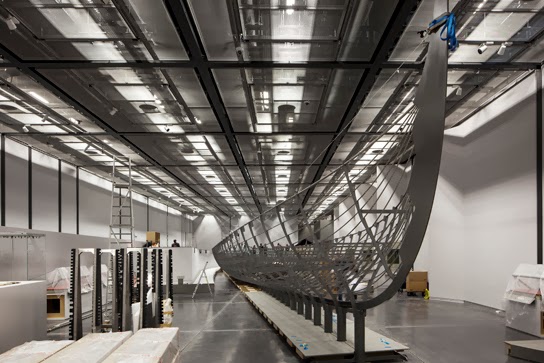
The stand--looking like the silver skeleton of a Viking ship--snaps together like a children's toy. Says Tom Williams of the British Museum, "This is a breathtaking work of modern design in its own right."
In Copenhagen, Roskilde 6 filled the hall from end to end, with the rest of the "Vikings!" exhibition organized around it. A wall-sized screen projected a slow-moving fjord scene. Standing on the raised "dock" beside the ship, you watched the scenery pass as if you were rowing on the ship. A thunderstorm approached; lightning struck. I expected to see Vikings frantically bailing--but it wasn't that real.
In January, Roskilde 6 "sailed" again to London, where it is the centerpiece of the "Vikings: Life and Legend" exhibition, running March 6 to June 22 at the British Museum. Photos courtesy of the British Museum, The National Museum of Denmark, and Kate Driscoll (of Crumlin-Pedersen).
Join me again next week at nancymariebrown.blogspot.com for another adventure in Iceland or the medieval world.
It was sleek and predatory, seven meters longer than the longest longship they had found in the 1950s, in the nearby Skuldelev harbor, for which the Viking Ship Museum was created. Those ships are now conserved and displayed in the museum's exhibition galleries, while replicas float at the dock outside. The biggest is named Havhingsten, or Sea Stallion, the replica of a 30-meter-long dragonship built in Glendalough, Ireland in 1042.Join me again next week at nancymariebrown.blogspot.com for another adventure in Iceland or the medieval world.
Wednesday, December 11, 2013
The Roskilde Viking Ship Museum
News of the terrible stormsurge that almost washed away the Viking Ship Museum in Roskilde, Denmark, earlier this month, brought up memories of my visit there in 2006, when I was researching my book The Far Traveler: Voyages of a Viking Woman.
Before then, when I imagined a Viking ship, I thought of the Gokstad ship, which I'm gazing at here in a photo from 1984. Found in the late 1800s in a burial mound in southern Norway, the Gokstad ship has the spareness and elegance of line that seem to me the epitome of a Viking ship. I’m not alone: closeups of its hull, head on, are reproduced on everything from magazine covers to Christmas ornaments as the emblem of the Vikings.
So I was disappointed at first to learn that the ship Gudrid the Far-Traveler sailed on to Vinland in North America did not look like this. Hers was a knarr, a cargo ship, like the replica Saga Siglar that sailed with copies of the Gokstad and Oseberg ships down the coast of North America in 1991. From the Ellis Island ferry, I had watched the three Viking ships sail into New York Harbor, side by side. In my notebook I wrote: "Saga Siglar is so squat and tubby compared to the others. It’s as if someone cut her too short."
Saga Siglar (the name means "Saga Sailor") was based on a ship recovered from the seabottom near Skuldelev, Denmark, by Ole Crumlin-Pedersen, whom I met in 2006 at the Viking Ship Museum in Roskilde. Tall, fair, white-haired, and smartly dressed in sailor's white, Crumlin-Pedersen had recently retired from the museum that housed his accomplishments: scraps of five Viking ships in five different styles, from a fishing boat to a dragonship, and a dock full of replicas made to their patterns. Nine more ships—found sunk in the museum's own harbor when they were expanding their exhibit space—were then in various stages of processing. One, the largest by far, a slim dragonship that carried up to 40 pairs of oars, is now the centerpiece of the Viking exhibition that just closed in Copenhagen and will be opening in London in the spring.
With a childlike smile and a courtly bashfulness, Crumlin-Pedersen explained to me how he knew that the tubby model was what the sagas meant by a knarr. "It’s because of the nickname for women in the Icelandic sagas: Knarrarbringu. 'Knarr breast.' Look at it from the front. It comes right up like this—" He pantomimed a woman's tight waist and heavy breasts.
"The replica ships going to Vinland should not be based on Gokstad," he continued, more seriously, "they should be based on this knarr, on Skuldelev 1. Gokstad is a combined sailing and rowing vessel, for a large crew. Skuldelev 1 is definitely a cargo ship. There's only a few oars for turning the ship in the wind or in harbor—it's a pure sailing vessel. Six men, working day and night, could handle it. On the other hand, you could have any number of people on board. You could move a farm with livestock and goods—but you wouldn't take more than one farm. Maybe to go to Vinland you would have wanted a vessel slightly larger than Skuldelev 1, but it would have been this same type of vessel."
The five Skuldelev ships had been scuttled at the head of the fjord to keep raiders from the Danish royal residence at Roskilde. Legend had it that they dated from Queen Margarethe's reign in the 1400s. But when parts of the barricade were removed by fishermen in the 1950s, to clear a deeper passage for their motorboats, Crumlin-Pedersen thought the bits he saw were Viking work. Trained as a maritime engineer, he signed on as a deep-sea diver to map out the wrecks, then, after a stint in the Navy, was hired by the Danish National Museum as a ship archaeologist. The Skuldelev site would be his training ground.
"Underwater archaeology was only just starting then," he told me as we toured the docks and warehouses and hands-on exhibits outside of the museum proper. "I went to the first conferences in Italy and London, and my colleagues tried to convince me that I should come to the warm, clear water of the Mediterranean, not stay in the cold, muddy water here. I insisted in exploring the potential here. It turned out to be very rich.
"We had thought the site was so damaged we could do no harm," he continued. "We had no experience. We could start there and continue on to more important sites. The first year we cleared the passage and found not one, but two ships. The next year, it was not two but four. The next year it was not four but six." (Later they would learn that ships number 4 and 6 were parts of a single widely-scattered vessel.)
"So we built a coffer dam. Sometimes it's a good thing to come from another education. As an engineer, I could come up with ideas and principles for the retrieving of ships that have become standards all over the world."
The coffer dam drained the fjord around the site. Then the problem was to lift the shattered wood out of the mud, while keeping it from drying out and disintegrating. "You keep the wood in water all the time until it can be treated with polyethylene glycol," Crumlin-Pedersen explained. A type of plastic, polyethelene glycol crystallizes within the wood cells. This plasticized wood can then be heated and gently pressed back into shape. "That brings out the lines of the boat."
Those lines are so various, just among the replica ships afloat in Roskilde harbor, that it's hard to say they’re all "Viking ships." The tubby knarr, 52 feet long and a buxom 16 feet wide, is docked beside the dragonship Havhingsten ("The Sea Stallion"), 98 feet long but a slender 12 feet wide. A smaller cargo ship, a byrding of more "elegant" proportions, carried only four-and-a-half tons of cargo to the bigger knarr's 24 tons, while a smaller warship, called a snekke or "snake," could only handle 30 warriors to Sea Stallion's 80.
And then there's the toy-sized fishing boat, 37 feet long by 8 feet wide, on which Crumlin-Pedersen signed me up as an oarsman when a German TV personality wanted to take a Sunday-morning ride. Nicely maneuverable in the narrow harbor (even with a raw crew brand-new to the oars), it seemed precariously low to the waves once the sail was up. Yet when they compared the pattern of the tree-rings in the original ship's pine timbers to wood samples from throughout the Viking world, they found a perfect match with the wood of the Urnes Stave Church in Sognefjord, Norway; the ship had been built there and had sailed the 500 miles to Roskilde at least once. By the time it was sunk to blockade the fjord, it had been patched in several places and refitted to be a small cargo ship, the rowlocks taken off and an extra strake added to give it a little more height.
All five Skuldelev ship types, Crumlin-Pedersen believes, developed after 900 out of the basic Gokstad style. "The development of cargo vessels seems to be a very late one in Scandinavia," he explained over a lunch of pickled herring and brown bread in the museum’s dockside restaurant (right under which, he pointed out, another longship had been found, 20 feet longer than Sea Stallion). "They didn’t have proper cargo vessels until the 10th century. I think that's because it was too dangerous to go out with a load of valuable cargo without a sufficient number of people to protect your goods. The Gokstad ship was capable of carrying eight to 10 tons of cargo, but also a sufficient crew to defend it. Then in the 10th to 11th centuries, we have the development of cargo ships and the transformation of warships into ships that couldn't carry cargo. I see that as a sign of royal control of the sea. It was one of the main jobs of the king, to keep trade safe."
The cargo ships got tubbier (and more practical), the warships got longer and sleeker and swifter; the principal of their design, according to Crumlin-Pedersen, being the "sporting element": fierce competition among royal Viking crews. One of these late longships is 11 times longer than it is wide and made from enormous oak trees, each thin plank over 32 feet long. "For the really royal ships, the shipbuilder had access to trees no one else could touch," Crumlin-Pedersen told me. "Such a ship as this is an amazing machine!" Racing such a royal ship, he said, must have been the sporting experience of a lifetime.
To read about the Viking Ship Museum's battle with the stormsurge, and see some spectacular photos, go to the museum's website, here: http://www.vikingeskibsmuseet.dk/en/about-us/news-room/photo-series/billedserie-vikingeskibene-stod-stormen-igennem/#c15886
There's also a film about the storm, here: http://www.vikingeskibsmuseet.dk/en/about-us/news-room/photo-series/billedserie-stormen-time-for-time/film-om-stormen/#c15878
Join me again next Wednesday at nancymariebrown.blogspot.com for another adventure in Iceland or the medieval world.
![]() |
| Photo by Katrin Driscoll |
![]() |
| Photo by Katrin Driscoll |
![]() |
| Photo by Katrin Driscoll |
Join me again next Wednesday at nancymariebrown.blogspot.com for another adventure in Iceland or the medieval world.
Labels:
Far Traveler,
Gudrid the Far-Traveler,
Icelandic sagas,
Leif Eiriksson,
medieval,
medieval science,
Newfoundland,
Ole Crumlin-Pedersen,
Roskilde,
saga,
travel,
Viking ship,
Vikings,
Vinland
Wednesday, October 9, 2013
Leif Eiriksson Day
Today, October 9, is officially Leif Eiriksson Day, named for the Viking explorer who discovered North America 500 years before Columbus (whose day we celebrate a symbolic three days later).
I've also heard from Donald Wiedman, who blogs at http://lavalhallalujah.wordpress.com. As he writes, "Though interested and intrigued by Denmark and Scandinavia, Donald was/is not on any particular mission to locate the lost Viking settlements in North America--but he’s positive he’s found them." Using Google Satellite and various old maps, he places Vinland in Laval, Quebec, which is in line with the speculations of many Old Norse scholars that any Vikings cruising the Gulf of St Lawrence would have sailed up the St Lawrence River toward what's now Quebec City.
But, like the Fara Heim sailors, unless Wiedman finds an archeological site with demonstrably Viking artifacts (as at L'Anse aux Meadows), the debate about where the Vikings sailed will go on and on.
Which is why it excites me. Icelandic storytellers kept the knowledge of Vinland alive for 200 years before it was written down in the two Vinland Sagas, The Saga of the Greenlanders and The Saga of Eirik the Red. These sagas were copied and recopied and come down to us in three manuscripts. The Saga of the Greenlanders takes up two pages in Flateyjarbók, the Book of Flatey, a beautiful manuscript written between 1387 and 1394. The Saga of Eirik the Red appears in two very different versions in Hauksbók, the Book of Haukur (1299-1334), and Skálholtsbók, the Book of Skalholt (written around 1420).
Six hundred years later, these Icelandic stories are still inspiring explorers and archaeologists. Their authors and editors and copyists should be proud. Today is their day too.
Join me again next week at nancymariebrown.blogspot.com for another adventure in Iceland or the medieval world.
Subscribe to:
Posts (Atom)