Showing posts with label British Museum. Show all posts

Wednesday, September 9, 2015

Meeting the Lewis Chessmen--In Person

"If you knew what they were valued at ..."

During a research trip to Edinburgh for my book Ivory Vikings: The Mystery of the Most Famous Chessmen in the World and the Woman Who Made Them, I had hoped to meet James Robinson, who wrote an excellent guidebook on the Lewis chessmen for the British Museum. Robinson is now a curator at the National Museum of Scotland (NMS), where 11 of the chessmen reside. I received no answer to my initial query, so I planned my research trip to Edinburgh without him.

A week before I left for Scotland, I tried again. Robinson immediately responded, apologizing that my email had been buried under a deluge of others while he'd been traveling. He would be away again while I was visiting Edinburgh, so we could not meet, but "I will forward your message to request access to the pieces for you," he said.

Until that moment, it had not occurred to me that I might "request access," that is, to see and handle the chessmen outside of their display case. And yet, because of Robinson's generous reading of my letter, that is exactly what happened. My request made its way to curator George Dalgleish, who asked which ones I wanted to see. He passed that information on to curator Jackie Moran, who cheerfully wrote to tell me that "I will get the chessmen off display at 08:00, as long as I can get the gallery lights switched on."


By 08:30 I was set up in Jackie's office at the NMS, with my computer, my notes, my camera, a borrowed magnifying glass, and the four chessmen I had chosen in a padded carrying case on the table in front of me. Jackie spread tissue on the tabletop and handed me a set of bright purple latex gloves, then returned to her own work at the desk behind me, leaving me face to face with these exquisite little 800-year-old works of art: a warder-rook, biting his shield like a Viking berserk; a bishop, raising his hand in blessing; and a king and queen pair.


The most interesting to me was the queen, whom I had thought at first had been broken and repaired. Now I could tell, studying her up close, that the patch had been applied (with four tiny ivory pegs) before the artist had finished her carving, in order to cover over a weak spot in the original walrus tusk. The workmanship was so fine and the materials so poor, compared to the other pieces, that I really had to wonder what was going through the artist's mind to have even tried to make a chess piece out of this defective lump of tusk.


Seated on her richly decorated throne, she has terrible posture. Her spine is hunched, her head juts forward; she looks old and almost all done in. Her hair is braided and looped up under a veil that is clipped in back. She wears a pleated skirt, a short gown, a robe with embroidered or fur-trimmed edges, a jewel at her throat, her wrists ringed with bangles. She is brooding, her jaw clenched. She claps her right hand to her cheek, cradles her elbow with the left.

Such love went into the making of that queen, I thought, marveling over her tiny fingers. Her left thumb curves back like mine does.


I was concentrating so hard on this little queen in my hand, turning her to take photos from all angles, that at one point my camera slipped out of my grasp. Thunk. I heard Jackie gasp. "It was the camera," I mumbled, and kept on with my work.

It wasn't until the next day, as I was having tea with former NMS curator David Caldwell in the museum cafe, that I realized how shocked Jackie must have been to have heard that thunk—and how completely the beauty of these pieces had made me forget everything but the desire to understand them. Said David, “If you knew what they were valued at, you wouldn’t want to pick one up.”


Read more about Ivory Vikings on my website, http://nancymariebrown.com, or check out these reviews:

"Bones of Contention," The Economist (August 29): http://www.economist.com/news/books-and-arts/21662487-bones-contention

"Review: Ivory Vikings," Minneapolis Star Tribune (August 29): http://www.startribune.com/review-ivory-vikings-by-nancy-marie-brown-the-mystery-of-the-lewis-chessmen/323230441/

Tuesday, September 1, 2015

Ivory Vikings Published Today!

Today is the official publication day of Ivory Vikings: The Mystery of the Most Famous Chessmen in the World and the Woman Who Made Them.

As a writer I live for such days, when the book that's been my world and work for the past three years finally meets you, the readers.

And the first reviews have reassured me that you're going to love it:

"Absorbing ... bristles with fascinating facts," said The Economist.

"A fascinating tale of discovery and mystery," said the Minneapolis Star Tribune.

"This book is a delight," said Booklist: "endlessly fascinating."

The New York Post included it in "This Week's Must-Read Books."

And on Amazon.com it's listed in "Best Books of the Month."

That's in addition to the wonderful blurbs it received from advance readers like Pulitzer-prize winner Geraldine Brooks, who said, "Brown's book is a true cornucopia, bursting with delicious revelations. Whether your passion is chess, art, archaeology, literature, or the uncanny and beautiful landscape of Iceland, Ivory Vikings offers rich and original insights by a writer who is as erudite as she is engaging."

To whet your appetite, here is the opening passage:

In the early 1800s, on a golden Hebridean beach, the sea exposed an ancient treasure cache: ninety-two game pieces carved of ivory and the buckle of the bag that once contained them. Seventy-eight are chessmen--the Lewis chessmen--the most famous chessmen in the world. Between one and five-eighths and four inches tall, these chessmen are Norse netsuke, each face individual, each full of quirks: the kings stout and stoic, the queens grieving or aghast, the bishops moon-faced and mild. The knights are doughty, if a bit ludicrous on their cute ponies. The rooks are not castles but warriors, some going berserk, biting their shield in battle frenzy. Only the pawns are lumps--simple octagons--and few at that, only nineteen, though the fourteen plain disks could be pawns or men for a different game, like checkers. Altogether, the hoard held almost four full chess sets--only one knight, four rooks, and forty-four pawns are missing--about three pounds of ivory treasure.
Who carved them? Where? How did they arrive in that sandbank or, as another account says, that underground cist--on the Isle of Lewis in westernmost Scotland? No one knows for sure: History, too, has many pieces missing. To play the game, we fill the empty squares with pieces of our own imagination.
Instead of facts about these chessmen, we have clues. Some come from medieval sagas; others from modern archaeology, art history, forensics, and the history of board games. The story of the Lewis chessmen encompasses the whole history of the Vikings in the North Atlantic, from 793 to 1066, when the sea road connected places we think of as far apart and culturally distinct: Norway and Scotland, Ireland and Iceland, the Orkney Islands and Greenland, the Hebrides and Newfoundland. Their story questions the economics behind the Viking voyages to the West, explores the Viking impact on Scotland, and shows how the whole North Atlantic was dominated by Norway for almost five hundred years, until the Scottish king finally claimed his islands in 1266. It reveals the struggle within Viking culture to accommodate Christianity, the ways in which Rome's rules were flouted, and how orthodoxy eventually prevailed. And finally, the story of the Lewis chessmen brings from the shadows an extraordinarily talented woman artist of the twelfth century: Margret the Adroit of Iceland.
The Lewis chessmen are the best-known Scottish archaeological treasure of all time. To David Caldwell, former curator at the National Museum of Scotland in Edinburgh, where eleven of the chessmen now reside, they may also be the most valuable: "It is difficult to translate that worth into money," he and Mark Hall wrote in a museum guidebook in 2010, "and practically impossible to measure their cultural significance and the enjoyment they have given countless museum visitors over the years." Or, as Caldwell phrased it to me over tea one afternoon in the museum's cafeteria: "If you knew what they were valued at, you wouldn't want to pick one up."
Too late for that. I'd already spent an hour handling four of them. Out of their glass display case, they are impossible to resist, warm and bright, seeming not old at all, but strangely alive. They nestle in the palm, smooth and weighty, ready to play. Set on a desktop, in lieu of the thirty-two-inch-square chessboard they'd require, they make a satisfying click.

I hope you'll join me at one of these events introducing Ivory Vikings. As more dates are scheduled, I'll add them to the Events page on my website at http://nancymariebrown.com.

September 9, 2015: Norwich Bookstore, Norwich, VT at 7:00 p.m.

September 11, 2015: Book Launch Party at 7:00 p.m. For an invitation, contact Kim at Green Mountain Books and Prints in Lyndonville, VT.

September 19, 2015: Northshire Bookstore, Manchester Center, VT at 7:00 p.m.

September 21, 2015: Scandinavia House, 58 Park Avenue, New York at 6:30 p.m.

October 15, 2015: The Fiske Icelandic Collection at Cornell University, Ithaca, NY at 4:30 p.m.

October 17, 2015: The Sixth Annual Iceland Affair, Winchester Center, CT; time to be announced.

November 1, 2015: Vermont Voices at Stone Church, Chester, VT at 2 p.m., hosted by Misty Valley Books.

Wednesday, March 5, 2014

Vikings Come to London

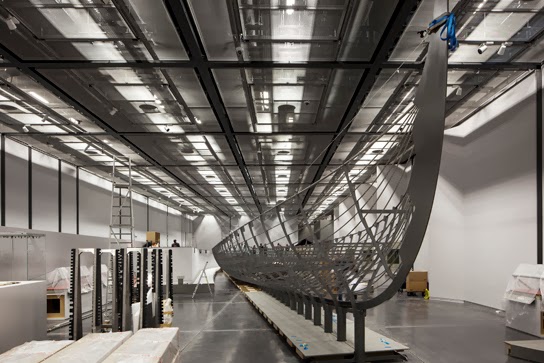
It's time for a field trip to London to see the "Vikings: Life and Legend" exhibition, which opens tomorrow at the British Museum. At its center is the biggest Viking ship in the world: a true dragonship.

I was lucky enough to see the ship last November at the "Vikings!" exhibition of the National Museum of Denmark in Copenhagen. Named Roskilde 6, the dragonship was discovered when the Viking Ship Museum in Roskilde, Denmark dredged its harbor area to build a restaurant and more exhibition space. I remember going to lunch with Ole Crumlin-Pedersen, former curator of the museum, when I was researching my book The Far Traveler in 2006. "Right under this restaurant we found another longship!" he exclaimed. "It stretched from this bush, almost to the edge of that building."

It was sleek and predatory, seven meters longer than the longest longship they had found in the 1950s, in the nearby Skuldelev harbor, for which the Viking Ship Museum was created. Those ships are now conserved and displayed in the museum's exhibition galleries, while replicas float at the dock outside. The biggest is named Havhingsten, or Sea Stallion, the replica of a 30-meter-long dragonship built in Glendalough, Ireland in 1042.

Roskilde 6 is 37 meters long. It was built near Oslo Fjord in 1025, according to tree-ring analysis, and carried 80 to 100 rowers. At one point, it traveled into the Baltic Sea, where it saw hard usage: A hole in the hull had to be patched. It was a king's ship, said Crumlin-Pedersen. "It’s of a very fine quality of craftmanship.

"It’s interesting," he continued. "Through these ship finds you can distinguish between different status levels, from ships of discount quality, to the Irish ship of standard quality, to the Roskilde ship of highest quality."

When it was made, King Olaf II (later known as Olaf the Saint) and Canute the Great, king of England and Denmark, were contesting the Norwegian throne. Roskilde 6 could have been built for either king.


"Ship finds," Crumlin-Pedersen added, "may lead you many places. I like to use the ship find as a lens through which to study the society. For years I’ve been in contact with sport divers, telling them the importance of protecting what’s lying on the seabed, trying to tell them that the great stories lie in the rotten timbers, not the gold coins."

Only 20 percent of Roskilde 6 is left--enough to make out its length and width (one tenth its length, of 3.7 meters). To preserve it took 15 years, according to the catalogue for the "Vikings!" exhibit at the National Museum of Denmark, "including 48 hours of vacuum freeze-drying in nine processes and more than 8,000 working hours in the conservation laboratory."

First the pieces were photographed and recorded, and all the parts numbered, while the "rotten timbers" lay on the harbor floor. Next the wreckage was transfered to water tanks at Roskilde and kept wet during cleaning "with water and paint brushes," to reveal traces of tool marks or carvings. Then it went to the National Museum's laboratories in Brede, north of Copenhagen, where the water in the wood was replaced with polyethylene glycol through the combination of freeze-drying and vacuum-processing.


Kristiane Straetkvern, who led the conservation team, writes, "The surviving parts of the wreck consisted of around 200 pieces and most of them were broken in many places. … The final part of the conservation process was to glue the broken pieces together." Then to design the support structure. "All the planks were provided with individual stainless steel supports. To ensure a safe move from one exhibition to the next, the timbers are packed in 35 boxes with individually designed crates."

The stand--looking like the silver skeleton of a Viking ship--snaps together like a children's toy. Says Tom Williams of the British Museum, "This is a breathtaking work of modern design in its own right."


In Copenhagen, Roskilde 6 filled the hall from end to end, with the rest of the "Vikings!" exhibition organized around it. A wall-sized screen projected a slow-moving fjord scene. Standing on the raised "dock" beside the ship, you watched the scenery pass as if you were rowing on the ship. A thunderstorm approached; lightning struck. I expected to see Vikings frantically bailing--but it wasn't that real.

In January, Roskilde 6 "sailed" again to London, where it is the centerpiece of the "Vikings: Life and Legend" exhibition, running March 6 to June 22 at the British Museum. Photos courtesy of the British Museum, The National Museum of Denmark, and Kate Driscoll (of Crumlin-Pedersen).


Join me again next week at nancymariebrown.blogspot.com for another adventure in Iceland or the medieval world.