Showing posts with label trolls. Show all posts

Tuesday, March 24, 2015

Trolls: An Unnatural History, by John Lindow

What is a troll? That's the question answered (sort of) by the very first troll on record, a troll-woman who accosted the 9th-century Viking skáld Bragi the Old on a deserted forest track late one night and challenged him to a poetry match.

Trolls call me moon of the dwelling-Rungnir, she declaimed: giant's wealth-sucker, storm-sun's bale, seeress's friendly companion, guardian of corpse-fjord, swallower of heaven wheel: what is a troll other than that?

In an earlier post I talked about how difficult it is to understand Viking poetry (see "The Viking Art of Poetry"). What do these kennings--giant's wealth-sucker, storm-sun's bale--mean? John Lindow, in his book Trolls: An Unnatural History (Reaktion Books 2014), only explains one of them: swallower of heaven wheel means "swallower of the sun or moon," which in Norse mythology is a wolf.

Is this troll a wolf? A shapeshifting werewolf? A wolf-like monster? Who knows--all that matters is, it's scary. Says Lindow, "The exchange between Bragi and the troll woman forms a paradigm that will often recur: a threatening encounter, in a place far from human habitation, between troll and human, with the human emerging unscathed in the end."

The trolls always lose. Remember that. It will help when you see how long-lived and nasty these creatures can be.

Through the Viking Age, the Saga Age, and into Iceland's Sturlung Age, when the Icelandic sagas were being written, trolls were a kind of malevolent land spirit. A woman who throws a love token away is said to have given it to the trolls. A warrior swears, "May the trolls take me if I never again redden my sword with blood." These trolls were "associated with the Other," Lindow notes: "the mysterious, inexplicable, and unknowable. … Or to put it another way," he adds later, "as the giants are to the gods in the mythology, so trolls are to humans."

Not until the later Middle Ages, will trolls take on the form familiar to us, the kind of ugly, stupid monster that appears in J.R.R. Tolkien's The Hobbit or J.K. Rowling's Harry Potter and the Sorceror's Stone. In Illuga saga Griðarfóstra (written as late as the 15th century), an Icelandic youth enters a cave in search of fire. He hears the heavy footsteps of the cave dweller and sees a decidedly un-wolflike troll woman:

He thought a storm or squall was blowing out of her nostrils. Mucus was hanging down in front of her mouth. She had a beard but her head was bald. Her hands were like the claws of an eagle, but both arms were singed and the baggy shirt she was wearing reached no lower than her loins in back but all the way to her toes in front. Her eyes were green and her forehead broad; her ears fell widely. No one would call her pretty.

This paragon of ugliness persists in our imagination largely due to folklorists Peter Christen Asbjørnsen and Jørgen Moe, who published a collection of Norwegian fairy tales in the 1840s. There we read: "'under that bridge lived a big, ugly troll, with eyes like pewter plates, and a nose as long as a rake handle.' Everybody knows this story," says Lindow. It's "The Three Billy Goats Gruff."

Of the ugly troll woman in the Icelandic cave, Lindow remarks: "What I find most striking about this description is the blurring of categories: male/female (beard and bald head), animal/human (claws), immodest/chaste (her garment). Such blurring suggests powerful operation of the imagination in creating the degree of otherness as it plays with the very shiftiness of trolls."

Blurring, otherness, shiftiness--and ugliness--these are the characteristics of the trolls that populate Scandinavian folk tales. In Sweden, "The trolls could change their shape," wrote folklorist Gunnar Olof Hylten-Cavallius, "and take on any sort of form whatever, such as hollowed-out trees, stumps, animals, skeins of yarn, rolling balls, etc."

Adds Lindow, "Trolls come at night. The night belongs to them, and they belong to the night." That's why--as Tolkien taught us--trolls turn to stone if the sun hits them. Actually, Lindow points out, that's only true for Icelandic trolls. According to Hylten-Cavallius, in Sweden it's giants whom the sun turns to stone. When Swedish trolls see the sun, they burst--pop!--and disappear.

Blurring, otherness, shiftiness, ugliness, and now darkness--or invisibility--or a dread of the light of truth… It didn't take long for literary artists to seize on the metaphor of the troll. When the Norwegian dramatist Henrik Ibsen in 1867 sent Peer Gynt into the Hall of the Mountain King, the troll-king asked, "What is the difference between trolls and humans?"

Answered Peer, "There is no difference, as far as I can tell. Big trolls want to cook me and small trolls want to claw me--same with us, if they only dared."

Norwegian author Jonas Lie said the same in his collection of stories, Trolls, published in 1891. In an introduction, he wrote: That there is something of the troll in human beings, everyone knows who has an eye for such things. It is situated inside in the personality and binds it like the immoveable mountain, the fickle sea, and violent weather...

He writes of seeing the troll inside an old lawyer: a strikingly wooden face, eyes like two dull opaque glass stones, a strangely certain power of judgment, not liable to be moved or led astray by impulses. His surroundings blew off him like weather and wind; his mind was so absolutely certain … Trolldom lives in that stage inside people as a temperament, natural will, explosive force.

Trolls in modern literature not only "threaten us from the outside," says Lindow, "but they can lurk inside, too."

Which brings us to today's trolls: Internet trolls. According to one list Lindow quotes, the wilderness of the web is populated by "plain trolls, bashing trolls, smartass trolls, non-caring trolls, opinion trolls, 12-year-old trolls, blaming trolls." They continue to be ugly, shifty, fearing the light.

"In the old tradition, people who spent time in the world of the trolls described it mostly as unpleasant," Lindow concludes, "and I cannot say that my brief visit to the world of today's trolls was in any way pleasant. Yet I experienced, ever more strongly, the fact that we cannot truly know trolls. If we could, they would not be trolls. This holds for the very first trolls, found in Viking Age poetry, through the trolls who populated the wilds of Scandinavia, to the trolls in books, films, and the Internet. Trolls are what we are not, or what we think we are not. Or was Jonas Lie right? Could there be a bit of troll in each of us?"
Trolls: An Unnatural History by John Lindow was published in 2014 by Reaktion Books.


Wednesday, October 30, 2013

Icelandic Witchcraft

On the way to Strandagaldur, the Museum of Icelandic Sorcery and Witchcraft, I had a panic attack. Getting to our B&B at Kirkjubóll was grueling: in and out of deep fjords, sometimes a paved road, sometimes gravel, sometimes two lanes, sometimes one, wind buffeting our tiny rental car, sun glare, traffic passing, pushing, campers and cars, and a sheer, sheer drop off to the sea far below, without even a white line to mark the edge of the road. It was tiring and took concentration to keep an eye on the road and not be distracted by the striking landscape or be pulled off into the void by that sheer, unmarked edge.

Did I mention I'm afraid of heights?

At a headland I pulled over between two campers (whose drivers were peeing over the edge) and my traveling companion, Jenny, pulled out her handy bottle of Rescue Remedy, a mix of herbs and vodka. Two drops on my tongue did the trick. My hands came uncramped from the wheel. I began to breath again.

Jenny is an herbalist. In Iceland when I introduced her, my friends would nod and whisper among themselves. Suddenly their faces lit up in a smile. "Oh, she's a witch!" And she did cure a little girl of the night terrors by giving her a potion and a posey to put under her pillow. Truly. 

Jenny's also a photographer, trained to see things differently. A perfect person to take to the Westfjords to see the witchcraft museum, someone's brilliant idea to lure tourists to an incredibly bleak part of Iceland with hair-raising roads.

When we reached our night's lodging, Jenny made herb tea from some leaves she picked behind the house. We took a stroll on an arc of black beach into the teeth of the wind, the late evening sun behind a mountain--this was June--bundled up in sweaters and scarves and ear-warmers (we could have used long underwear), singing, and picking up mussel shells, orange scallops, broken conchs, driftwood, feathers, sea urchins, while the arctic terns and oystercatchers and razorbills strafed us, shrieking. Suddenly, I was ecstatic: waves and mountains with snow on them, bird cries, cold. It was magic.

The next morning we drove to the town of Hólmavík in misty low cloud, over a gravel road between banks of old snow--it really was June--and a few brave tussocks of flowering lamb's-grass and bilberry. We passed more black-sand bays littered with driftwood logs. Someone had pulled them from the tide and sorted them by size. Also ropes, nets, pallets, and flat building panels. We passed a road sign that said "I." Jenny decided it meant, not "Information," but "Isolation."

Hólmavík is a very small town, even for Iceland. There's a gas station, a bank, a health clinic, and Strandagaldur, the Museum of Icelandic Sorcery and Witchcraft, which itself is very small but beautifully designed by Árni Páll Johannsson, who also designs movie sets. The exhibits are evocative, the descriptions informative, with a good mix of "wow" displays and deep scholarly stuff (reproductions of manuscript pages, maps, timelines, genealogies).

The English audio-guide took about an hour and focused mostly on who the witches were and why they were singled out. Their stories were well-told: You could draw your own conclusions about their magic powers and were sympathetic to these 20 men and 1 woman who were burned at the stake in the late 1600s for being different. Many were the victims of one rich woman, the sheriff's wife, who accused someone of witchcraft every time she got sick. In another case, the priest was awarded "compensation" for any acts of witchcraft in his parish--meaning he got to confiscate all the witch's property. Quite an incentive to accuse a neighbor of working black magic. I bought the book Angurgapi: The Witch-hunts in Iceland by Magnús Rafnsson to learn more.

Then there's the magic itself, with lots of spells written in runes. I bought a booklet of Love Spells. Here's one:


It says you are supposed to carve this design on a piece of bread and cheese and give it to your beloved to eat. A sure way to his or her heart.

Other spells will make your sheep docile or give them twin lambs, protect them from being drowned in floods or keep foxes away, make fish jump onto your hooks, keep a scythe sharp, and strengthen your rowing or wrestling or grass-mowing skill.

Still other spells will prevent theft, kill an enemy's horse, or just break its leg. To keep visitors away, according to another booklet published by the museum, carve this rune stave 


on a piece of rowan wood when the sun is at its zenith. Walk three times around the house the way the sun turns and three times widdershins (the opposite way) holding the carved rowan stick in one hand and "sharp thorn grass" in the other. Then lay both of them on the gable above your house door.

The rune stave at the head of this blog post, the Helm of Awe or Ægishjálmur, used as the museum's logo, induces fear and protects you against abuses of power--if you carve it in lead and press it on your forehead.

The grisliest (and most popular) magic item on view at the museum was the pair of corpse-skin trousers or "necropants" that promise to make you rich. You can see a video about them here on their website [click here].

Here's how to make them, according to the website--be sure to get permission first!

If  you want to make your own necropants (literally, nábrók), you have to get permission from a living man to use his skin after his death. After he has been buried, you must dig up his body and flay the skin of the corpse in one piece from the waist down. As soon as you step into the pants, they will stick to your own skin. A coin must be stolen from a poor widow and placed in the scrotum along with this magical sign


written on a piece of paper. Consequently the coin will draw money into the scrotum so it will never be empty, as long as the original coin is not removed. 

If you want to go to heaven after you die, however, you have to be sure to pass your necropants on to someone else while you're alive (and still rather flexible): That person has to step into each leg of the skin as soon as you step out of it. The necropants can thus keep a family in riches for generations.

Note that, despite what you might have read elsewhere on the internet (such as at the International Business Times, here), the necropants in the museum are plastic fakes, not "dead human skin on display," as that headline claims. The article itself is clear: "just a replica, according to The Huffington Post." (The headline at HuffPo also screams: "Necropants, Made from Dead Man's Skin…" Told you this was the most popular exhibit.)

The Sorceror's Cottage was a good second act. "Let there be mist and mischief," said a witch from these parts in the most famous of the medieval Icelandic sagas, Njal's Saga. We drove about an hour farther to see the cottage, through mist, on rocky, bumpy, scary roads, and encountered more than enough mischief in the form of a strange knocking sound from beneath our car that sounded like we were dragging a body--but when we stopped to look nothing was there. Might have been a stone in the wheel-well. We hoped so, at least.

The Sorceror's Cottage is a very rough turf-house of the poorest sort, a low-ceilinged, dirty hovel with a pen for the sheep next to two beds for the people. Again, it was very realistically recreated, stocked with 17th-century tools and rough, hooded robes. The curator wisely told us to go through the house twice: look, read the text, then look again. 

When there are more than two tourists, the curator puts on her witch's robe and acts the part. With us she simply shared the story of the three trolls who tried to separate the Westfjords from the rest of Iceland so they could escape the awful ringing of the church bells. She gave us directions to the rock stacks the trolls turned into when the sun rose and caught them at their work. 

We went to find them and had a picnic beside one troll, a tall, black slab of columnar basalt laid up sideways like a stack of firewood, the size of a house but only about 6 feet thick. It stood on a grassy lawn between the swimming pool and some guest cottages at the hamlet of Drangsnes. On the way there we had passed the other two trolls, standing at the tip of a rocky headland with their feet in the sea. 


Join me again next Wednesday at nancymariebrown.com for another adventure in Iceland or the medieval world.

Wednesday, August 1, 2012

Tolkien’s Icelandic Trolls


My recent post on Bilbo Baggins’s ride and the influence of Iceland on JRR Tolkien brought a wonderful response from Þóra Magnúsdóttir in Iceland, who sent me a link to the February 28, 1999 issue of the Icelandic newspaper Morgunblaðið. There, reporter Linda Ásdísardóttir interviewed 89-year-old Arndís Þorbjarnardóttir who had been an au-pair in the Tolkien household while JRR Tolkien was writing The Hobbit.

Describing her time in Oxford, Arndís noted that the Tolkien boys often asked her to tell them about Iceland, especially “about trolls and monsters.” After reading The Hobbit, she said, she realized “the professor” had been listening in to her Icelandic tales. He must have, “to create those little folk who have hairy toes just like ptarmigans!”

I must admit I never before saw any similarity between hobbits and ptarmigans.

But I have long thought Tolkien’s trolls were Icelandic.

The troll scene in The Hobbit is one of my favorites. Bert, Bill, and Tom are so blusteringly barbaric, comparing the taste of mutton to manflesh, and Bill’s squeaking purse is such a fine surprise for both Bilbo and the reader. But mostly I liked Tolkien’s scene for its ending:

“Dawn take you all, and be stone to you!” Gandalf pronounced, after having kept the trolls arguing among themselves all night until the sun came up. “And there they stand to this day, all alone, unless the birds perch on them,” Tolkien writes, “for trolls, as you probably know, must be underground before dawn, or they go back to the stuff of the mountains they are made of, and never move again.”

John Rateliff, in his fascinating two-part study, The History of the Hobbit (HarperCollins, 2007), finds Tolkien’s “as you probably know” to be rather coy. Tolkien “seems to have introduced the motif” of trolls turning to stone if struck by the sun’s rays “to English fiction,” Rateliff writes, so his readers could not possibly have known.

Yet I knew. Perhaps not the first time I heard The Hobbit read to me, at the age of four, but at least by the time I read it to my own son when he was four in 1993. For by then I had been to Iceland several times.

And in Iceland you can hardly take a hike without meeting a troll—often with birds perched on them, as in the beautiful picture book by Guðrun Helgadóttir and Brian Pilkington, Flumbra: An Icelandic Folktale (Iðunn 1981; though they call Flumbra a giant, not a troll). Here is one of Pilkington’s illustrations:


The summer my family lived at the abandoned farm of Litla Hraun on the west coast of Iceland—a summer described in my book A Good Horse Has No Color, as well as in my husband’s Summer at Little Lava (FSG 1998)—we looked out our window every day at the story of a troll.

One night, an amorous trollwoman decided to visit her lover on the western end of the Snaefellsnes peninsula. She took her horse, and a bucket of skýr (a kind of Icelandic yogurt) as a gift. She and her lover sported all night and she got a late start going home. About the middle of the peninsula, she dropped the empty bucket to ride faster. A little further on, her horse foundered and she abandoned him, running as hard as she could for home. The sun caught her at the mountain pass now named for her, Kerlingarskarð, and turned her to stone. Or at least that’s how our neighbor, the farmer at Snorrastaðir, told us the story.


Out my window, I could easily pick out the mountain peaks called Skýr Bucket and Horse. (You can see the back of the Horse just above the crater of Eldborg in this photo.) Crossing (on the old road) north to the town of Stykkishólmur, I would crane my head out the car window to say hello to the old trollwoman, the Kerling.

On a later visit to Skagafjörður, I learned the story of the blocky island Drangey that dominates the fjord. A troll and his wife had a cow in heat, but their cowherd was away so they decided themselves to lead her across the fjord to a neighbor’s bull. They misjudged the distance. The rising sun caught them only halfway across the water, and there they remained: the cow as the island itself, Karl as a tall rock stack on the seaward side, and Kerling as a matching stack on the landward side (though one or the other of the trolls, I forget which, has since tumbled down).


Every Icelandic farmer I’ve met knows stories like these of the mountains and islands and rocks near his or her farm. One of my friends jokes that you can’t take a step in Iceland without standing on a story. I agree. And while we know that Tolkien himself never visited Iceland, it seems that Iceland—and its stories—visited him. In the interview in Morgunblaðið, Arndís notes that she was not the first Icelandic au-pair to work for the Tolkiens in Oxford. Aslaug, an Icelandic woman who had gone to school with Arndís, had been there for the previous year and a half and had gotten Arndís the job. Who knows what stories Aslaug might have told. Perhaps the stories of Iceland’s Hidden Folk, who are so much like Tolkien’s elves?


Wednesday, May 2, 2012

A Troll’s Tale from Iceland


A few years ago, I rode a marvelous blue-dun horse across Iceland. Nearing the end of our six-day trek, we stopped for lunch at the church of Haukadalur, near the famous geysers. To entertain us while we ate, our trekking guide, Svandis, told the story of the church and its resident troll.

Bergthor of Blafell was unlike other trolls: He liked the sound of church bells. He was further unusual, in Icelandic folklore, for having a human best friend. One day Bergthor (whose name means Mountain Thor, or God of the Mountain), asked his friend to do him a favor. “When I die, will you bury me beside the church?”

His friend agreed. “But how will I know you are dead?”

“I will prop my walking stick outside my cave the night I die, and I will leave a chest of gold beside my bed to pay for the funeral.”

All happened as the troll said. The friend saw the walking stick propped against the cave door. He got a party together to fetch the huge corpse. He found a little chest—but it was full of dry, yellow leaves.

Heaving a sigh (What do you expect from a troll?), he fulfilled his side of the bargain and brought the corpse to church. They dug a grave just outside the churchyard and buried Bergthor beneath a red stone. It’s still there—“You can go see it,” Svandis said.


We dutifully traipsed through the churchyard, peeking into the windows of the little wooden church with its four pews and blue-painted ceiling. There was the stone, “Bergthor” carved in a suspiciously modern font.

“But that’s not the end of the story,” Svandis said.

One of the gravediggers suddenly felt his pants slipping down. He had filled his pockets with dead leaves from the chest, and the leaves had turned to solid gold.

The troll’s friend hurried back to the cave to fetch the forgotten chest of gold—but it was too late. It was gone.

“He should have trusted Bergthor’s word,” Svandis said, “even if he was a troll.” He should have trusted the God of the Mountain.


You can read another version of this story in the book A Traveller's Guide to Icelandic Folk Tales by Jón R. Hjálmarsson. For a review of the book from the newspaper, The Reykjavík Grapevine, click here.

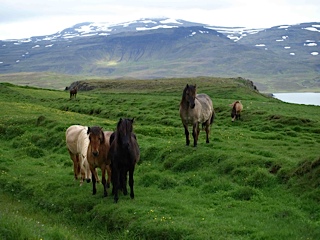
If you're inspired to ride across Iceland like I did, I recommend Íshestar's Highland tour named Kjölur. The photo above comes from their website, which has many other inspiring shots of Iceland's interior highlands, the haunt of trolls.

Join me again next Wednesday for another adventure in Iceland or the medieval world at http://nancymariebrown.blogspot.com.