Showing posts with label Snorrastadir. Show all posts

Wednesday, November 6, 2013

Touring Saga Land

I'm in Iceland, for the 18th time, to learn more about the sagas. And although today is a library day (gray skies, spitting rain, fierce wind), I'm hoping to visit some saga sites over the weekend. I might rent a car, or even take a bus tour.

When I first went to Iceland in 1986, saga tourism was minimal. I, like many writers before and since, wanted to see the places made vivid and unforgettable by the medieval authors: 

Where Njal and his wife, their house afire, their enemies surrounding it, refused to come out. Said Njal, "I am an old man now and ill-equipped to avenge my sons; and I do not want to live in shame." Said Bergthora, "I was given to Njal in marriage when young, and I have promised him that we would share the same fate." 

Where Gunnar's horse stumbled and he spoke the famous lines, "How lovely the slopes are, more lovely than they have ever seemed to me before, golden cornfields and new-mown hay. I am going back home, and I will not go away."

But these places were on working farms and the farmers, understandably, treasured their privacy. I passed by on the main road, looked from afar, was never quite sure I'd found the right spot.

Now, I'm happy to say, there's a museum devoted to Njal's Saga at Hvolsvöllur [www.njala.is] in southern Iceland, offering exhibits and guided tours to the saga sites. There's even a community-wide activity, embroidering the Story of Burnt Njal in the style of the Bayeux tapestry.

In fact, according to an Icelandic publication called The Museum Guide 2013, there are currently 134 museums in Iceland--for a population of 320,000. Can you imagine 134 museums in Pittsburgh, PA or St. Louis, MO? Of these 134, by my count 11 focus on the sagas or the Viking Age. 

In addition to the Saga Centre in Hvolsvöllur, one of my favorites is the Settlement Centre in Borgarnes in western Iceland. [www.settlementcentre.is] One of its exhibits explores the settlement of Iceland between 870 and 930, as told in the sagas; the other tells the story of Egil's Saga through renderings by modern artists. An audio guide for your smartphone allows you to drive around the vicinity and find the places mentioned in the saga.

Such as the farm of Borg, where Egil, depressed, lay down to die after the drowning of a beloved son. One of his daughters craftily revived his will to live by getting him to make a poem about it, the beautiful “Lament for My Sons”: 
My mouth strains
To move the tongue,
To weigh and wing
The choice word:
Not easy to breathe
Odin’s inspiration
In my heart’s hinterland,
Little hope there… 

The poem is as much about poetry, the “purest of possessions,” the “word-mead,” as it is about the dead boy. “Now I feel it surge, swell / Like a sea, old giant’s blood.” As he created the poem, the saga says, “Egil began to get back his spirits.” When it was finished, he took his seat in the hall and declaimed the lament before all the family. 

A little further inland is Snorrastofa [www.snorrastofa.is], a museum, library, and research centre named for the 13th-century writer Snorri Sturluson on the site of his estate, Reykholt. Snorri may have written Egil's Saga. He is better known as the author of Heimskringla, a set of 16 sagas that contain almost everything we know about the history of Norway from its foundation to 1177. His masterpiece, though, is the Edda, which is our major (and sometimes our only) source for the stories of Norse mythology. 

In my biography of Snorri, Song of the Vikings, I imagine him in the hot-tub at Reykholt, regaling his friends with the story of Odin's eight-legged horse, Sleipnir:

One day while Thor was off fighting trolls in the east, a giant entered the gods’ city of Asgard. He was a stonemason, he said, and offered to build the gods a wall so strong it would keep out any ogre or giant or troll. All he wanted in return was the sun and the moon and goddess Freya for his wife.
The gods talked it over, wondering how they could get the wall for free. “If you build it in one winter, with no one’s help,” the gods said, thinking that impossible, “we have a deal.”
“Can I use my stallion?” the giant asked.
Loki replied, “I see no harm in that.” The other gods agreed. They swore mighty oaths.
The giant got to work. By night the stallion hauled enormous loads of stone, by day the giant laid them up. The wall rose, course upon course. With three days left of winter, it was nearly done.
“Whose idea was it to spoil the sky by giving away the sun and the moon—not to mention marrying Freyja into Giantland?” the gods shouted. They wanted out of their bargain. “It’s all Loki’s fault,” they agreed. “He’d better fix it.”
Loki transformed himself into a mare in heat. That evening, when the mason drove his stallion to the quarry, his horse was uncontrollable. It broke the traces and ran after the mare. The giant chased after them all night and, needless to say, he got no work done. Nor could he finish the wall the next day with no stone. His always-edgy temper snapped. He flew into a giant rage. The gods’ oaths were forgotten. Thor raised his terrible hammer and smashed the giant’s skull.
Eleven months later, Loki had a foal. It was grey and had eight legs. It grew up to be the best horse among gods and men. 

There's a wonderful exhibition about Snorri Sturluson's life and art at Reykholt now. Last June I spent a good hour or two going through it with a group of tourists from the horse-trekking company America2Iceland. I had very few quibbles with the text--not surprising, since it was written by Óskar Guðmundsson, whose masterful 2009 biography, Snorri: Ævisaga Snorra Sturlusonar 1179-1241, inspired me to write Song of the Vikings. 

We dipped our fingers in Snorri's hot-tub, before mounting our horses to continue our week-long trek through the countryside of Borgarfjord. Yes, you guessed it, I am now leading saga tours myself. They're not precisely the kind of tours I was looking for in 1986--but I hadn't discovered the joys of riding Icelandic horses back then. If you'd like to join me in 2014, visit America2Iceland.com and put your name on the list.


Join me again next week at nancymariebrown.blogspot.com for another adventure in Iceland or the medieval world.
Wednesday, August 15, 2012

Homosexuality in the Icelandic Sagas


 A story I read the other day in The Reykjavík Grapevine, “Iceland’s First Gay Lovers,” surprised me by explaining something I had written about many years ago.

In 1997, while researching my book A Good Horse Has No Color, I stayed for some weeks at Snorrastadir in the west of Iceland. One afternoon I listened in as the farmer, Haukur, and another guest, a horsewoman named Hallgerdur, discussed Njal’s Saga, the medieval masterpiece that contains a famous “feminist” character also named Hallgerdur.

Here’s how I described the scene in my book:

…Known for her hip-length hair and her “thief’s eyes,” this storied Hallgerdur had been wooed and wed by the handsome Gunnar of Hlidarendi, that paragon of Icelandic manhood who, according to the saga, could “jump more than his own height in full armor, and just as far backwards as forwards.”

“He could swim like a seal,” the book said.

“There was no sport at which anyone could even attempt to compete with him.”

“There has never been his equal.”

The marriage was a disaster. It ended in Gunnar’s death when, his house surrounded by enemies his wife had made for him, his bowstring broke and he asked for some strands of her long hair to plait into a new one; she refused.

Snorrastadir at midnight.

It was this that Haukur and Hallgerdur were discussing: why the Saga-Age Hallgerdur—an historical woman who lived and died about a thousand years ago—had refused the gift of her hair.

They chattered on too fast for me to more than snatch at the argument. I marveled again that these sagas, of esoteric, antiquarian interest at home, were so alive here, centuries after they were written. I was heading again for that hot cup of tea when Haukur gave out a great guffaw.

“Er Gunnar á Hlidarendi, nú, hommi?!” he asked. “Is Gunnar of Hlidarendi, now, a homosexual?”

I stopped. I looked at Hallgerdur. The answer she was arguing was yes. You could write a dissertation on that one, I thought—Homosexuality in Njal’s Saga. Gunnar did have an unusually close friendship with Njal, whose manhood was in question because he couldn’t grow a beard. I wished I could comprehend the details of Hallgerdur’s thesis and join in the conversation, but though I’d read the saga several times and knew it inside out, my spoken Icelandic wasn’t up to the task. I retreated to the kitchen, where Ingibjorg gracefully drew my attention to the fact that the dishwasher could be unstacked and the table set for dinner. With the clatter drowning out Haukur’s increasing outrage, I replayed the point in English in my head and awarded the set and match to Hallgerdur…

Snorrastadir and the crater Eldborg.

That’s what I witnessed in 1997.

I had gone to Iceland first in 1986, after studying Old Norse for several years—and having been taught that the language was “dead,” like Latin. As I wrote earlier in this blog (“Practical Education”), I was delighted to learn to the contrary on that first visit that Old Norse wasn’t “dead” after all. It had just shifted into Icelandic, changing about as much as English has since Shakespeare’s day.

By 1997 (my seventh trip to Iceland), I knew that the sagas themselves were still very much alive, some 800 years after they had been written. Everywhere I went in Iceland, someone shared an allusion from a saga. The medieval past was remembered in the name of every hill and farmstead (not to mention every beer and candybar). There was a saga everywhere I turned.

What I didn’t know, when I witnessed Haukur and Hallgerdur arguing over homosexuality in Njal’s Saga, was the news peg.

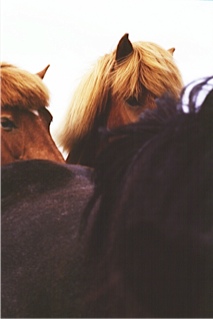
Horses at Snorrastadir.

It’s true that Icelandic farmers are surprisingly keen readers compared to the farmers I know in America. Another day I came upon Haukur and a guest comparing the novel Independent People, by Iceland’s Nobel prize-winner Halldor Laxness, to Growth of the Soil, by the Norwegian Nobelist, Knut Hamsun.

But Homosexuality in Njal’s Saga was not Hallgerdur’s idea. The dissertation didn’t need to be written—a book was already in print, as I learned last week from The Reykjavík Grapevine.

In “Íslenska Kynlífsbókin” (The Icelandic Sex Reader), published in 1990, Óttar Guðmundsson, a psychiatrist at the Landspítali hospital in Reykjavík, “famously argued that Njáll and Gunnar, heroes of ‘Njáls Saga,’ were gay and in love with each other,” the Grapevine says. The newspaper also mentions Óttar’s new book, “Hetjur og hugarvíl” (Anxious Heroes), “devoted to psychoanalysing the main characters of some of the more prominent Icelandic Sagas.”

Looks like I have some further reading to do. And a thank-you letter to send to psychiatrist Óttar Guðmundsson for his help in keeping the Icelandic sagas alive.

Join me again next Wednesday at nancymariebrown.blogspot.com for another writing adventure in Iceland or the medieval world.

Wednesday, August 1, 2012

Tolkien’s Icelandic Trolls


My recent post on Bilbo Baggins’s ride and the influence of Iceland on JRR Tolkien brought a wonderful response from Þóra Magnúsdóttir in Iceland, who sent me a link to the February 28, 1999 issue of the Icelandic newspaper Morgunblaðið. There, reporter Linda Ásdísardóttir interviewed 89-year-old Arndís Þorbjarnardóttir who had been an au-pair in the Tolkien household while JRR Tolkien was writing The Hobbit.

Describing her time in Oxford, Arndís noted that the Tolkien boys often asked her to tell them about Iceland, especially “about trolls and monsters.” After reading The Hobbit, she said, she realized “the professor” had been listening in to her Icelandic tales. He must have, “to create those little folk who have hairy toes just like ptarmigans!”

I must admit I never before saw any similarity between hobbits and ptarmigans.

But I have long thought Tolkien’s trolls were Icelandic.

The troll scene in The Hobbit is one of my favorites. Bert, Bill, and Tom are so blusteringly barbaric, comparing the taste of mutton to manflesh, and Bill’s squeaking purse is such a fine surprise for both Bilbo and the reader. But mostly I liked Tolkien’s scene for its ending:

“Dawn take you all, and be stone to you!” Gandalf pronounced, after having kept the trolls arguing among themselves all night until the sun came up. “And there they stand to this day, all alone, unless the birds perch on them,” Tolkien writes, “for trolls, as you probably know, must be underground before dawn, or they go back to the stuff of the mountains they are made of, and never move again.”

John Rateliff, in his fascinating two-part study, The History of the Hobbit (HarperCollins, 2007), finds Tolkien’s “as you probably know” to be rather coy. Tolkien “seems to have introduced the motif” of trolls turning to stone if struck by the sun’s rays “to English fiction,” Rateliff writes, so his readers could not possibly have known.

Yet I knew. Perhaps not the first time I heard The Hobbit read to me, at the age of four, but at least by the time I read it to my own son when he was four in 1993. For by then I had been to Iceland several times.

And in Iceland you can hardly take a hike without meeting a troll—often with birds perched on them, as in the beautiful picture book by Guðrun Helgadóttir and Brian Pilkington, Flumbra: An Icelandic Folktale (Iðunn 1981; though they call Flumbra a giant, not a troll). Here is one of Pilkington’s illustrations:


The summer my family lived at the abandoned farm of Litla Hraun on the west coast of Iceland—a summer described in my book A Good Horse Has No Color, as well as in my husband’s Summer at Little Lava (FSG 1998)—we looked out our window every day at the story of a troll.

One night, an amorous trollwoman decided to visit her lover on the western end of the Snaefellsnes peninsula. She took her horse, and a bucket of skýr (a kind of Icelandic yogurt) as a gift. She and her lover sported all night and she got a late start going home. About the middle of the peninsula, she dropped the empty bucket to ride faster. A little further on, her horse foundered and she abandoned him, running as hard as she could for home. The sun caught her at the mountain pass now named for her, Kerlingarskarð, and turned her to stone. Or at least that’s how our neighbor, the farmer at Snorrastaðir, told us the story.


Out my window, I could easily pick out the mountain peaks called Skýr Bucket and Horse. (You can see the back of the Horse just above the crater of Eldborg in this photo.) Crossing (on the old road) north to the town of Stykkishólmur, I would crane my head out the car window to say hello to the old trollwoman, the Kerling.

On a later visit to Skagafjörður, I learned the story of the blocky island Drangey that dominates the fjord. A troll and his wife had a cow in heat, but their cowherd was away so they decided themselves to lead her across the fjord to a neighbor’s bull. They misjudged the distance. The rising sun caught them only halfway across the water, and there they remained: the cow as the island itself, Karl as a tall rock stack on the seaward side, and Kerling as a matching stack on the landward side (though one or the other of the trolls, I forget which, has since tumbled down).


Every Icelandic farmer I’ve met knows stories like these of the mountains and islands and rocks near his or her farm. One of my friends jokes that you can’t take a step in Iceland without standing on a story. I agree. And while we know that Tolkien himself never visited Iceland, it seems that Iceland—and its stories—visited him. In the interview in Morgunblaðið, Arndís notes that she was not the first Icelandic au-pair to work for the Tolkiens in Oxford. Aslaug, an Icelandic woman who had gone to school with Arndís, had been there for the previous year and a half and had gotten Arndís the job. Who knows what stories Aslaug might have told. Perhaps the stories of Iceland’s Hidden Folk, who are so much like Tolkien’s elves?