Showing posts with label Tolkien. Show all posts

Wednesday, November 30, 2016

That Stern High World

"Icelandic studies may be more than a mere cultural discipline; they may contribute to the positive exaltation of those who pass through them into that stern high world where our forefathers lived and died with fearless eyes and undefeated hearts." – Watson Kirkconnell, OC FRSC (1895–1977)

When the Icelandic-Canadian newspaper Lögberg-Heimskringla sent that snippet of wisdom out over its Facebook page last November, it struck a chord--though one with a bit of dissonance.

I do rather like the idea that my many years of studying Icelandic sagas have resulted in my "positive exaltation," and I think I know what Kirkconnell means by "that stern high world."

It's rather like what J.R.R. Tolkien and C.S. Lewis characterized by the term "Northernness." As I wrote in Song of the Vikings, these writers of high fantasy were not only drawn to the Norse mythology's dragons and dwarves, fair elves and werewolves, wandering wizards, and trolls that turned into stone, but to their portrayal of men with a bitter courage who stood fast on the side of Right and Good even when there was no hope at all.

According to Tolkien, this theory of courage was "the great contribution of early Northern literature." It is a "creed of unyielding will," the heroes refusing to give up even when they know the monsters will win.

For that is the big difference between the Norse Ragnarok and the Christian Doomsday. Odin and the human army of Valhalla do not win. They have no hope of winning. They are doomed and they know it.

There's a "shadow of despair" about these heroes, Tolkien noted, an "intense emotion of regret" as in his own fantasy world. For even if Middle-earth is saved from the evil forces of Sauron, the elves must leave; magic will dwindle. Still men and elves, dwarves, wizards, and hobbits fight and die for the Good and the Right.

But there's a big gap--a Ginnungagap--between Kirkconnell's "fearless eyes and undefeated hearts" and Tolkien's despair and regret.

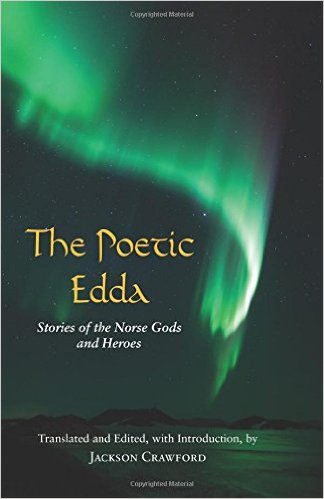
In the introduction to his new translation of the poems of the Poetic Edda (Hackett Publishing, 2015), Jackson Crawford attempts to bridge that gap, pointing out that many of these heroic and mythological poems allude to "the belief that each person has an inevitable, fixed date of death, decided by the shadowy goddesses of fate called the Norns."

Sigurd is not afraid of fighting the dragon Fafnir because nothing he can do (or not do) will change the date of his death. If he kills the dragon, it was fated to be so. If the dragon kills him, ditto. All he can do is "manage his own wealth / till his fated death-day"--with all the good things in life wrapped up in that one word "wealth."

Likewise Sorli can shrug off losing the battle by saying, "But we fought well, /... We earned honor here, / though we are fated to die today-- / a man will not live one day longer / than the Norns have decided."

Writes Crawford, "The characters in these myths are marching toward their doom, unable to change course or to step off their predetermined path even if they fight it the entire way." But are they hopeless? despairing? We, the readers of these myths, may despair for them, but "the gods and heroes alike are actively engaged in courageously combating the inevitable," Crawford writes. "This code of boldness and the defiance of fate must have stirred something in the Norse audience in their barren farmsteads ... just as it may stir a modern audience faced with the seemingly hopeless circumstances of life in the crowded, postindustrial world of today."

We may no longer believe in the Norns, but it's still true that each one of us is fated to die. It does no good to live in fear of it. Why not instead spend our days earning honor? Our methods may be a little different than Sorli's or Sigurd's or Frodo's, but it's still a stern high world out there.

Tuesday, August 25, 2015

Did Tolkien Ever Go to Iceland?

No, Tolkien never went to Iceland. Elsewhere on this blog (see "The Tolkien Connection"), I've talked about how much Tolkien was inspired by Iceland and Icelandic literature--and how his love of Iceland inspired me.

Tolkien's trolls are Icelandic trolls. His hobbit holes are like Icelandic turf houses. Bilbo's ride to Rivendell matches, more or less, a ride through the Icelandic landscape. Gandalf's character comes from Icelandic tales of Odin. Hobbits, too, may have Icelandic antecedants. But Tolkien never went to Iceland.

I've always thought that was sad. It was Tolkien who, in a roundabout way, sent me to Iceland the first time, and I've been back about 20 times since. Iceland has inspired five of my seven books.


But a recent conversation on the listserv of the Mythopoeic Society made me think of Tolkien's travel gap in a different way. Wrote David Bratman, a librarian and Tolkien scholar, "Tolkien, and the Inklings in general, tended to consider merely visiting places to be over-rated as a way of getting to know them."


Bratman refers to a letter Tolkien wrote to his son Christopher in 1943, in which he complains about what some people might call progress: "The bigger things get the smaller and duller or flatter the globe gets. It is getting to be all one blasted little provincial suburb. ... At any rate it ought to cut down on travel. There will be nowhere to go. So people will (I opine) go all the faster."

Instead of travelers, Bratman explains, Tolkien and his friends were "bookmen, who learned of places through deep immersion in the literature of a place, and not just in reports by other visitors. Tolkien's thorough knowledge of Icelandic civilization came from his intensive and lifelong reading of Old Norse literature."

For Tolkien, that approach obviously worked. For me--not so much.

For one thing, I write history and historical fiction, not fantasy. What places actually look like matters to me. When I wrote Song of the Vikings, for example, I spent several weeks tromping around in the area Snorri Sturluson ruled in the 13th century. Suddenly I understood why his father, in Sturlunga Saga, got involved in a feud over the ownership of the seemingly inconsequential farm of Deildartunga.


Nowhere in the saga does it explain that Deildartunga owned the highest-volume hotspring in the world. Because of this feud, Snorri was fostered by Jon Loftsson and educated at Oddi, where he learned to write. This hotspring, you could say, led directly to the writing of Heimskringla: The History of the Kings of Norway and The Prose Edda, containing nearly all that we know of Norse mythology, and perhaps even Egil's Saga, which influenced the writing of so many other sagas.


Such on-the-ground research in Iceland and Greenland also helped me write The Far Traveler and my young adult novel based on it, The Saga of Gudrid the Far-Traveler. I spent months living where Gudrid lived, walking where Gudrid walked, taking a boat down the fjord Gudrid sailed or a horse into the mountains where Gudrid rode.


True, things have changed since she lived there around the year 1000. I took full advantage of electric lights, geothermal heat, jeeps, power boats, hi-tech hiking clothes, you name it. But some things hadn't changed: the wind on my face, the stinging rain, the way the sun sank behind the mountains, the cries of the birds, the smell of the seaweed or the hay, the spirited horses, how difficult it was to walk through a lumpy, bumpy, frost-heaved pasture without twisting an ankle, the way the tide surged in over the sea flats.


Armchair travel is one of my favorite pastimes. All winter I travel through books--and it's the only way I know to travel back in time. But come summer, my wanderlust isn't so easily contained and you can find me--for at least part of the time--in Iceland. After 20 visits in nearly 30 years, I'm just getting to know the place.

Tuesday, March 24, 2015

Trolls: An Unnatural History, by John Lindow

What is a troll? That's the question answered (sort of) by the very first troll on record, a troll-woman who accosted the 9th-century Viking skáld Bragi the Old on a deserted forest track late one night and challenged him to a poetry match.

Trolls call me moon of the dwelling-Rungnir, she declaimed: giant's wealth-sucker, storm-sun's bale, seeress's friendly companion, guardian of corpse-fjord, swallower of heaven wheel: what is a troll other than that?

In an earlier post I talked about how difficult it is to understand Viking poetry (see "The Viking Art of Poetry"). What do these kennings--giant's wealth-sucker, storm-sun's bale--mean? John Lindow, in his book Trolls: An Unnatural History (Reaktion Books 2014), only explains one of them: swallower of heaven wheel means "swallower of the sun or moon," which in Norse mythology is a wolf.

Is this troll a wolf? A shapeshifting werewolf? A wolf-like monster? Who knows--all that matters is, it's scary. Says Lindow, "The exchange between Bragi and the troll woman forms a paradigm that will often recur: a threatening encounter, in a place far from human habitation, between troll and human, with the human emerging unscathed in the end."

The trolls always lose. Remember that. It will help when you see how long-lived and nasty these creatures can be.

Through the Viking Age, the Saga Age, and into Iceland's Sturlung Age, when the Icelandic sagas were being written, trolls were a kind of malevolent land spirit. A woman who throws a love token away is said to have given it to the trolls. A warrior swears, "May the trolls take me if I never again redden my sword with blood." These trolls were "associated with the Other," Lindow notes: "the mysterious, inexplicable, and unknowable. … Or to put it another way," he adds later, "as the giants are to the gods in the mythology, so trolls are to humans."

Not until the later Middle Ages, will trolls take on the form familiar to us, the kind of ugly, stupid monster that appears in J.R.R. Tolkien's The Hobbit or J.K. Rowling's Harry Potter and the Sorceror's Stone. In Illuga saga Griðarfóstra (written as late as the 15th century), an Icelandic youth enters a cave in search of fire. He hears the heavy footsteps of the cave dweller and sees a decidedly un-wolflike troll woman:

He thought a storm or squall was blowing out of her nostrils. Mucus was hanging down in front of her mouth. She had a beard but her head was bald. Her hands were like the claws of an eagle, but both arms were singed and the baggy shirt she was wearing reached no lower than her loins in back but all the way to her toes in front. Her eyes were green and her forehead broad; her ears fell widely. No one would call her pretty.

This paragon of ugliness persists in our imagination largely due to folklorists Peter Christen Asbjørnsen and Jørgen Moe, who published a collection of Norwegian fairy tales in the 1840s. There we read: "'under that bridge lived a big, ugly troll, with eyes like pewter plates, and a nose as long as a rake handle.' Everybody knows this story," says Lindow. It's "The Three Billy Goats Gruff."

Of the ugly troll woman in the Icelandic cave, Lindow remarks: "What I find most striking about this description is the blurring of categories: male/female (beard and bald head), animal/human (claws), immodest/chaste (her garment). Such blurring suggests powerful operation of the imagination in creating the degree of otherness as it plays with the very shiftiness of trolls."

Blurring, otherness, shiftiness--and ugliness--these are the characteristics of the trolls that populate Scandinavian folk tales. In Sweden, "The trolls could change their shape," wrote folklorist Gunnar Olof Hylten-Cavallius, "and take on any sort of form whatever, such as hollowed-out trees, stumps, animals, skeins of yarn, rolling balls, etc."

Adds Lindow, "Trolls come at night. The night belongs to them, and they belong to the night." That's why--as Tolkien taught us--trolls turn to stone if the sun hits them. Actually, Lindow points out, that's only true for Icelandic trolls. According to Hylten-Cavallius, in Sweden it's giants whom the sun turns to stone. When Swedish trolls see the sun, they burst--pop!--and disappear.

Blurring, otherness, shiftiness, ugliness, and now darkness--or invisibility--or a dread of the light of truth… It didn't take long for literary artists to seize on the metaphor of the troll. When the Norwegian dramatist Henrik Ibsen in 1867 sent Peer Gynt into the Hall of the Mountain King, the troll-king asked, "What is the difference between trolls and humans?"

Answered Peer, "There is no difference, as far as I can tell. Big trolls want to cook me and small trolls want to claw me--same with us, if they only dared."

Norwegian author Jonas Lie said the same in his collection of stories, Trolls, published in 1891. In an introduction, he wrote: That there is something of the troll in human beings, everyone knows who has an eye for such things. It is situated inside in the personality and binds it like the immoveable mountain, the fickle sea, and violent weather...

He writes of seeing the troll inside an old lawyer: a strikingly wooden face, eyes like two dull opaque glass stones, a strangely certain power of judgment, not liable to be moved or led astray by impulses. His surroundings blew off him like weather and wind; his mind was so absolutely certain … Trolldom lives in that stage inside people as a temperament, natural will, explosive force.

Trolls in modern literature not only "threaten us from the outside," says Lindow, "but they can lurk inside, too."

Which brings us to today's trolls: Internet trolls. According to one list Lindow quotes, the wilderness of the web is populated by "plain trolls, bashing trolls, smartass trolls, non-caring trolls, opinion trolls, 12-year-old trolls, blaming trolls." They continue to be ugly, shifty, fearing the light.

"In the old tradition, people who spent time in the world of the trolls described it mostly as unpleasant," Lindow concludes, "and I cannot say that my brief visit to the world of today's trolls was in any way pleasant. Yet I experienced, ever more strongly, the fact that we cannot truly know trolls. If we could, they would not be trolls. This holds for the very first trolls, found in Viking Age poetry, through the trolls who populated the wilds of Scandinavia, to the trolls in books, films, and the Internet. Trolls are what we are not, or what we think we are not. Or was Jonas Lie right? Could there be a bit of troll in each of us?"
Trolls: An Unnatural History by John Lindow was published in 2014 by Reaktion Books.


Wednesday, February 25, 2015

Michael Ridpath's "Where the Shadows Lie"


"Amid Iceland's wild, volcanic landscape, rumors swirl of an ancient manuscript inscribed with a long-lost saga about a ring of terrible power..."

Whoever wrote the jacket copy for Michael Ridpath's thriller Where the Shadows Lie, number one in his Fire & Ice series, might just as well have added, "This one's for you, Nancy," because, though I've never met Ridpath, I think he had me in mind as his perfect reader.

Rarely have I read a book about Iceland by a non-Icelander in which I can find nothing to complain about. (Okay, maybe the behavior of the golden plovers.) Ridpath may have grown up in Yorkshire and live in London, but it's clear he's visited Iceland--probably as many times as I have--and he hasn't just hung around Reykjavik and seen the standard tourist spots. He's read a lot of the books I have on my shelves, from Njal's Saga to Jesse Byock's Viking Age Iceland to J.R.R. Tolkien's Lord of the Rings, and he's mashed them all up inside a wholly believeable crime novel that has real people bumbling around in a real Iceland.

Here is an example. Our hero, Magnus, an Icelander who has grown up in Boston and is now a Boston police officer, and an Icelandic woman named Ingileif are driving through south Iceland, in the shadow of Mount Hekla:

At Ingileif's direction, Magnus turned off the road and along a dirt track, winding up through the hills and into a small valley. His police-issued Skoda strained to maintain traction: the road was in poor condition and in places very steep. After a bone-rattling eight kilometres they finally came across a small white farm with a red roof nestling in the hillside at the head of its own little valley. Beneath the farm the obligatory lush green home meadow stretched down to a fast-flowing stream. The rest of the grass in the valley lurked brown and lacklustre, where it wasn't still covered in snow.
Alfabrekka.
"'How fair the slopes are,'" Ingileif said.
Magnus smiled as he recognized the quotation from Njal's Saga. He finished it: "'Fairer than they have ever seemed to me before.'"

I've been in that car. I've had that interaction--though usually the Icelanders with me don't offer such an obvious quotation to complete.

And when the story continues, I recognize the farmhouse, the kitchen, the people there:

The father, an impossibly wizened man, stirred himself from a comfortable armchair, while the mother busied herself with coffee and cakes. A stove warmed the living room, which was chock full of Icelandic knick-knacks, including at least four miniature Icelandic flags.
And a giant high-definition television screen. Just to remind them that they were truly in Iceland.
The younger farmer who had greeted them did most of the talking. His name was Adalsteinn. And before they could ask him any questions he told them about his parents, the fact that he himself was single, the fact that the farm had been in the family for generations, and particularly the fact that farming these days was tough, very tough indeed.
The coffee was delicious, as were the cakes.

Michael Ridpath has met Icelanders and paid attention to their wisdom and depth, as well as to the obvious quirks and foibles most journalists seize upon. He understands how Icelanders feel about volcanoes and glaciers--as well as elves and trolls. Most importantly, he understands Icelandic sagas and the role they have played in Icelandic culture.

And not only in Icelandic culture. One of the reasons I wrote my biography of Snorri Sturluson, Song of the Vikings, was to reveal how, through Tolkien, medieval Icelandic literature has shaped modern American and British culture. A number of readers have told me how surprised they were to learn, as one put it, that Snorri Sturluson was the "granddaddy of Bilbo Baggins."

Ridpath makes the same point--effortlessly and convincingly--in Where the Shadows Lie, though he has the advantage of fiction where I had to stick to fact.

For centuries, a family of Icelanders has hidden away a saga--and the ring of power it refers to. One of the only people they allowed to read it was J.R.R. Tolkien, and it clearly inspired The Lord of the Rings. (They even have letters from Tolkien to prove it.) So when the economic crisis hits Iceland and one of the family members decides to bail out her business by selling the family saga, it finds a ready market in LOTR fans. One of them is a Silicon Valley billionaire. Another is a Yorkshire truck driver. A number of people get bashed in the head and/or plunge to their deaths beside waterfalls before Magnus, our Boston cop, solves the mystery. As he and the Yorkshire truck driver are rushing to prevent the final killing, the Yorkshireman says,

"'There's nothing wrong in being a Lord of the Rings fan… What is wrong is when you let it blind you to what's going on in the real world.' He looked around at the extraordinary countryside flashing through the mist around them. 'Although sometimes I find it hard to believe that this country is part of the real world.'"

"I know what you mean," Magnus says.

I know what he means too.


Learn more at http://www.michaelridpath.com/icelandic-series-home.html

Wednesday, November 27, 2013

Turf Houses and Hobbit Holes

Whenever I see an Icelandic turf house, especially from the back, I think of the opening of Tolkien's The Hobbit:

"In a hole in the ground there lived a hobbit. Not a nasty, dirty, wet hole, filled with the ends of worms and an oozy smell, nor yet a dry, bare, sandy hole with nothing in it to sit down on or to eat: it was a hobbit-hole, and that means comfort."

When I first went to Iceland, I wondered why it seemed so familiar. Then I learned that Tolkien had read William Morris's journal of his travels to Iceland in 1873 and used them as the basis for much of the hobbit Bilbo Baggins's quest.

Morris's view of an Icelandic turf house, though, was that of a guest. "We are soon all housed in a little room about twelve feet by eight," he writes, "two beds in an alcove on one side of the room and three chests on the other, and a little table under the window: the walls are panelled and the floor boarded; the window looks through four little panes of glass, and a turf wall five feet thick (by measurement) on to a wild enough landscape of the black valley, with the green slopes we have come down, and beyond the snow-striped black cliffs and white dome of Geitland's Jokul."

Quaint and pretty, it seems--with a little imagination, it could be a hobbit hole.

But what was it really like to live in a turf house?

When I was in Iceland earlier this month, I picked up a book by the writer Thórbergur Thórdarson that has just come out in English translation as The Stones Speak. Thórbergur was born in 1888 in a remote part of the country. He moved to Reykjavik in 1906, became a schoolteacher, and in 1924 published a novel, Bréf til Láru (or, Letter to Lára) that "became an overnight sensation," says translator Julian Meldon D'Arcy. (The book also got him fired from his teaching job.) Thórbergur is now considered "as important an author in the Icelandic canon as his friend, the contemporary novelist and Nobel Prize winner Halldór Laxness," D'Arcy says.

The Stones Speak tells of his childhood living in a turf house in Suðursveit, about 400 kilometers east of Reykjavik near the beautiful national park of Skaftafell. If you want to get an idea of what it was like to live in Iceland in the early 1900s, this is the book to read.

Here is how he describes his home:

"Its three houses stood next to each other in a row with their peaked front gables facing south and their sterns toward the mountain. It was a pleasure to see them from the home field below standing side by side like that, as if they were taking care of each other, and it was easy to see that they all got on well together. When it started to grow dark it was as if they slept all huddled up as one."

It's characteristic of Thórbergur's writing style to infuse the houses with feeling, as if they were alive--as if they, like the stones of the title, the paving stones outside his front door, could speak. What stories they could tell if only we would listen!

Yet for all the warmth with which he looks back on his childhood home, Thórbergur's eye is sharp. One of my favorite passages in The Stones Speak describes the kitchen, warmed by its fire of sheep dung:

"The first thing you saw when you came in through the kitchen passageway, after you'd just carried in the dung, was the dung screen. This was a high wall made from stacked sheep droppings at the front of the dung heap to prevent the heap from tumbling all over the floor. The screen reached right across the kitchen, from wall to wall, a short distance from the fireplace. I thought it was beautiful. It made quite an artistic impression on me seeing the droppings regularly stacked up like cards on top of each other and side by side in a high and broad wall. And when the fire blazed brightly in the fireplace, a living glow flickered on this screen in different shades and tones. It was a poem in living colours. What a pleasure it was to look at, it was as if something delightful was aroused deep inside me as I stood and gazed at it."

A pile of sheep shit--is a "poem in living colours"! Thórbergur's description made me laugh. He is writing as the older and wiser man looking back on his naive childish self and, of course, he means to make me laugh. But he also means to make me think. Here in Vermont we heat with wood, not sheep dung, and those who stack the wood also take pride in their work. I could probably even find one or two who would describe their woodstacks as poems.

Another key feature of Thórbergur's kitchen was its rather temperamental smoke vent: When the wind changed, someone had to climb up onto the kitchen roof to reposition the vent.

Writes Thórbergur:
"In good weather it was always nice to get up onto the front wall of the kitchen. From there the whole of existence was a little different from down on the paved forecourt. The home field became broader and so did the Lagoon. Breiðabólsstaður and Gerði and the sheepcotes and stables on the home field seemed lower. You could see further out over the sea and west to the Breiðamerkursandur gravel plain. Hrollaugseyjar isles were a little further from land, and the folk and the dog on the forecourt became smaller while you yourself became bigger. That's life for you. When you yourself become big, others become small."

The Stones Speak by Thórbergur Thórdarson was published in 2012 by Mál og Menning, an imprint of the publisher Forlagið. You can buy it from the publisher's website, here: http://www.forlagid.is/?p=601952

The first two turf-house photos accompanying this blog are of the farmhouse in the Skagafjordur Heritage Museum at Glaumbær--about as far from Thórbergur's Suðursveit as you can get and still be in Iceland--but one of the best-preserved turf houses in the country. Learn more about it at: http://www2.skagafjordur.is/default.asp?cat_id=1123

The last one is from the Skogar Folk Museum in south Iceland: http://www.skogasafn.is. I wrote about visiting both Skogar and Glaumbær in June in "An Icelandic Horse(hair) Tale": http://www.nancymariebrown.blogspot.com/2013/06/an-icelandic-horse-hair-tale.html

Join me again next Wednesday at nancymariebrown.blogspot.com for another adventure in Iceland or the medieval world.

Thursday, June 27, 2013

Names for the Sea


British writer Sarah Moss and I are kindred spirits. Shortly after I visited Greenland to see Viking Age archaeological sites in 2006, I read her novel Cold Earth, in which strange things happen during an archaeological investigation in Greenland. The novel remains one of my favorites, recommended to many friends, so it's no surprise I bought her memoir about a year in Iceland, Names for the Sea, as soon as it was available in the U.S. I have always wanted to spend a year in Iceland.

Instead, I visit frequently and I read a lot about Iceland--though most of what I read disappoints me. American journalists always seem to have landed on some other island that bears no relationship to the Iceland I've known and loved since 1986. For one thing, I've spent very little time in the city of Reykjavik, particularly the city these journalists seem to find, with its "diverse milieu of funky cafes, cutting-edge restaurants and Icelandic-chic bars, all catering to a cozy chat society that hummed late into the infinite night" (NY Times, January 18, 2013), and where "half the country appears to take it as a professional obligation to drink themselves into oblivion and wander the streets until what should be sunrise" (Vanity Fair, April 2009).

Never seen it. Granted, I'm never out wandering the city streets in the wee hours looking for it. Reykjavik to me is a city of libraries, museums, and bookstores--especially bookstores, some of which I'll grant are funky (like the one inside the weekly flea-market at Kolaportid), and which I wish were open until what should be sunrise.

Sarah Moss, in Names of the Sea, doesn't dwell on the drunken nightlife. She's in Iceland to teach English literature at the university, with a husband and two young children in tow. But her Iceland is still not my Iceland. In a year she seems to have rarely left the city. And she never discovered the joys of the bookstores. She does not read Icelandic, she confesses. I'll forgive her that. Icelandic is a very difficult language to learn.

But Moss also doesn't seem to have read much Icelandic literature in translation. Particularly, in a whole year of living in the country, Moss doesn't seem to have read a single Icelandic saga.

That is harder for me to understand. Iceland without its sagas is just not Iceland. Iceland's medieval manuscripts, in which the sagas are preserved, "are at one and the same time the repository of medieval Icelandic culture and its visible symbol," according to the 2004 book The Manuscripts of Iceland. They are Iceland’s "main source of pride."

Only someone who had never read an Icelandic saga could write, as Moss does: 

"The sagas are long narrative poems about the settlement years, which were first written down in the 12th and 13th centuries, several hundred years after the events they describe. In the 20th century, Icelandic historians questioned the status of the sagas as historical truth, and the poems are now widely seen as literary artefacts, but there is still something of the sacred text about them. Many Icelanders can quote the sagas in the way that 17th-century Puritans quoted the Bible. Every so often, a discussion in a faculty meeting will end with someone saying something in Icelandic alliterative verse. … everyone else will be nodding and agreeing, the issue somehow resolved, and I'll know the sagas have spoken again. They combine the functions of the Bible and the Domesday Book…"

Poems? Narrative poems?? At first I thought it was a typo, and Moss meant to say "the sagas are long narratives." But no, she repeats the word poems and even believes her fellow academics were quoting the sagas when they said something in alliterative verse. They were not.

Moss has missed the whole point of the sagas' literary-historical importance. The Icelandic sagas are not poems. If someone was quoting alliterative verse, they were probably quoting the Poetic Edda, or maybe just a proverb.

The Icelandic sagas are "the envy of most world literatures," according to scholar William Ian Miller, because they are not poems: The sagas are written in prose. About 40 tales, some as quick as a short story, others stretching to several volumes in today’s paperback translations, make up the corpus. They tell of Iceland’s Golden Age, the Saga Age, 400 years of a free republic before the island succumbed to Norwegian rule in 1262. And they tell it beautifully: "This is not only the stuff of art," said Miller, "it is the stuff of a confident art that needs no instruction in sophistication."

In the 13th century, when verse was the norm in Europe, Icelanders were writing a vernacular prose that "achieved a height of excellence which can only be paralleled in modern times," declared E. V. Gordon, author of the standard Old Icelandic grammar book. 

Peter Hallberg, who wrote a college text on the sagas, compared their style to Hemingway’s, with its simple, lucid sentence structure and finely calculated artistic effects. And there is none of that “metaphysical brooding,” in Hallberg’s words, that make medieval works like Dante’s Divine Comedy, for example, so tedious.

The sagas are Iceland’s claim to literary fame. Literary scholars have called them "muscled, powerful narratives" that are surprising in their "seductiveness." They have inspired countless authors, from Kipling and Longfellow to Milan Kundera and Günter Grass. 

J. R. R. Tolkien found much of his Middle Earth in Icelandic literature; he and C. S. Lewis started a saga-reading club at Oxford University and translated the texts from Old Norse, the Viking language. 

Another saga translator was the Victorian writer and designer William Morris. Asked once if he was going on a trip to Iceland, Morris replied, "No, I am going on a pilgrimage to Iceland." 

Quoting Morris, the Argentine poet Jorge Luis Borges said, "This is also my answer. Any specialist in Anglo-Saxon literature is sooner or later drawn to Icelandic literature. It is like admiring a sunset or falling in love." 

The American novelist Jane Smiley ranks the sagas beside the works of "Homer, Shakespeare, Socrates, and those few others who live at the very heart of human literary endeavor."

I enjoyed Names for the Sea. It was fun to see Iceland through the eyes of a sensitive observer to whom everything was new--the light on the mountainsides, the cruel shapes in the lava, the misty rain, the ever-present sea. I envied her her ability to knit. But Moss's Iceland--without sagas!--is not my Iceland. 

Join me again next Wednesday at nancymariebrown.blogspot.com for another adventure in Iceland and the medieval world.

Wednesday, May 15, 2013

Songs of the Vikings


"I know giants of ages past, … I know how nine roots form nine worlds / below the Earth where the Ash Tree rises..."

Last week I heard the "Song of the Sibyl" for the first time. I'd read this classic Old Icelandic poem, this witch's vision of the creation and destruction of the world many times in both English and the original language. I'd written about it in my book Song of the Vikings: “What troubles the gods? What troubles the elves?”

But never before had I heard someone recite it. In Old Icelandic, spontaneously, spouting off a few stanzas to make his point.

I was in Kalamazoo, Michigan, at the yearly conference of 5,000 or so of my fellow wizards, um, medieval scholars. One I'd particularly hoped to meet was Terry Gunnell of the University of Iceland. I knew him for his translations of Icelandic folklore, but Gunnell is most interested in drama--old drama, like that of the Poetic Edda, which to me was never drama before but just a bunch of poems on a page. Some, like "Song of the Sibyl," I found quite moving. Others I thought were silly.


Then I listened to Gunnell speak on "Performance and the Study of Old Norse Religions."

When we read an oral poem silently, we "necessarily" take it out of context, Gunnell said, quoting the great scholar of oral literature John Miles Foley.

Added Gunnell, "We ignore the 'happening.'" The two poems he was talking about, Eiriksmál and Hákonarmál (loosely, "the Lay of Eirik" and "the Lay of Hakon"), "were not intended as written texts. They were meant as soundscapes presented to an audience who brought knowledge to them. They demand movement in space and gesture."

Think of a mead hall like the one in Beowulf,  or our Hollywood image of Valhalla, or Beorn's hall in Tolkien's The Hobbit: a great wood-ceilinged hall with tree trunks for pillars, a long fire bisecting it, benches full of boisterous Vikings (or dwarves in Tolkien's version) brandishing their drinking horns. Someone stands up and starts reciting Hákonarmal.

"The room is dark and smoky," said Gunnell. "The long fire is raising shadows. Impure alcohol has been imbibed. The performer is saying I. He's using the words in here. He's putting himself into the role of Odin, and the audience finds itself playing a role as well: We are the dead heroes of Valhalla and Ragnarok is about to become…

"We need to get away from seeing these poems as literature and to think of them more like music," Gunnell said in the Q&A afterwards. "Listen to the music of Völuspá"--it's here he started reciting it, the syllables crashing and clashing. It wasn't at all like the version on YouTube by Sveinbjörn Beinteinsson, which is all smooth and lilting and frankly puts me to sleep:


Gunnell's version was more like the concert I saw in Boston a few months ago by Sigur Rós: hammering, pulsing, the sound cracking open the mind.

"Listen," said Gunnell. He only gave us two stanzas. "It starts slow and open, then boom-boom-boom-boom, there's this little punk routine in the middle. Think of the smoke, the light, the booze. It's a PowerPoint in your head. The poet creates images in your head, helped by the alcohol and the next morning you say, What the hell was that?"


After the lecture I went up to Gunnell. "How much beer do I have to buy you to hear you recite the whole poem?" He laughed, but I was serious. I hope to meet him again in Iceland and be transported to the mead hall. I'll never just read the songs of the Vikings again.

Join me again next Wednesday at nancymariebrown.blogspot.com for another adventure in Iceland or the medieval world.

Wednesday, February 20, 2013

The Spirit of the North


At the end of Song of the Vikings, I traced the effect of Snorri’s Edda and other medieval Icelandic literature on fantasy writers William Morris, J.R.R. Tolkien, and C.S. Lewis. They were smitten, writes Lewis, by “pure ‘Northernness.’”

One writer I did not include, but should have, was E.R. Eddison.

I read Eddison’s The Worm Ouroboros, published in 1922, just after reading The Lord of the Rings for the first time. I clearly remember talking to my English teacher about Tolkien—I think I was in seventh or eighth grade—and asking, Are there any more books out there like his? She suggested The Worm Ouroboros.

Tolkien once called Eddison “The greatest and most convincing writer of invented worlds that I have read.” I wouldn’t go that far. But, looking back, Eddison and Tolkien may be the writers most responsible for my love, not of fantasy novels, but of “Northernness.” Rereading The Worm Ouroboros, my favorite part would have to be the introductory scene on page 2 of my tattered paperback:

…He had her hand in his. This was their House.
            “Should we finish that chapter of Njal?” she said.
            She took the heavy volume with its faded green cover and read: “He went out on the night of the Lord’s day, when nine weeks were still to winter; he heard a great crash, so that he thought both heaven and earth shook. Then he looked into the west airt and he thought he saw thereabouts a ring of fiery hue, and within the ring a man on a gray horse. He passed quickly by him, and rode hard. He had a flaming firebrand in his hand, and he rode so close to him that he could see him plainly. He was black as pitch, and he sung this song with a mighty voice—
            Here I ride swift steed,
            His flank flecked with rim,
            Rain from his mane drips,
            Horse mighty for harm;
            Flames flare at each end,
            Gall glows in the midst,
            So fares it with Flosi’s redes
            As this flaming brand flies;
            And so fares it with Flosi’s redes
            As this flaming brand flies.
“Then he thought he hurled the firebrand east towards the fells before him, and such a blaze of fire leapt up to meet it that he could not see the fells for the blaze. It seemed as though that man rode east among the flames and vanished there… So he went and told Hjallti, but he said he had seen ‘the Wolf’s Ride, and that comes ever before great tidings.’”
            They were silent awhile…

Njal’s Saga was the first saga I ever read—over Thanksgiving break in my second year of college, I believe. I don’t now recall if I recognized that passage from The Worm Ouroboros when I saw it in the original, but I do know that the fire-rider or volcano-spirit has long been one of my favorite images from medieval Iceland.

The Tolkien quote appears on the cover of a new edition of Styrbiorn the Strong, published by the University of Minnesota Press in 2011 with an afterword by Paul Edmund Thomas.

 “Styrbiorn’s name has sounded in my memory like a drum ever since, twenty years ago, I first read the passing reference to him in the Eyrbyggja Saga,” Eddison wrote in a letter to his younger brother in 1922. According to Thomas, Eddison bought the William Morris and Eirikr Magnusson translation of the saga in 1900.

Writing to his typist just after The Worm Ouroboros came out, Eddison said, “I am starting on a new book: a historical story this time about people who really lived in this world, in the Viking age in Sweden a thousand years ago, the age of the great classic saga literature of the north, which I have studied these twenty years and which I love more than any other.”

What about the sagas inspired him? In the “Closing Note” to Styrbiorn the Strong, Eddison explained: “The spirit of the North, to the inheritance of which I believe (pace Mr. Hilaire Belloc) our own country largely owes her greatness, is embodied in its purest form in its prose epic, the Icelandic Sagas of the classical age, such as (to name a few) Njal’s Saga, the Laxdale Saga, the Saga of Egil Skallagrimsson, Gisli’s Saga, and the Saga of Hrafnkel the Priest of Frey.”

He continued: “There is no ‘Keltic Twilight’ here, no barbaric exaggerations, no embroidery, no weaving of words or fancies, no boggling at truth: there is much shrewd insight into character and the springs of action, a power of direct and vivid narrative rarely matched in any other literature, much deep-seated humour and philosophy of hard and manly life.”

And finally: “But this is not the place to do more than hint at some obvious qualities of that genius which has shed about the lives of a few great families, dwelling in lonely homesteads in distant Iceland, an atmosphere of tragic and epic grandeur like the grandeur that is about windy Ilios; bringing us, in the end, as Homer brings us, not to take sides with Greeks or Trojans, with Njal’s sons or the Burners, but to ponder (somewhat perhaps as the Gods may ponder) on the greatness and the pitifulness of human things.”

It’s interesting to read Styrbiorn the Strong and see how close Eddison came to his models. And then, of course, to reread a saga. Perhaps Eyrbyggja Saga.

For as Eddison said in his letter to his brother, “There is no saga of the Swedish prince after whom this story is named. If there were, I do not think my story would have been written. For it is not my study to emulate a writer for whose other work I have a respect, in treating the sagas as Tate & Cibber treated Shakespeare, tricking out these imperishable prose epics of the north with modern fripperies of sentimental love interest and psychological disquisition. … I am so simple as to believe that those grand stories are so elemental, so beautiful, so firm set in the soil of life, that they are quite able to look after themselves.”

Join me again next Wednesday at nancymariebrown.blogspot.com for another writing adventure in Iceland or the medieval world.


Wednesday, February 13, 2013

Snorri the Hobbit?


A year after completing my biography of Snorri Sturluson, Song of the Vikings, I am rethinking his character. Snorri, I now see, was a hobbit.

Writing about Tolkien’s debt to Snorri at the end of my book, I discussed the Icelandic antecedants of the wizard Gandalf, the dwarves, elves and orcs, the dragon, the shapeshifter Beorn, warrior women, the riders of Rohan, the giant eagles, the trolls, the wargs, barrow-wights, magic swords, Mount Doom, and the cursed ring of power.

I may not have gone far enough.

I should have included hobbits on my list, argues Gloriana St. Clair in a paper I recently rediscovered: “Tolkien’s Cauldron: Northern Literature and The Lord of the Rings,” published online by University Libraries Research in 2000 (See http://repository.cmu.edu/lib_science/67). (The rediscovery was thanks to the marvelous website http://www.medievalists.net.)

In her chapter four, “Creatures,” St. Clair counts “over 35 types of mortals, immortals, and monsters” in Tolkien’s Middle-earth. “Those that show some affinity with the Northern myths and folk traditions are 1) Hobbits, 2) Elves and Orcs, 3) Dwarves, 4) Wizards, 5) Tree-kin, 6) Birds, 7) Dragons, 8) Wargs, 9) The Eye, and 10) Ancients.”

None of the others surprised me, but hobbits? I think of them more as the quintessential English country folk. St. Clair has anticipated my objections.

She writes: “Perhaps one of the most unlikely comparisons possible is between the short, fat, meek hobbits and the tall, strong, daring Vikings”—a term she applies to characters from the Icelandic sagas. “Yet the two peoples do share some traits.”

Her list of traits is convincing—and strangely matches my description of the writer of the Edda, Heimskringla, and (most likely) Egil’s Saga, Tolkien’s muse Snorri Sturluson.

“One of the first things that Tolkien mentions about the hobbits is their fondness for visitors,” writes St. Clair. Snorri also loved visitors—he practically kept open house at his grand estate of Reykholt for poets and writers.

Among hobbits, says St. Clair, “Storytelling was held in particular demand. … Bilbo recollects stories told about Gandalf. … Sam refers sentimentally to the great stories without ends … [and] mentions Frodo’s probable fame in the storytelling of the Shire.” Storytelling was one of Snorri’s great loves too. He collected stories, he memorized stories, he made up stories, and, fortunately for us, he filled page after page of parchment with stories. Otherwise, as I have argued here earlier, we would know little or nothing about Norse mythology.

Hobbits liked to eat six meals a day, if they could get them, and they loved parties. So did Snorri. According to his nephew, who wrote part of Sturlunga Saga, Snorri gave elaborate feasts and was a cheerful host. Snorri himself writes often and at length about eating and drinking: In Heimskringla it seems that a nobleman’s major duty was to organize feasts.

“Hobbits and Vikings were vain about their dress,” says St. Clair. As was Snorri. In his history of the kings of Norway, Heimskringla, Snorri allows King Sigurd the Jerusalem-farer to declare that “a king must be tall, so as to be conspicuous in a crowd.” Scholars believe Snorri was writing about himself when he has King Eystein answer his brother, “It is no less important that a man is well-dressed, so as to be easily known on that account.”

Hobbits and Icelanders “both loved to reckon their ancestors,” St. Clair points out. Snorri’s interest in genealogy is clear in everything he wrote.

Concludes St. Clair, “Even the fear Bilbo shows when he begins to sense the nature of his unrequested journey is not unknown in the sagas. The coward who must be converted to bravery is almost a conventional character.” In the only portrayal we have of Snorri himself, the one written by his nephew, the saga-writer comes off as a very Bilbo-esque coward. Unfortunately, he never “converted to bravery,” though he wrote eloquently about it. He did not live up to his Viking ideals, to the heroes portrayed in his books. He did not die with a laugh—or a poem—on his lips. His last words were “Don’t strike!” As the poet Jorge Luis Borges sums him up in a beautiful poem, the writer who “bequeathed a mythology / Of ice and fire” and “violent glory” to us was a coward: “On / Your head, your sickly face, falls the sword, / As it fell so often in your book.”

As I describe him in Song of the Vikings, Snorri was “one of the richest men in Iceland, holder of seven chieftaincies, owner of five profitable estates and a harbor, husband of an heiress, lover of several mistresses, a fat man soon to go gouty, a hard drinker, a seeker of ease prone to soaking long hours in his hot-tub while sipping stout ale, not a Viking warrior by any stretch of the imagination, but clever. Crafty, cunning, and ambitious. A good businessman. So well-versed in the law that few other Icelanders could out-argue him. A respectable poet and a lover of books.”

Think of Bilbo Baggins with a sex life, a lot of lawyerly cunning, and a lack of moral fiber. Perhaps a Sackville-Baggins?

Join me again next Wednesday at nancymariebrown.blogspot.com for another writing adventure in Iceland or the medieval world.