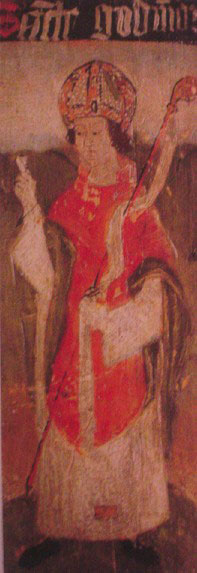
Showing posts with label Gudmund the Good. Show all posts

Wednesday, September 3, 2014

Snorri and the Volcanoes


There’s a volcano erupting in Iceland again. They happen quite often—I saw one in 2010, when I took these photos, just before it shut down European airspace with clouds of ash.

Eruptions are a fact of life for Icelanders. A big one happened in 871 (plus or minus two years): The dark layer of ash it sprinkled over much of the country now helps archaeologists date the time of the first settlement of Iceland to just about that time, using a technique called tephrachronology. Another big eruption in 1104 laid down a layer of ash in a conveniently lighter color, which helps archaeologists bracket the Viking Age.

Geologists estimate ten volcanic eruptions per century took place between Iceland’s founding in the 870s and when the Icelandic sagas began to be written in the early 1200s. Then the frequency increased to about fifteen per century.

So why are eruptions essentially missing from the sagas?


Only once, in Kristnisaga, the Saga of Christianity, is an eruption a plot point. The chieftains were meeting in the year 1000 to debate whether Iceland should become Christian, as the king of Norway insisted. A rider broke into the proceedings to shout, “Earth fire! In Olfus!” A volcano had erupted on one of the chieftains’ farms.

“It is no wonder. The gods are angry at such talk,” people muttered.

“And what were the gods angry about,” said one chieftain, gesturing to the black, ropy lava all around, “when they burned the wasteland we’re standing on now?”


The great Icelandic writer Snorri Sturluson, subject of my book, Song of the Vikings, grew up in the shadow of a volcano. Hekla, the cloud-hooded mountain known in the Middle Ages as the Mouth of Hell, erupted twice during Snorri’s lifetime. Possibly three times, for the church annals record “darkness across the south” the year he turned five.

The annalist knew what caused that darkness. The Saga of Bishop Gudmund, written in the mid-1200s, contains this explanation (translated here by my friend Oren Falk of Cornell University):

“There are mountains in this land, which emit awful fire with the most violent hurling of stones, so that the crack and crash are heard throughout the country.… Such great darkness can follow downwind from this terror that, on midsummer at midday, one cannot make out one’s own hand.”


To the east of Snorri’s childhood home rose the ice cap of Eyjafjallajokull--from under which erupted the volcano I visited in 2010. Snorri would have seen only tier upon tier of vast blank whiteness, a glimmering dome mingling with the clouds so that on some days the horizon disappeared.

But Snorri’s contemporaries were aware that active volcanoes lurked beneath the ice. A thirteenth-century poet told how “glaciers blaze,” “coal-black crags burst,” “fire unleashes storms,” and “a marvelous mud begins to flow from the ground.” (Again, in Oren’s translation.)

Lava also spouted from the sea in Snorri’s lifetime, forming rugged black islands that rose above the waves only long enough for a few intrepid souls to row out and give them a name, the Fire Islands.

It is not surprising, then, that volcanoes also informed Snorri’s version of the creation of the world.


In the beginning, Snorri wrote in his Edda, there was nothing. No sand, no sea, no cooling wave. No earth, no heaven above. Nothing but the yawning empty gap, Ginnungagap. All was cold and grim.

Then came the giant Surt with a crashing noise, bright and burning. He bore a flaming sword. Rivers of fire flowed till they turned hard as slag from an iron-maker’s forge, then froze to ice.

The ice-rime grew, layer upon layer, till it bridged the mighty, magical gap.

Where the ice met sparks of flame and still-flowing lava from Surt’s home in the south, it thawed and dripped. Like an icicle it formed the first frost-giant, Ymir, and his cow.

Ymir drank the cow’s abundant milk. The cow licked the ice-rime, which was salty. It licked free a handsome man and his wife. They had three sons, one of whom was Odin, the ruler of heaven and earth, the greatest and most glorious of the gods: the All-father.

Odin and his brothers killed Ymir. From his giant body they fashioned the world: His flesh was the soil, his blood the sea. His bones and teeth became stones and scree. His hair were trees, his skull was the sky, his brain, clouds.

From his eyebrows they made Middle Earth, which they peopled with men, crafting the first man and woman from an ash tree and an elm they found on the seashore.


So Snorri explains the creation of the world in the beginning of his Edda. Partly he is quoting an older poem, the “Song of the Sibyl,” whose author he does not name. Partly he seems to be making it up—especially the bit about the world forming in a kind of volcanic eruption, and then freezing to ice.

This part of the myth cannot be ancient. The Scandinavian homelands--Norway, Sweden, and Denmark--are not volcanic. But there is nothing so characteristic of Iceland as the clash between fire and ice.

Wednesday, December 18, 2013

Music for Saint Thorlak's Day

Last November, I spent a few days at Skalholt, the medieval capital of Iceland and site of its first cathedral. While there, I began understanding the Icelanders' fondness for their patron saint, Thorlak Thorhallsson, who was bishop of Skalholt from 1178 to 1193 and declared a saint in 1198.

November days are very short in Iceland. Through a fluke of scheduling, I was completely alone in the cathedral guesthouse. It was eerie, walking around the grounds at night--even before the storm came--and I soon imagined I heard voices in the babbling of the brook and the whinny of a distance horse. There could, indeed, be a lot of ghosts at Skalholt: I knew its history. Though not a "believer" I found I had Saint Thorlak's name on my lips and rushed back inside, where a gift from the current bishop of Skalholt awaited me.

Since December 23rd is Saint Thorlak's Day, I thought I'd share that gift. But first, a bit about Thorlak, whom I met while researching Song of the Vikings, my biography of Snorri Sturluson.

Thorlak was a well-educated man: He studied at Paris, France and Lincoln, England. After that he returned to Iceland and "was ever at writing," his saga says. He dressed plainly, ate and drank like an ascetic (no meat, only water), and was rather dull company, the saga implies, noting that it "was a great misfortune that his speech was hard and slow." On the other hand, "he was so lucky in his brewing that the ale never burst that he had blessed."

Soon after Thorlak died, people began reporting miracles that occurred when they called on him for aid. These miracles provide a digest of the common Icelander's woes in the 12th century: Saint Thorlak cured stiff hands, sore throats, burning eyes, and gassy stomachs. He found lost hobbles, lost sheep, a sledgehammer, and a ring. He healed a horse ridden "unwarily where there was volcanic heat"; its legs "got so burned that people thought it would die." He healed a woman who "fell into a hot spring in Reykholt and got so severely burned that her flesh and skin came off with her clothes." He stemmed the flow of blood when a chieftain, soaking in his hot-tub, cut himself with a razor. He calmed storms and floods, resuscitated a drowned boy, quenched a house fire, and mesmerized a seal so a starving mother could kill it.

In Song of the Vikings I describe these miracles, along with the glorious translation of Bishop Thorlak—the ceremony by which he was officially recognized as Iceland's first saint in 1198.

The bishop's coffin, buried for five years, was dug up, dusted off, and carried into Skalholt Cathedral. Saint Thorlak's holy relics (his bones) were taken from the coffin, washed, and encased in a golden shrine. The priest Gudmund the Good, then 38, was a coffin-bearer; he chanted the Te Deum in his unforgettable voice. Twenty-year-old Snorri probably accompanied his foster-brothers Saemund and Orm, whom the saga says attended the ceremony. During the Mass which followed, Snorri would have marveled at the 230 expensive beeswax candles twinkling on the altar (all imported, since honeybees did not live in Iceland).

But what I didn't know when I wrote Song of the Vikings was that the music written for the ceremony still survives. On my recent trip to Skalholt, Bishop Kristjan Valur Ingolfsson lent me a recording of it by the early-music ensemble Voces Thules.

You can listen to part of it here: http://www.youtube.com/watch?v=emmG7Pl3mCU

As explained in the CD's liner notes, "Liturgical chants are a kind of soothing incantation, in which flow has an all-important role to play, like sailing effortlessly on the crest of the wave toward a nevertheless clear destination. The singing of music of this kind is the most intimate form of worship and meditation still to be preserved within the sanctuary of the Christian Church."

The six members of Voces Thules depended on the doctoral thesis of Robert Ottosson (1912-74) to understand how to reconstruct this chant from the 24 pages of manuscript in the archives. These manuscript pages are also online; you can see them at the Icelandic music website www.ismus.is. Click on "Handrit og prent," then on manuscript number "AM 241a fol. Þorlákstíðir," then on "Síður (24)" and the pages of manuscript will appear and you can scroll down through them.

The "Office of Saint Thorlak" was performed in 1998, for the first time in centuries, to mark the 800th anniversary of Bishop Thorlak's death. It was part of the Reykjavik Arts Festival that year, stretching over a day and a half and culminating in a High Mass, at which Kristjan Valur and another priest also sang.

I listened to Saint Thorlak's music at Skalholt on that dark November night, while the wind howled and the rain lashed against the windows and I was the only person in the entire guesthouse.

"The darkness flees, the light illuminates the mind, a devoted nation dances," the Office begins. "Let us prepare for the festival of jubilation and offer praise, cast out the darkness at the world's extreme."


Join me again next week at nancymariebrown.blogspot.com for another adventure in Iceland or the medieval world.

Wednesday, December 26, 2012

Songs of Iceland


The title of my book, Song of the Vikings, doesn’t refer to music, as I’ve noted previously. It’s more like George R.R. Martin’s A Song of Ice and Fire, his overall title for the series that starts with Game of Thrones.

But I was fascinated to find, second on this list of “typical Icelandic songs,” one written by a contemporary of Snorri Sturluson, the 13th-century Icelandic writer and chieftain whose story Song of the Vikings tells.

“This is what Icelanders listen to when they want to hear the very best Icelandic songs,” writes the listmaker, Benedikt Jóhannesson, on the Iceland Review website. “We may sing, dance, or cry, depending on the mood. Listen to the songs and then you will understand Icelandic culture a bit better.”

About his second choice, Benedikt writes: “The next song is a psalm, and the text comes from the 13th century by Kolbeinn Tumason, who is said to have written the psalm the day before he was killed in battle with the bishop of Iceland! The composer, Thorkell Sigurbjörnsson, is best known for his very modernistic compositions. Here the psalm is performed by Eivör, the great Faroe Isles singer, who has resided in Iceland on and off for the last few years. Hördur Áskelsson, organist and conductor, has called this an almost perfect psalm. It is called Heyr himna smiður or ‘Hear me, Maker of Heaven.’”


I found Eivör’s version especially moving (though one of my Icelandic friends pointed out that she sings with a Faroese accent). This is not the kind of song I would have associated with Kolbein Tumason, who makes a brief appearance in Song of the Vikings. Like Snorri, Kolbeinn was quite greedy for wealth and power, yet here he is opening his soul.

Here is another version (in proper Icelandic), with English translation, sung by the Icelandic singer Ellen Kristjánsdóttir:


You can also find the full text and translation here: http://en.wikipedia.org/wiki/Kolbeinn_Tumason

Listen, smith of the heavens,
what the poet asks.
May softly come unto me
your mercy.…

Drive out, O king of suns,
generous and great,
every human sorrow
from the city of the heart….

Here is the story behind the psalm: In 1206, in the north of Iceland, Bishop Gudmund the Good came to court in full episcopal regalia and broke up a lawsuit between the chieftain Kolbein Tumason and a priest who owed him money. It was a little, everyday lawsuit. No one could have predicted the cataclysm it unleashed.

The bishop “forbade them to pass sentence on the priest,” the saga says. “But they passed sentence on him just the same.”

The priest was outlawed—exiled from Iceland.

The bishop took the outlawed priest into his own household at Holar (which made the bishop an outlaw too), and banned Kolbein from church. When Kolbein protested, Bishop Gudmund formally excommunicated him.

Kolbein was taken aback. He considered himself a pious Christian. He had long been the bishop’s firm supporter. Gudmund was a cousin of Kolbein’s wife and had been chaplain of the family’s church before the chieftain pushed for his election as bishop in 1201. True, his support may not have been entirely selfless. Notes Sturlunga Saga, “Many men commented that Kolbein had wanted Gudmund chosen bishop because he thought he himself would thus control both laymen and clergy in the north.” The writer of a later Life of Gudmund the Good, adds, “As soon as they got to Holar, Kolbein assumed full control both of household affairs and of finances.”

Historians blame Gudmund the Good for much of the strife that enveloped Iceland during the Sturlung Age—strife that would climax with the murder of Snorri Sturluson at the request of the king of Norway in 1241 and result in Iceland becoming a colony of Norway in 1262. When Bishop Gudmund denied the universality of Iceland’s laws, “the fate of Iceland’s independence was ultimately sealed.”

But Gudmund was not thinking about Iceland’s independence. If he thought about anything other than the rights of the Church it was the martyrdom of Saint Thomas Becket, murdered in Canterbury Cathedral when Gudmund was a stubborn boy of ten. Saint Thomas’s dispute with King Henry II hinged on the punishment of “criminous clerks,” churchmen who committed crimes, just as Gudmund’s dispute with the Icelandic chieftains did. In the Saga of Gudmund the Good, written by one of his pupils, a woman dreams that Gudmund will “rank as high in Iceland as Thomas in England.” A verse by Kolbein himself is quoted: Gudmund, he says, “keeps firm his wish / to wield such power / as Thomas Becket. / This bodes danger.”

The first time Gudmund insisted that churchmen were above the law—when Kolbein sued the priest who owed him money—Kolbein backed down. The chieftain offered the bishop self-judgment and settled for a fine of twelve cows. He got six. The next time Kolbein sued some clerics (for theft), he said there was no use making an agreement, since the bishop wouldn’t keep it. 

A scuffle broke out. Someone threw a stone. It hit Kolbein in the forehead and killed him. God’s will be done.

Listen, smith of the heavens,
what the poet asks.
May softly come unto me
your mercy.

Parts of this essay were adapted from my biography of Snorri Sturluson, Song of the Vikings: Snorri and the Making of Norse Myths, published by Palgrave Macmillan.

Join me again next Wednesday at nancymariebrown.blogspot.com for another writing adventure in Iceland or the medieval world.