|
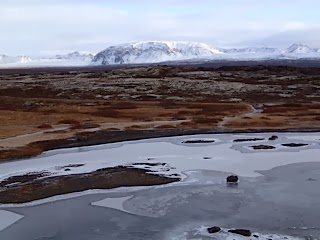
| Thingvellir, where Iceland's medieval parliament met. |
Where does our concept of liberty come from? Scholars in the 1700s traced it to medieval Iceland.
Iceland was an anomaly in the Middle Ages. It bowed to no king.
The first settlers, coming to this cold and windy island outpost
in the late 800s, had disliked the very idea of a king. Many had fled Norway,
having lost their lands in the bloody civil war by which Harald Fair-Hair
unified the country, becoming the first king of all Norway in about 885. As
king, Harald claimed every farm and forest for himself, reapportioning the land
to those who would pay taxes. He gave the Norwegians three choices: swear oaths
of loyalty, leave, or face the consequences, which included torture, maiming,
and death. Some who left went first to the British Isles, only to be pestered
by kings and their oaths and their taxes there too. They sailed to Iceland to
be free of such nonsense.
 |
| Iceland was settled by Vikings in the 800s. |
But after fifty years of anarchy the Icelanders deemed some form
of government to be, in fact, necessary, and in 930 a cabal of wealthy men
worked out a way to share power. They divided the island into four quarters:
North, South, East, and West. In each quarter, three spring assemblies were to
be held (four in the larger North Quarter) to discuss local matters and to
solve disputes. Each spring assembly would be governed by three chieftains, for
a total of thirty-nine. To these posts, they appointed themselves.
The thirty-nine chieftains
of Iceland were, in theory, equals, but some grew more powerful than others,
for this new system of government was organized, not geographically, but by
alliances. Uninhabited when it was discovered in 870, Iceland was home to at
least 10,000 people by 930. (By 1262, when Iceland lost its independence, there
would be 50,000.) There were no towns on the island, and would not be until the
eighteenth century. Instead, Icelanders lived on scattered farms around the periphery
of the island, which has at its center a vast, uninhabitable wasteland of
volcanoes and glaciers. Some farms were immense, supporting up to a hundred
people; others were as small as one nuclear family. Every farmer who owned at
least one cow or boat or fishing net for each one of his dependents had to ally
himself with a chieftain, paying him taxes, and, if requested, accompanying him
to assemblies or fighting in his battles. The farmer could choose which of the
thirty-nine chieftains he wanted to support, and he could change his allegiance
once a year. But generally only the richer farmers dared annoy the local
chieftain by choosing a more distant one.
Usually it paid to support
a chieftain who lived close by. He was nearer to hand if the farmer was robbed,
or his hay-store ran out in a harsh winter, and travel wasn’t so onerous when
the farmer was invited to a Yule feast or summoned for a raid. Yet two
chieftains often lived within a day’s ride of each other. In that case, it paid
to choose the one who was less easily bullied, for the support of a chieftain
was the only protection a family had from a rival clan. Only a chieftain could
bring a lawsuit to one of the assemblies, and only a chieftain could answer it.
 |
| Thingvellir on a summer day. |
In addition to the spring assemblies held in each quarter of the
country, once a year, on the tenth Thor’s Day of summer, in the great rift
valley of Thingvellir beside its deep blue lake, Iceland’s thirty-nine
chieftains and their wives and children and followers gathered for the Althing,
the General Assembly of all Iceland. The Althing was a grand party. Thousands
of people stayed for two weeks in tents and turf-walled booths on the banks of
the Axe River, drinking ale, telling tales, taking part in horse fights and
wrestling matches, races and dice games, making wedding plans or finalizing
divorces, witnessing court cases, and wrangling over the law.
Disputes between Icelanders of any rank could be settled at the
Althing, by appeal to Iceland’s laws. There were five law courts: one for each
quarter plus an appeals court, each with thirty-six judges. The judges were
chosen by the chieftains, each chieftain being allowed to nominate or to veto a
certain number. Presiding was Iceland’s only elected official, the Lawspeaker;
he recited one third of the law code at each Althing. The place where he stood,
called the Law Rock, was a height of land that formed a natural amphitheatre.
The chieftains gathered around the Law Rock and, after the recitation, the laws
were debated, adjusted, and agreed upon for, as the sagas say, “With laws shall
our land be built up, but with lawlessness laid waste.”
Iceland’s medieval parliament was brought to the attention of the
English-speaking world in the mid-1700s by Thomas Percy, bishop of Dromore and
friend of Samuel Johnson and James Boswell. Percy translated a long work on the
history and lore of the Norse written by Paul-Henri Mallet, the Swiss tutor to the Crown Prince of Denmark
and later professor in Copenhagen. Mallet drew heavily from Snorri Sturluson’s Edda and the Poetic Edda, and from Snorri’s history of the Norwegian kings, Heimskringla. He amplified Snorri’s
works with other Icelandic sagas and sources such as Tacitus, Saxo Grammaticus,
the Anglo-Saxon Chronicle, Adam of Bremen, and Saxon law codes. He writes, “It
will appear pretty extraordinary to hear a historian of Denmark cite, for his
authorities, the writers of Iceland, a country cut off, as it were, from the
rest of the world, and lying almost under the northern pole.” But Iceland’s
medieval skalds, he declares, were “famous throughout the north for their songs.”
 |
| The white flagpole marks the Law Rock. |
In Percy’s translation of Mallet, called Northern Antiquities, English readers found a world not only savage
and sublime, but imbued with a passion for liberty. The religion of the Vikings
was as “simple and martial as themselves,” Percy wrote. Their form of
government was “dictated by good sense and liberty,” while their “restless
unconquered spirit,” was “apt to take fire at the very mention of subjection
and constraint.”
Or as Joseph Sterling wrote, prefacing his 1782 Icelandic Odes: “To them we are indebted
for laying the foundation of that liberty which we now enjoy.”
This essay is excerpted from my book-in-progress, Song of the Vikings: Snorri and the Making of Norse Myths, due out from Palgrave Macmillan in October 2012. If you'd like me to visit your area on my book tour, please let me know.
Join me again next Wednesday at nancymariebrown.blogspot.com for another adventure in Iceland or the medieval world.